An Inside Look: Adolph Gottlieb and David Smith


Adolph Gottlieb and sculptor David Smith became fast friends in 1933, and remained friends through Smith's death in 1965.

In an interview in 1975, Esther Gottlieb describes Gottlieb and Smith's early relationship

"...We were living in Brooklyn Heights and no amount of conversation or suggestions on the part of anybody else made any difference.  David Smith was living on the next block.  I can’t remember where he met David, but they were very good friends, and in those days David was a painter.  There was a very close relationship between all the artists who lived in the area during the WPA days, because all these men were on what’s called the Easel Project.  They were allowed to paint at home, but they had to sign in everyday.  Someone suggested as an alternative that one artist’s studio be designated as headquarters so the men could walk to sign in and not have to spend the time and money to go to the center.  Adolph’s studio became the headquarters.  I don’t know why his studio—it just happened.

We lived on State Street around 1935.  State Street goes straight down to the river, and one block over was Atlantic Avenue, which goes down to the shipyards.  At that time, down near the waterfront, there was an iron works in connection with the ship-building.  Adolph and David would stand at the door and watch them working.  David would reminisce about how he was a sheet metal worker, way back.  One day they were talking about painting and sculpture and David had some great ideas for sculpture, if he only had facilities for doing them.  'What’s the matter with the Terminal Iron Works,' says he one day as they were walking along.  So they stopped in.  He told the man that he was a painter and worked in the neighborhood, and he had experience and knew how to acetylene torches, and that he wanted to do a little work.  So the man said okay.  David went around picking up stuff – all types of metal one could find.  With the scrap metal from the yard, David made his first sculpture."

– An Interview with Esther Gottlieb by Stephen Pearson, 1975

Gottlieb and Smith lost touch briefly in the 1940s when Smith moved away from New York City, but they reconnected later in the decade when Smith began making regular trips to New York. One of the ways in which they maintained their friendship was through regular correspondence.

A 1956 letter from Smith to Gottlieb, discussing the death of Jackson Pollock and Smith's frustration with the art world at the time.

"I'm not feuding with Whitney--I'm dropping them...The hell with them and any other person or institution which doesn't value my work as I do. With a family to support and sculpture to make I shouldn't have this attitude, but I suppose its my death defying acts like Jacks [Jackson Pollock]. I seem to be getting more this way--I want equal rights and I don't want museum people or the like to tell me what art is. I want art to be what I make--or not to hear from them."

– David Smith


A letter from Smith to Gottlieb, December 25, 1957


"Dear Adolph
This is a fan letter. Your show at the Museum was great. It was excellently chosen and some of the 1957 works I had not seen, even better. I hope you get some great sales from it. Anyhow for me it was wonderful to see so many over the period.

Seasons Greetings to you and Esther,
David
"

a letter from Gottlieb to Smith, December 30th, 1957

"Dear David:
Many thanks for your very nice note. It seems that we have a mutual admiration society, which is a most unusual thing for old friends, and I am very pleased with that...
"

Gottlieb Foundation Executive Director, Sanford Hirsch, describes a "sympathy between the two in how they approached material, color, and form." Close relationships can be seen in the paintings and sculpture that Smith and Gottlieb created over the course of their careers.

Adolph Gottlieb, The Sea Chest, 1942, oil on canvas, 26 1/16 x 34 3/16". Currently in the collection of the Guggenheim Museum, New York

David Smith, Home of the Welder, 1945, steel, 533 × 438 × 356 mm. Currently in the collection of the Tate, London

Historian and art critic Karen Wilkin pointed out some similarities between Smith’s The Letter of 1950 and Gottlieb’s Pictographs of the same period.

Adolph Gottlieb, Letter to a Friend, 1948, Oil, tempera, and gouache on canvas, 47 7/8 x 36 1/4"

David Smith, The Letter, c. 1950, 37 5/8 x 22 7/8 x 9 1/4”. Photograph by David Smith

Later works by both artists continue to display many parallels.

Adolph Gottlieb, Spray, 1959, oil on canvas, 90 1/4 x 72 3/8“. Currently in the collection of the Hirshhorn Museum and Sculpture Garden, Smithsonian Institution, Washington, DC

David Smith. 7 Hours. 1961. Steel, paint, 84 1/2 x 48 x 18” (214.6 x 121.9 x 45.7 cm). Collection Onnasch, Berlin. Photo: Robert McKeever

All Artworks by Adolph Gottlieb ©Adolph and Esther Gottlieb Foundation/Licensed by ARS, NY, NY
All Artworks by David Smith © 2020 The Estate of David Smith / Licensed by VAGA at Artists Rights Society (ARS), NY.

To see more works by Adolph Gottlieb, click here.
To learn more about David Smith, visit the website of the David Smith Estate.


From the Archive: A Family Album

The Adolph and Esther Gottlieb Foundation would like to wish you a happy holiday season. Please enjoy the following photographs of the Gottlieb family.

 
Adolph and Esther Gottlieb with their dog Mickey at the Brooklyn waterfront, early 1930s.

Adolph and Esther Gottlieb with their dog Mickey at the Brooklyn waterfront, early 1930s.


Adolph Gottlieb (far right), his mother (second from the right). June 15, 1922. Photographer: Schloss Atelier, Berlin.

Adolph Gottlieb (far right), his mother (second from the right). June 15, 1922. Photographer: Schloss Atelier, Berlin.

 
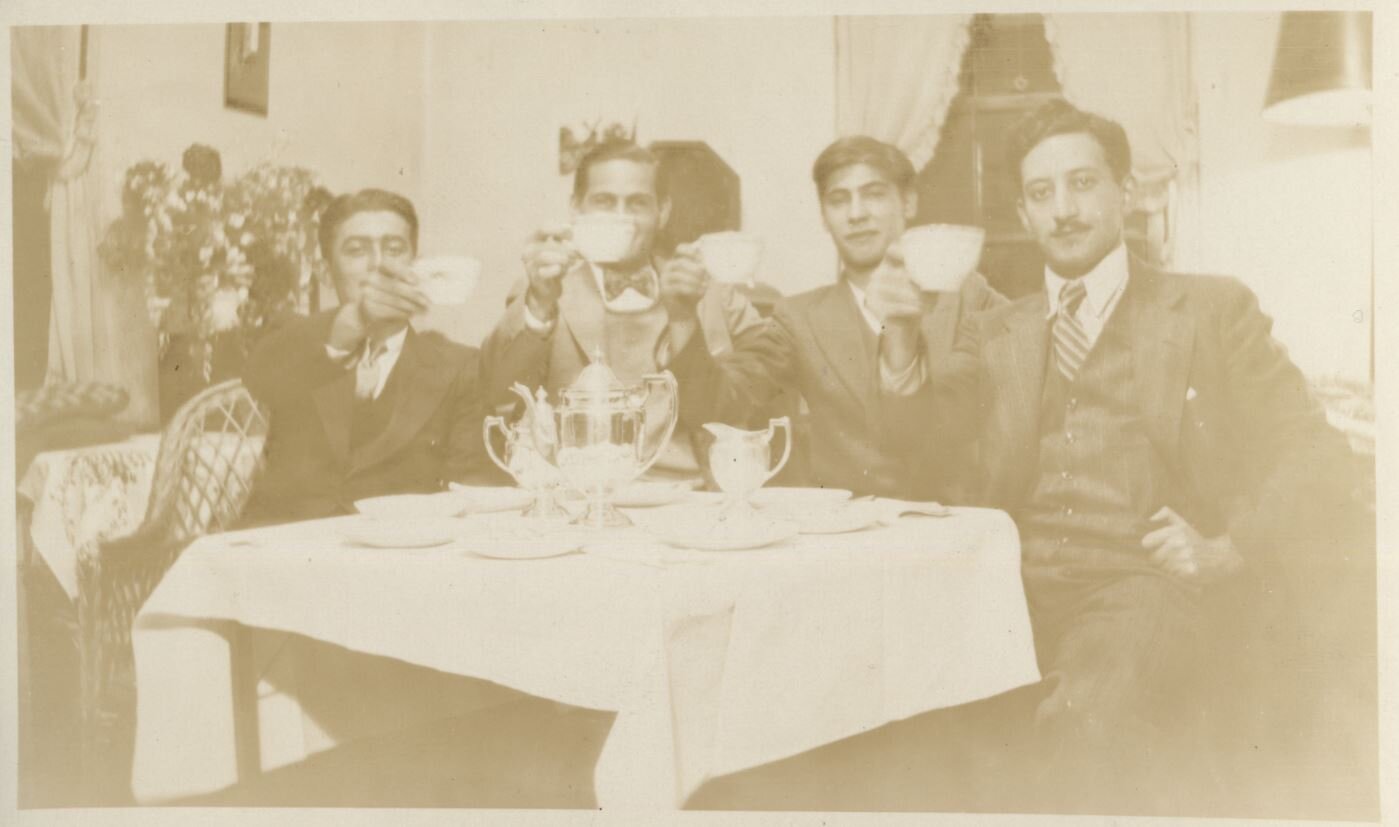
Adolph Gottlieb with family and friends (Adolph Gottlieb far right).

Adolph Gottlieb with family and friends (Adolph Gottlieb far right).

Adolph Gottlieb with family and friend (Adolph Gottlieb 2nd right).

Adolph Gottlieb with family and friend (Adolph Gottlieb 2nd right).

 
Adolph Gottlieb (seated far left) with Emil, Rhoda, Elsie and Edna Gottlieb in their New York apartment. October 1930.

Adolph Gottlieb (seated far left) with Emil, Rhoda, Elsie and Edna Gottlieb in their New York apartment. October 1930.

To see more photos of Adolph Gottlieb, click here.


A Closer Look: Exploring Abstract Images


Adolph Gottlieb began his Pictographs in 1941 after thinking through contemporary issues and approaches to painting. The Pictographs, based on presenting visual images organized within a hand-drawn grid, were a major development in Modern painting and Gottlieb continued to develop the idea for the next ten years. At the same time, his commitment to exploring the same ideas about abstract images with emotional content also led him to create a group of works utilizing a central image between 1942 and early 1944. A few of these less-known works and some material from our archives, appear in this newsletter.


Untitled, 1944, Etching and drypoint on laid paper, 3 1/4 x 2 1/2"

Head, c 1944, linocut on cream wove paper, 7 3/8 x 6”


Untitled, 1944, woodcut printed on wove paper, 14 3/16 x 11 13/16”

Untitled, 1944, woodcut printed on wove paper, 14 3/16 x 11 13/16”

Untitled, 1943, drypoint on linen laid paper, 5 7/8 x 3 7/8"


Untitled, 1942, pastel on paper, 24 1/2 x 19 1/2"

Untitled, 1943, watercolor, pastel and graphite on paper, 26 x 20"


Persephone, 1942, oil on canvas, 34 x 26"

The Rape of Persephone, 1943, oil on canvas, 33 x 25"


Red Portrait, 1944, oil with cotton waste on canvas, 29 1/2 x 23 1/2"

Amoeba, 1944, oil on canvas, 24 x 20"


In 1944, Gottlieb exhibited a collection of pastels at the Wakefield Gallery, many of which were part of his abstract exploration. Above is the interior of the exhibition brochure, including a written foreword by Barnett Newman.
"It is a pleasure, then, to see Adolph Gottlieb repudiate, in these studies of bodies and heads, this narcissus attitude, to face the age-old philosophic problem of mind and matter, the flesh and the spirit, on equal ground with the philosophers. And he sets it forth with simplicity and dignity."


Above: a postcard from John Graham commenting on the Wakefield exhibition.


"Dear Adolph-- you are the one man in art in America who has been continuously progressing--your present show is the best you ever had. i was happy to see it and to feel enthusiastic about it. I would like Amoeba for myself. Much of everything to you, ever affectionately,
Graham"

Shown here: a letter from Gottlieb and Mark Rothko (with the assistance of Barnett Newman) to Edward Alden Jewell, art editor of The New York Times, 1943.

Shown here: a letter from Gottlieb and Mark Rothko (with the assistance of Barnett Newman) to Edward Alden Jewell, art editor of The New York Times, 1943.

In the letter above, Gottlieb, Rothko and Newman rebut Jewell's "befuddled" reaction to their new paintings in a group exhibition and lay out their aesthetic beliefs.

"We favor the simple expression of complex thought. We are for the large shape because it has the impact of the unequivocal. We wish to reassert the picture plane. We are for flat forms because they destroy illusion and reveal truth."

All artworks ©Adolph and Esther Gottlieb Foundation/Licensed by ARS, NY, NY
To see more works by Adolph Gottlieb, click here.


A Closer Look: Andrew Hudson and Adolph Gottlieb


Photograph of Andrew Hudson and Adolph Gottlieb, from the article ''Adolph Gottlieb: An Artist Who Is Surviving'' by Andrew Hudson, Arts Magazine, March/April 1978. Photo by Roger Tripp


Andrew Hudson was an art critic for the Washington Post, he is an artist himself, and he taught at the Corcoran School in Washington for over thirty years. In his role as a critic, Andrew conducted two lengthy interviews with Adolph Gottlieb, and he reviewed his art on several occasions and got to know the artist and his wife Esther.

We were lucky enough to recently interview him. We are currently working on the full-length video, but in the meantime, here are a couple video vignettes and excerpts from the interview.


"I wrote Adolph a letter asking for an interview, but before he even got the letter, I bumped into him at the Museum of Modern Art in New York in the lobby. So I went up to him and said, 'Hey Mr. Gottlieb. I’m Andrew Hudson from the Washington Post. I’ve just written you a letter to ask you if we can have an interview.' So he said, 'Well come to my studio the next time you’re in New York,' which I did; it was in the Flatiron building then.

And it was very interesting because when I arrived he led me into a small room with about nine or ten paintings on the walls, very good paintings. And I was sure that this was like a test, that if I responded ok to the paintings, he would give an interview, and maybe if I didn’t respond very well, he wouldn’t. But I obviously responded very well. So we had the interview, and I loved that interview! Since it was just the two of us in his studio, he talked a lot about 'making paintings.' And he had wonderful things to say about—sometimes a painting would happen all by itself like a miracle, but of course he was also very good at correcting things and seeing things in his paintings. That went very well."
 

Shown here: Adolph Gottlieb, Spray, 1959, oil on canvas, 90 1/4 x 72 3/8“
Collection: Hirshhorn Museum and Sculpture Garden, Smithsonian Institution, Washington, DC
©Adolph and Esther Gottlieb Foundation/Licensed by ARS, NY, NY⠀

Andrew Hudson: Let me tell you something else Esther told me in East Hampton. Funny story about Hirshhorn, Mr. Hirshhorn. She said that people who were struggling financially had to sell their paintings to Hirshhorn at lower prices when he asked for lower prices, but Adolph didn’t have to do that. So Hirshhorn would come and say, 'How much is that painting?' And Adolph would quote a figure and Hirshhorn would say, 'What’s that, a telephone number?' But eventually would have to pay what Adolph was asking, because Adolph did not budge, which was very good for Adolph I think, heh!

Sanford Hirsch: It was and Hirshhorn had—has a number of really top paintings.

Andrew Hudson: Oh absolutely. I mean, when I did that article on the Whitney’s part of the museum show in New York, I was so happy about a painting called Two Discs which belonged to Hirshhorn because I knew they were going to have to come from Washington. But the curators only ever showed it within the first year of it being in the collection. It’s never been up, it’s been in storage. And I read an article complaining about that in a small magazine up in Washington because at the National Gallery someone like Rubens has something like four or five paintings. So someone like Adolph should have several paintings. And they’ve got the wonderful painting Spray which is usually up, but they should also put Two Discs up as well, in my opinion. They’re depriving the art world of seeing how great Adolph really was, or is.


Shown here: Adolph Gottlieb, Two Discs, 1963, oil on canvas, 90 x 108"
Collection: Hirshhorn Museum and Sculpture Garden, Smithsonian Institution, Washington, DC
©Adolph and Esther Gottlieb Foundation/Licensed by ARS, NY, NY


"I bumped into Adolph in I guess ’66. Noland’s very first show of Stripe paintings at Emmerich Gallery. And they were large paintings with rows of stripes parallel, horizontal stripes, like there might be a dozen stripes of gray going across a white canvas. And they were kind of a bit monochromatic, monotonous, but they were something totally new at the time. And I met Adolph there and he said, 'These are just like bedsheets.' But then he came back to me seeing I wasn’t too pleased with his comment, because I admired Noland. He said, 'I was only kidding.' He said, 'He’s a good painter.' And that’s very much like Matisse...because Matisse was also very good at acknowledging that the artists that come after you are not going to be like you, they’re going to be rebelling against you."

"I felt very akin to Adolph in many ways even though I was trying to paint in a way where I didn’t see the composition at all. It was sort of going against him in that sense, but I always have felt I was closest to him as an artist than to the other painters I mentioned, Bush or Olitski. So he was very much a force in my life as an artist as much as someone I admired as an art critic.”


Shown here: Andrew Hudson in his studio, with print of Nadir in the background.
Adolph Gottlieb, Nadir, 1952, oil on canvas, 42 x 72"
©Adolph and Esther Gottlieb Foundation/Licensed by ARS, NY, NY


To read more writings on Adolph Gottlieb by Andrew Hudson, click here.


A Photo Essay: Adolph Gottlieb and His Studios


Listed above:

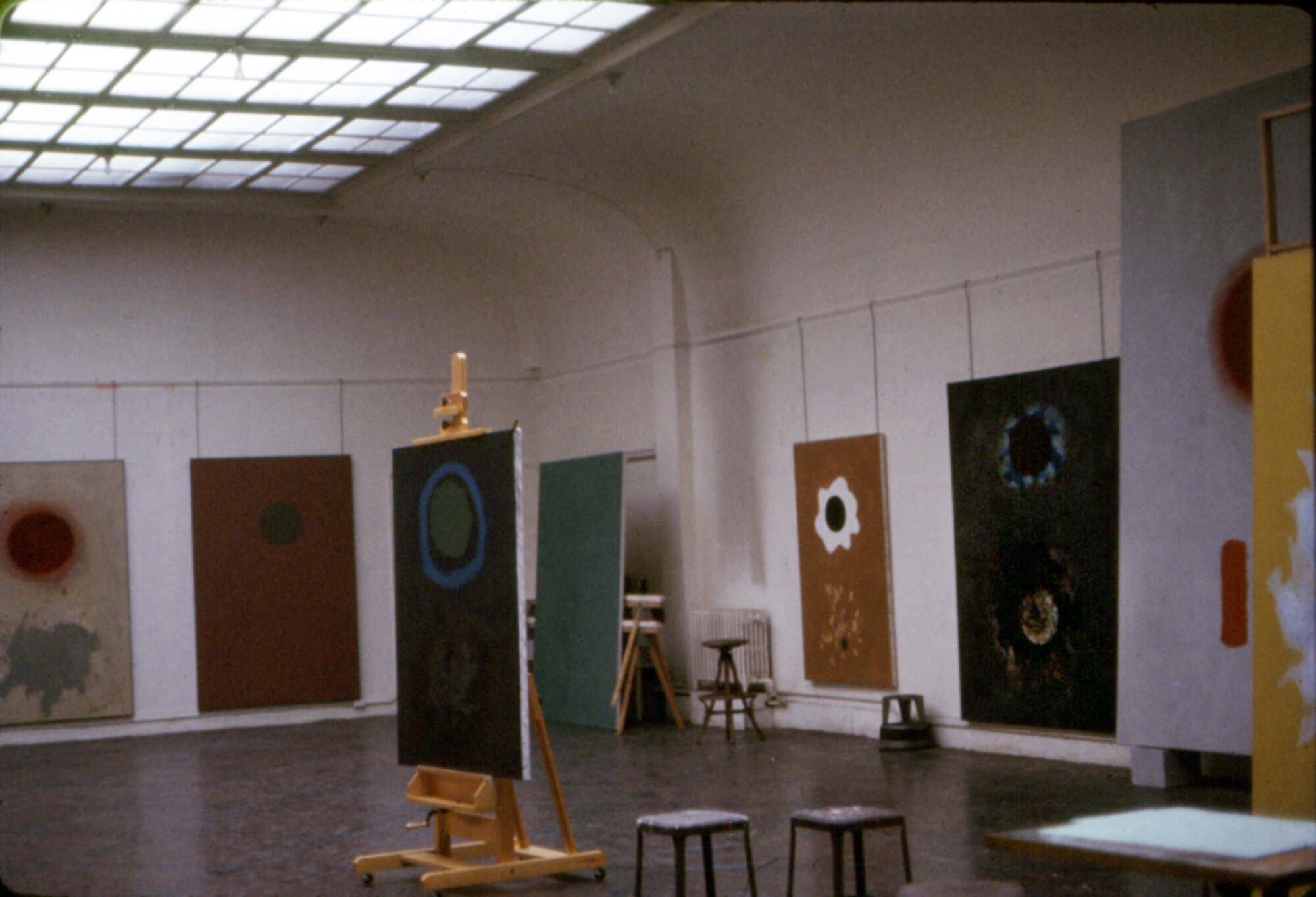
  1. Adolph Gottlieb in his home studio in Brooklyn with paintings including Reflection (1941) and Pictograph (1942), 1942. Photo by Aaron Siskind.

  2. Adolph Gottlieb in his Provincetown, MA studio, summer 1952. Photo by Maurice Berezov.

  3. Adolph Gottlieb in his studio at 206 W 23rd St. painting Ascent (1958), 1958. Photo by Rudolph Burckhardt.

  4. Adolph Gottlieb in his 23rd St. studio, 1960. Photo by Guy Weill.

  5. Adolph Gottlieb painting in his 23rd St. studio. Saturnalia and Duo in the background (both 1962), February 1962. Photo by Fred McDarrah

  6. Interior of East Hampton studio with the painting Orb (1964), 1964. Photo by John F. Waggaman.

  7. Wide view of paintings in studio at 940 Broadway, December 1965. Shown here: Scatter (1965), Blue and Green on Blue Black (1965),  Untitled (1965), Icon (1964), Deep Over Pale (1964), Untitled (1965), and two unidentified paintings. Photo by Ruth Bowman

  8. Adolph Gottlieb in his studio at 190 Bowery, 1968. Photo by Michael Fredericks.

  9. Adolph Gottlieb in his 190 Bowery studio with sculptures Petaloid with Hexagon (on floor) and Tilted Wall (on table),  and paintings Open (all 1968) and Solitary (1969), c.1969

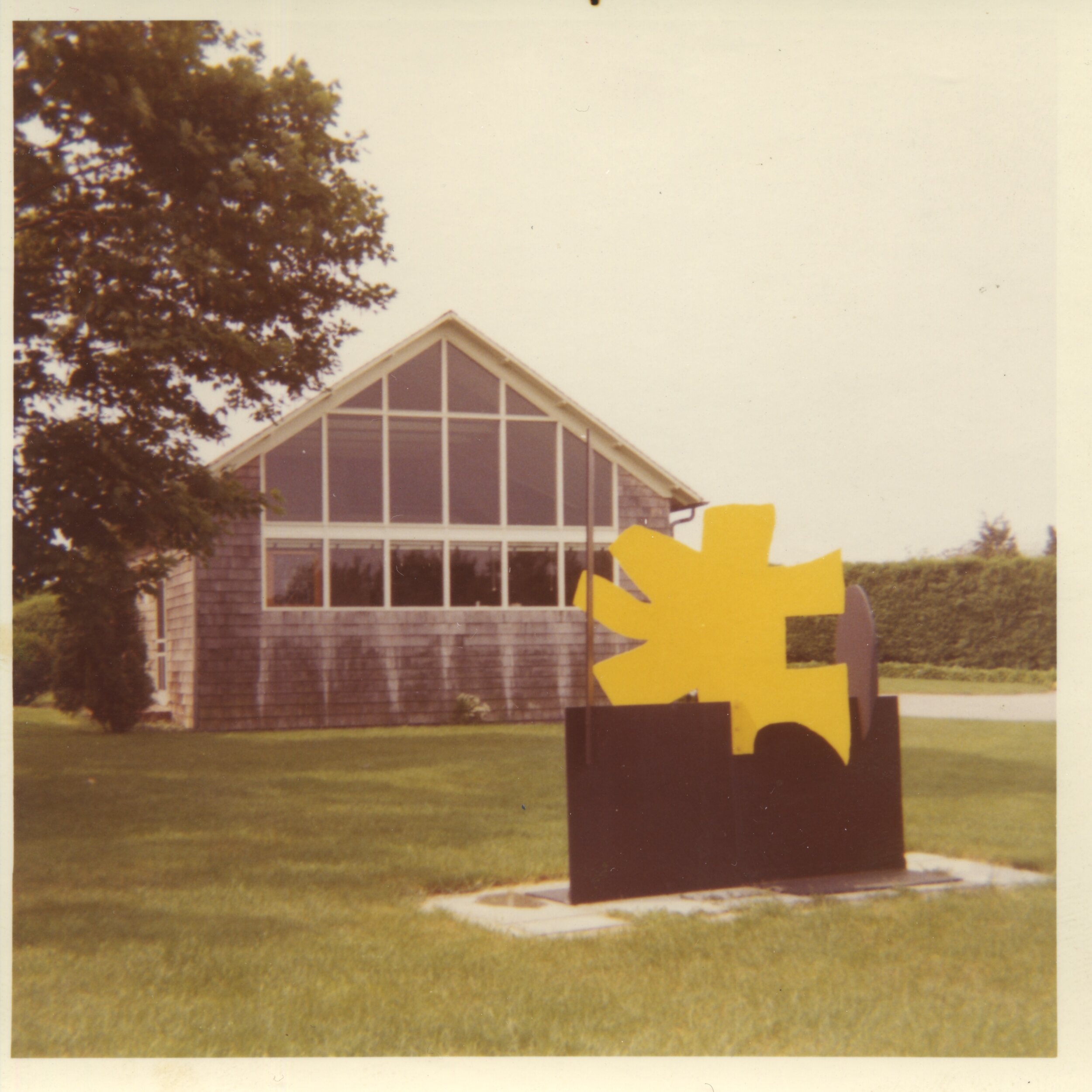
  10. East Hampton studio with Petaloid (1968) in front, summer 1971. Photo by Hermann Neumann.

  11. Adolph Gottlieb in his East Hampton studio with Roman III #3, Russet,  Amorphous, Burst 1973, and Festival (all 1973), summer 1973. photographer unknown.

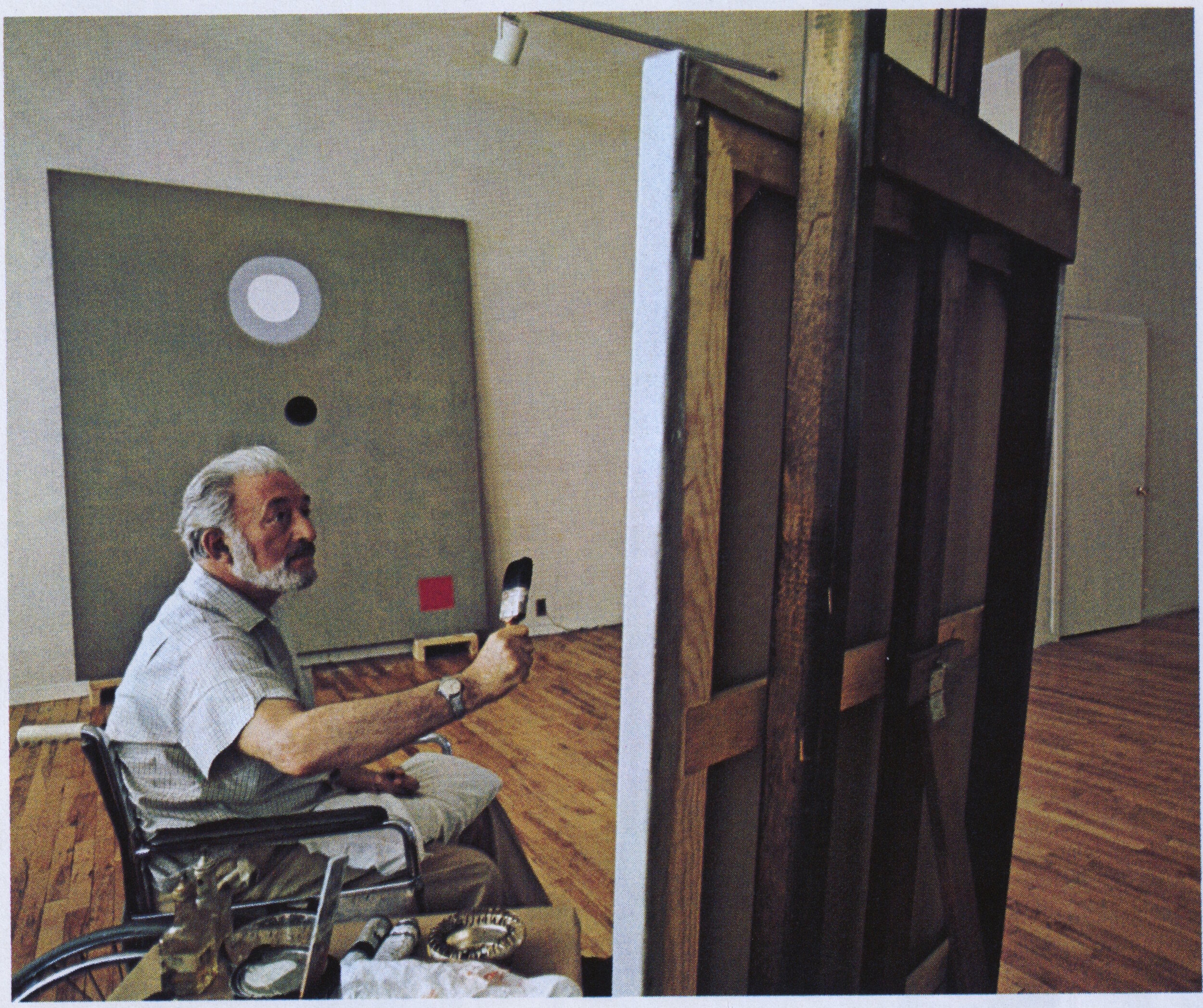
  12. Adolph Gottlieb working in his West Broadway studio in front of Max-Minimal (1973), 1974. Photo by Arnold Newman for an article in Horizon Magazine.

"In the beginning, nobody really had a studio. You used part of an apartment selecting the largest room with the best light, and that became the studio.”

– Esther Gottlieb, Interviewed by Phyllis Tuchman, 1981.

Over the years, Adolph Gottlieb had the opportunity to work in many different studios. The last studio pictured above was Adolph Gottlieb's final workspace, at West Broadway, in SoHo. A few years later, that studio would find a new purpose as the home of the Gottlieb Foundation, which remains the Foundation's base of operations to this day.


Adolph Gottlieb and Sailing


Adolph Gottlieb sailing in Provincetown, late 1940s

Adolph Gottlieb sailing in Provincetown, late 1940s


"Adolph would have a hint of a smile on his face, no more; Esther might break into a real grin. No one minded, and we all, soon enough, realized it wasn't the boat that was faster, it was Adolph."
– Everett Rattray, The East Hampton Star, 1977

Adolph and Esther sailing off of the coast of Cape Ann, MA, 1934

Adolph and Esther sailing off of the coast of Cape Ann, MA, 1934

Adolph and Esther sailing in Provincetown, MA, 1940s

Adolph and Esther sailing in Provincetown, MA, 1940s

Adolph and Esther Gottlieb usually spent their summers near the ocean. From the 1930s through the mid-1950s this meant either Cape Ann or Provincetown, Massachusetts.

sailing in Provincetown, c. 1946 

sailing in Provincetown, c. 1946

sailing in Provincetown, c. 1946

sailing in Provincetown, c. 1946

sailing in Provincetown, c. 1946

sailing in Provincetown, c. 1946

Adolph & Esther Gottlieb in a sailboat race off Provincetown, late 1940s.

Adolph & Esther Gottlieb in a sailboat race off Provincetown, late 1940s.

By the 1940s, Gottlieb had become a regular competitor in small sailboat races. Below are a few of the items that Adolph kept over the years commemorating both his skill and his love of sailing. 

sailing trophy.jpeg
pennant.jpg

In 1960, the Gottliebs bought a house in East Hampton about 100 yards from the Atlantic.

Gottlieb sailing in East Hampton, 1964. Photograph by Bob Adelman

Gottlieb sailing in East Hampton, 1964. Photograph by Bob Adelman

%23+Hampton%2C+1964.+Photographer+Bob+Adelman+4.jpg

In a 1977 issue of the East Hampton Star, Everett Rattray commemorated "Gottlieb's genius to be able to focus on the task at hand, sailing his boat, while registering those maritime images with what Hess called 'a pilot's understanding.'“

1977 East Hampton Starr 1.JPG
1977 East Hampton Starr 2.JPG
 

An Inside Look: Wall 1969, Part 1

The recent installation of Adolph Gottlieb’s sculpture WALL in The National Gallery on Washington DC gives us a chance to explore how the artist developed this sculpture, what was involved in its conservation, and its current installation. In this first part of a two-part newsletter, learn about how WALL was created.

Read more

A Look Back: Evolution of an Exhibition Poster

On February 14th, 1968, a major exhibition of Adolph Gottlieb's paintings organized jointly by the Whitney Museum of American Art and the Solomon R. Guggenheim Museum opens at both museums in New York City simultaneously – the first and only time this has occurred. Below are some different ideas Gottlieb considered for a poster for the exhibition…

Read more