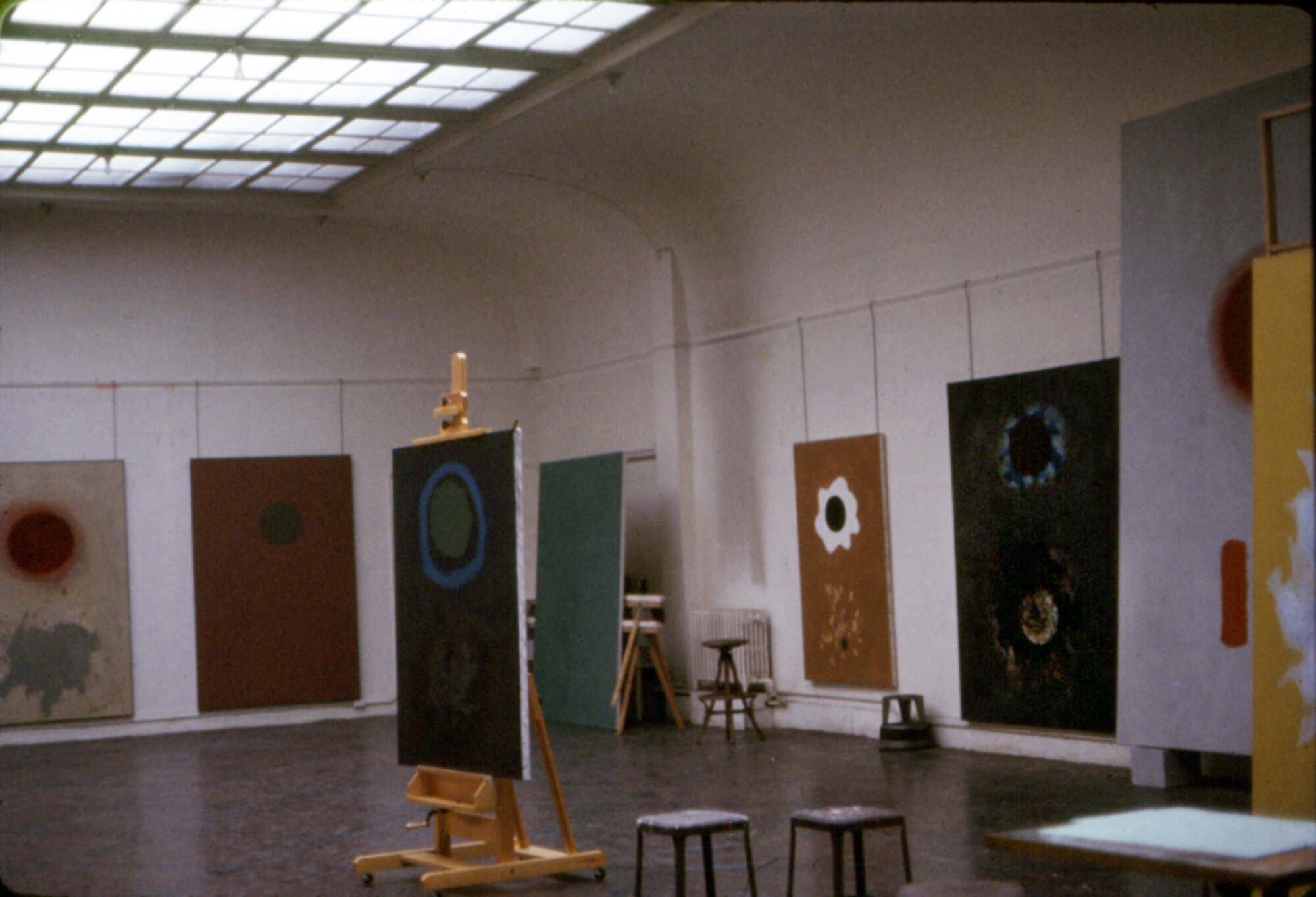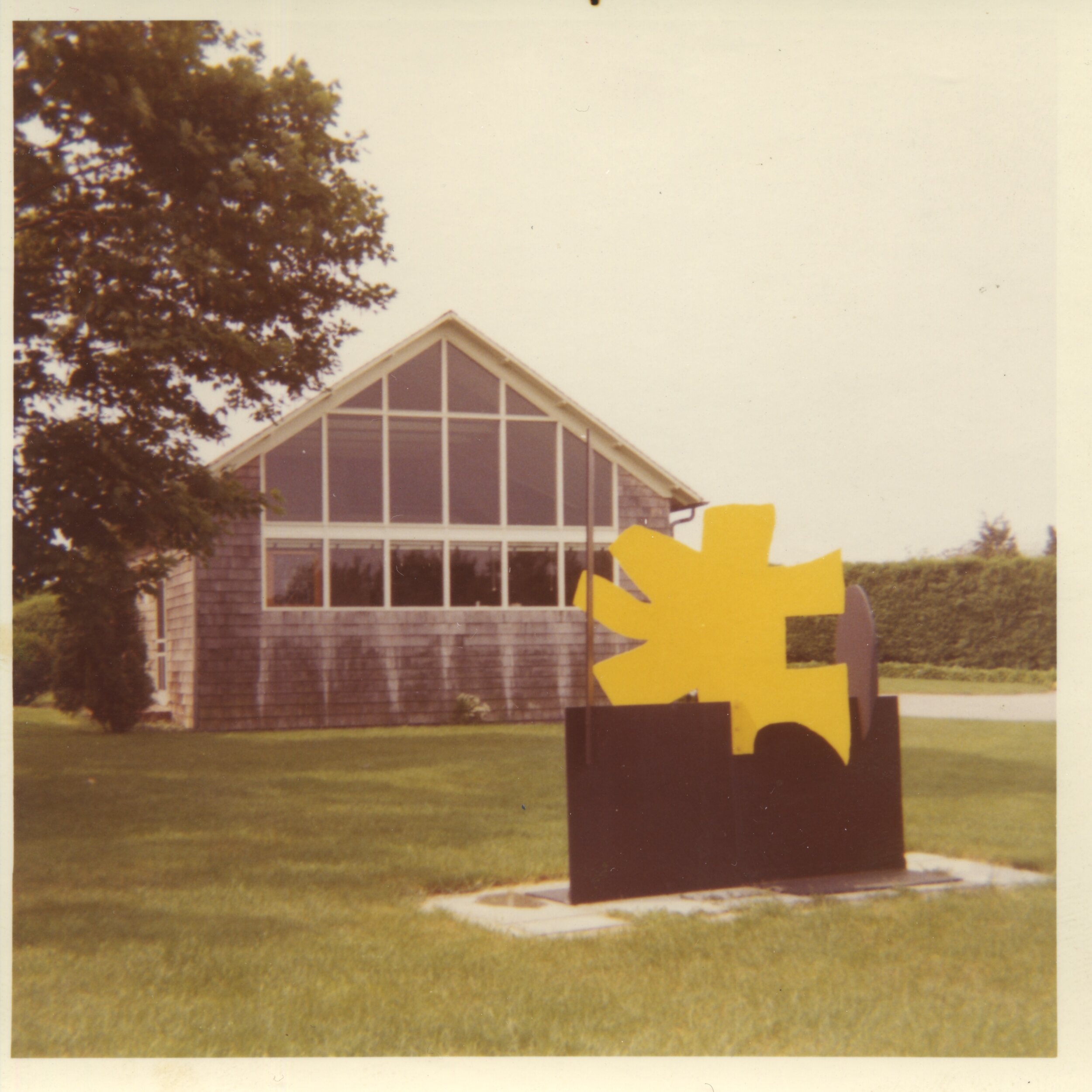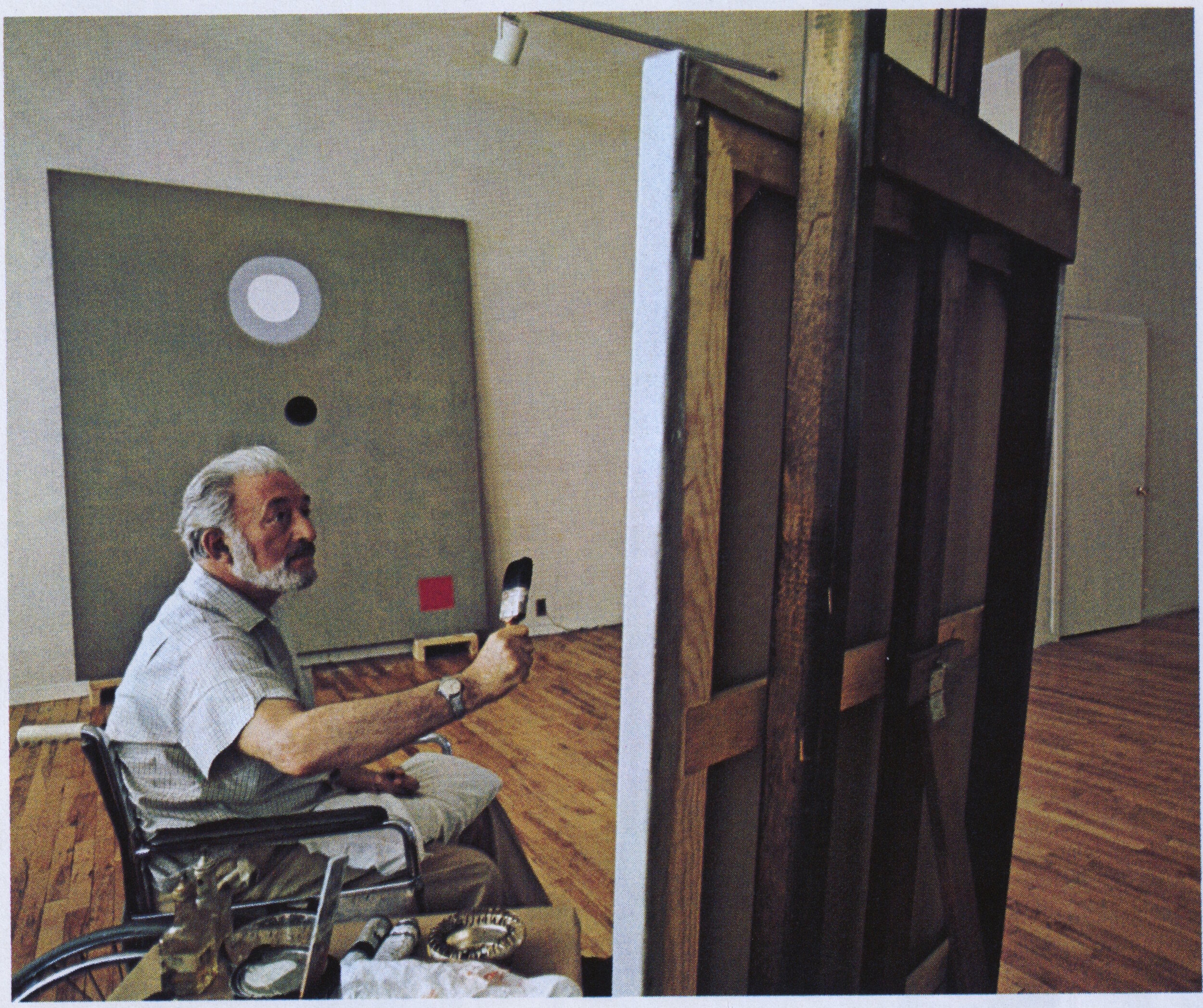
Photograph of Andrew Hudson and Adolph Gottlieb, from the article ''Adolph Gottlieb: An Artist Who Is Surviving'' by Andrew Hudson, Arts Magazine, March/April 1978. Photo by Roger Tripp
Andrew Hudson was an art critic for the Washington Post, he is an artist himself, and he taught at the Corcoran School in Washington for over thirty years. In his role as a critic, Andrew conducted two lengthy interviews with Adolph Gottlieb, and he reviewed his art on several occasions and got to know the artist and his wife Esther.
We were lucky enough to recently interview him. We are currently working on the full-length video, but in the meantime, here are a couple video vignettes and excerpts from the interview.
"I wrote Adolph a letter asking for an interview, but before he even got the letter, I bumped into him at the Museum of Modern Art in New York in the lobby. So I went up to him and said, 'Hey Mr. Gottlieb. I’m Andrew Hudson from the Washington Post. I’ve just written you a letter to ask you if we can have an interview.' So he said, 'Well come to my studio the next time you’re in New York,' which I did; it was in the Flatiron building then.
And it was very interesting because when I arrived he led me into a small room with about nine or ten paintings on the walls, very good paintings. And I was sure that this was like a test, that if I responded ok to the paintings, he would give an interview, and maybe if I didn’t respond very well, he wouldn’t. But I obviously responded very well. So we had the interview, and I loved that interview! Since it was just the two of us in his studio, he talked a lot about 'making paintings.' And he had wonderful things to say about—sometimes a painting would happen all by itself like a miracle, but of course he was also very good at correcting things and seeing things in his paintings. That went very well."
Shown here: Adolph Gottlieb, Spray, 1959, oil on canvas, 90 1/4 x 72 3/8“
Collection: Hirshhorn Museum and Sculpture Garden, Smithsonian Institution, Washington, DC
©Adolph and Esther Gottlieb Foundation/Licensed by ARS, NY, NY⠀
Andrew Hudson: Let me tell you something else Esther told me in East Hampton. Funny story about Hirshhorn, Mr. Hirshhorn. She said that people who were struggling financially had to sell their paintings to Hirshhorn at lower prices when he asked for lower prices, but Adolph didn’t have to do that. So Hirshhorn would come and say, 'How much is that painting?' And Adolph would quote a figure and Hirshhorn would say, 'What’s that, a telephone number?' But eventually would have to pay what Adolph was asking, because Adolph did not budge, which was very good for Adolph I think, heh!
Sanford Hirsch: It was and Hirshhorn had—has a number of really top paintings.
Andrew Hudson: Oh absolutely. I mean, when I did that article on the Whitney’s part of the museum show in New York, I was so happy about a painting called Two Discs which belonged to Hirshhorn because I knew they were going to have to come from Washington. But the curators only ever showed it within the first year of it being in the collection. It’s never been up, it’s been in storage. And I read an article complaining about that in a small magazine up in Washington because at the National Gallery someone like Rubens has something like four or five paintings. So someone like Adolph should have several paintings. And they’ve got the wonderful painting Spray which is usually up, but they should also put Two Discs up as well, in my opinion. They’re depriving the art world of seeing how great Adolph really was, or is.
Shown here: Adolph Gottlieb, Two Discs, 1963, oil on canvas, 90 x 108"
Collection: Hirshhorn Museum and Sculpture Garden, Smithsonian Institution, Washington, DC
©Adolph and Esther Gottlieb Foundation/Licensed by ARS, NY, NY
"I bumped into Adolph in I guess ’66. Noland’s very first show of Stripe paintings at Emmerich Gallery. And they were large paintings with rows of stripes parallel, horizontal stripes, like there might be a dozen stripes of gray going across a white canvas. And they were kind of a bit monochromatic, monotonous, but they were something totally new at the time. And I met Adolph there and he said, 'These are just like bedsheets.' But then he came back to me seeing I wasn’t too pleased with his comment, because I admired Noland. He said, 'I was only kidding.' He said, 'He’s a good painter.' And that’s very much like Matisse...because Matisse was also very good at acknowledging that the artists that come after you are not going to be like you, they’re going to be rebelling against you."
"I felt very akin to Adolph in many ways even though I was trying to paint in a way where I didn’t see the composition at all. It was sort of going against him in that sense, but I always have felt I was closest to him as an artist than to the other painters I mentioned, Bush or Olitski. So he was very much a force in my life as an artist as much as someone I admired as an art critic.”
Shown here: Andrew Hudson in his studio, with print of Nadir in the background.
Adolph Gottlieb, Nadir, 1952, oil on canvas, 42 x 72"
©Adolph and Esther Gottlieb Foundation/Licensed by ARS, NY, NY
To read more writings on Adolph Gottlieb by Andrew Hudson, click here.