
Avery, Gottlieb & Rothko: By the Sea
"We would like to spend two weeks in Gloucester, just as a change from the desert. The thought of the sea fills me with nostalgia.”
–Adolph Gottlieb in a postcard to Paul Bodin planning his return to the East Coast after 9 months in Arizona, June 1938
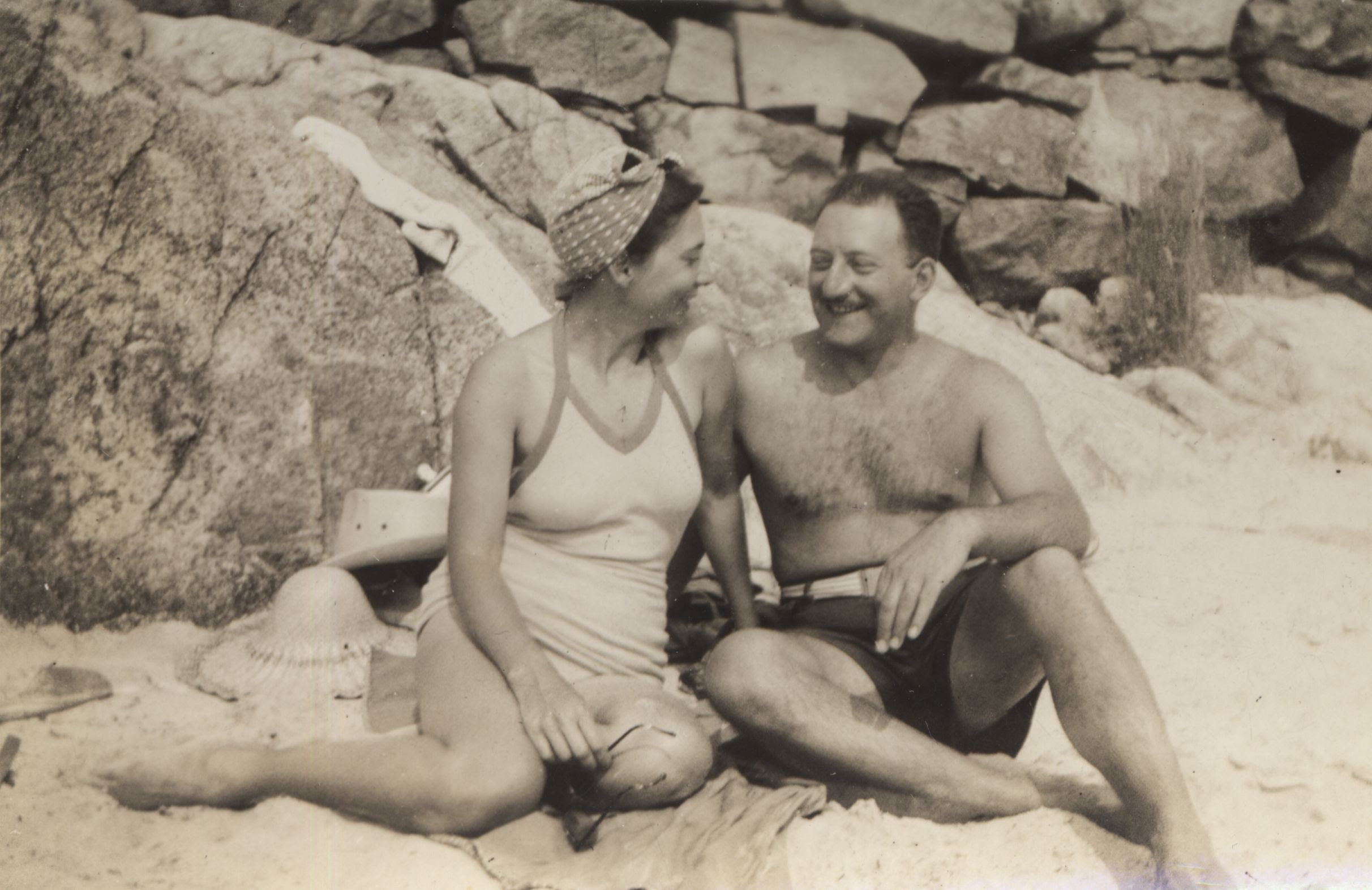
Adolph Gottlieb and Esther Gottlieb on the beach in Gloucester, c. 1943
Avery, Gottlieb & Rothko: By the Sea is open through September 27th at the Cape Ann Museum. The exhibition explores the friendships between Milton Avery, Mark Rothko, and Adolph Gottlieb with a focus on the summers they spent together in Gloucester and Cape Ann, MA in the 1930s and 1940s.
Please enjoy the following supplemental exhibition guide featuring photographs and accounts of the times Avery, Gottlieb, and Rothko spent together.
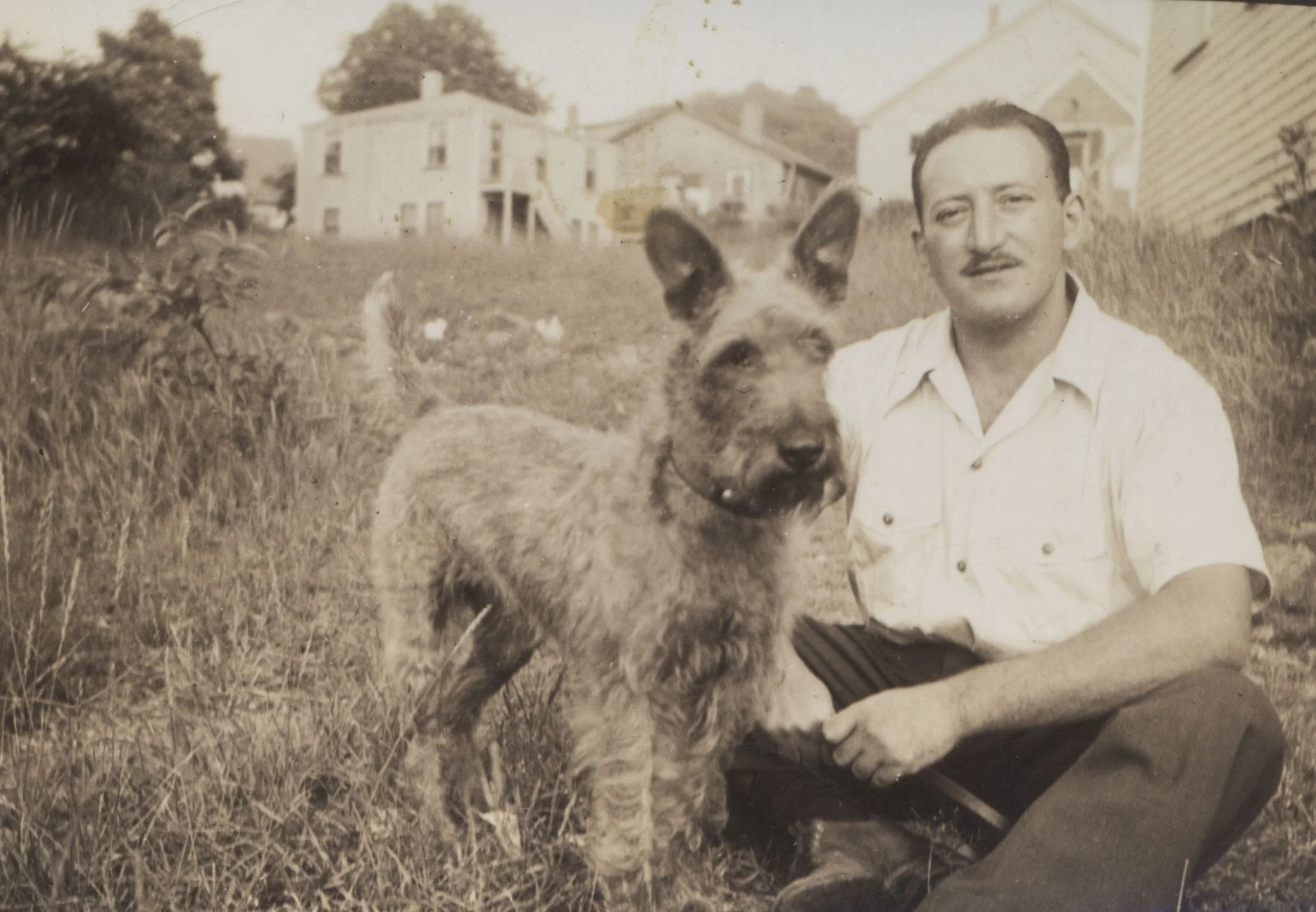
Adolph Gottlieb with Mickey the dog, possibly Gloucester, c. 1930s.
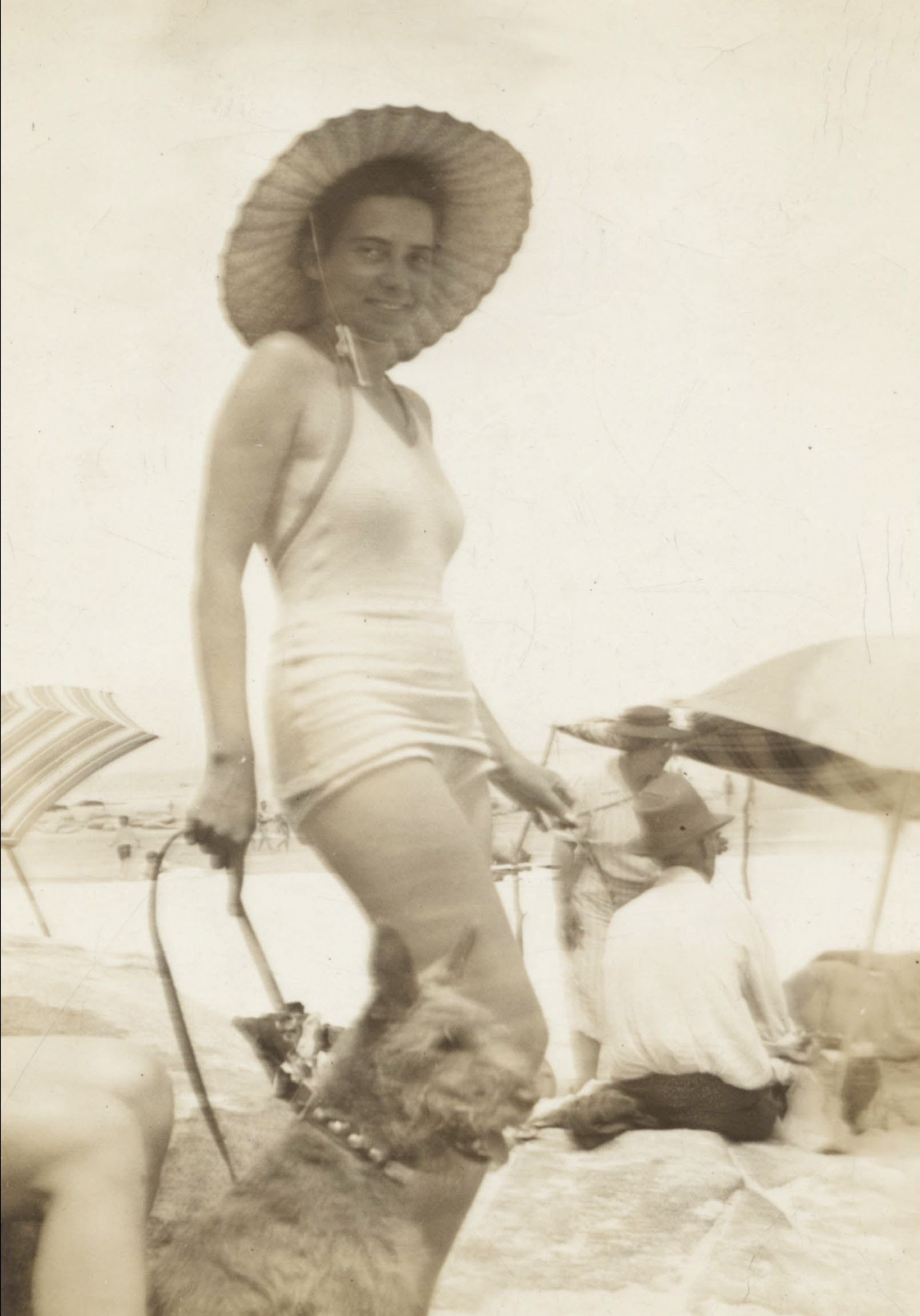
Esther Gottlieb on the beach in Gloucester with Mickey the dog, c. 1943.
"We [the Averys, Gottliebs, and Rothkos] used to go to the country – usually, you know, to Rockport or Gloucester. For $25 you could rent a place for the summer. We’d chip in and go together on it and hire a car to take us. If the car was driven at night, it would cost less to hire a car. So we’d have to take turns sitting up front with the driver to keep him awake."
–Esther Gottlieb in an interview with Phyllis Tuchman, October 1981
"Had a very pleasant trip up on the boat. Had a little difficulty locating a place, but the Rothkowitzes [Rothkos], who got here ahead of us and took the place we wanted on Calder St., put us up for two days. They are in Mrs. Enos’ house where Simeon was last year. Mrs. Enos was wonderful to us, taking us around in her car looking for places, and finally she found us a little cottage with many little rooms at 5 Calder St. for $20 a month."
–Adolph Gottlieb, writing from Gloucester, in a postcard to his friend Paul Bodin, July 1934
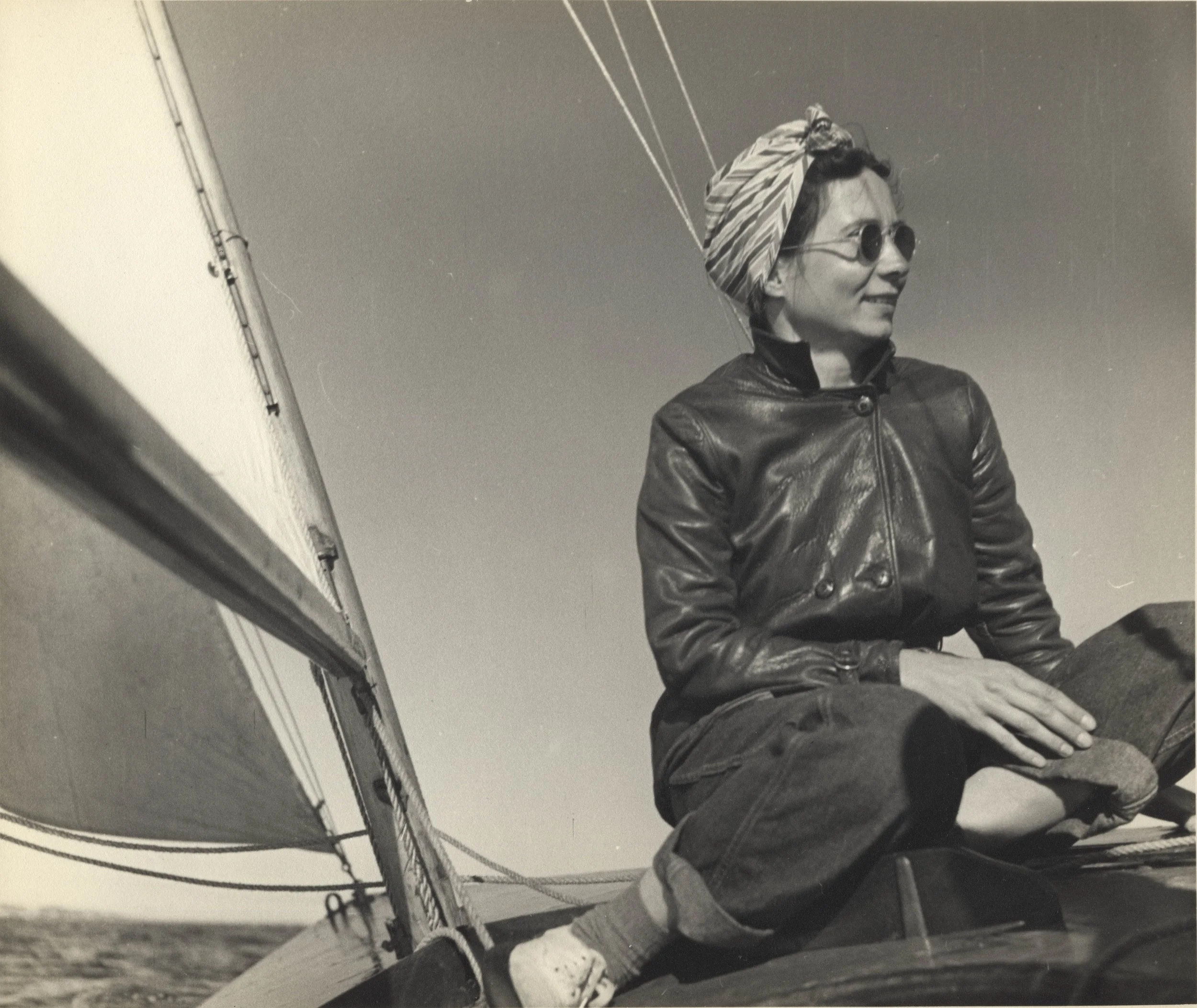
Esther Gottlieb sailing with Adolph in Cape Ann, c. 1934.
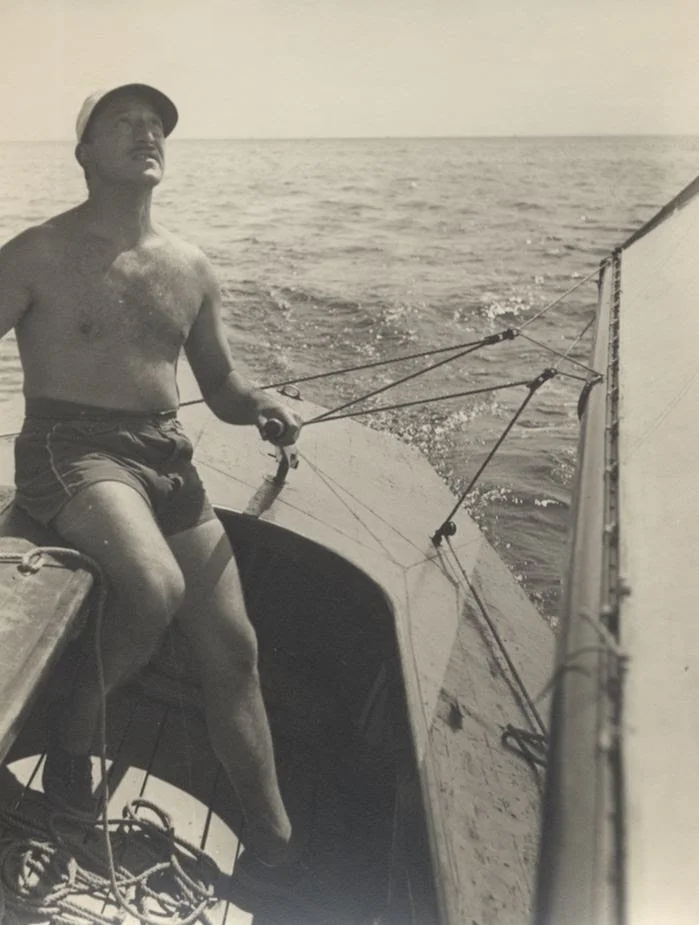
Adolph Gottlieb sailing in Cape Ann, summer 1934.
"We are down to our regular routine now. I paint in the morning while Esther keeps busy with mending or some other household activity. Afternoons we sail regularly, weather permitting. Have been doing watercolors and was not particularly pleased with results until this past week when I did a few that I like. I must admit they are quite abstract."
–Adolph Gottlieb in a letter to Paul Bodin, August 1943
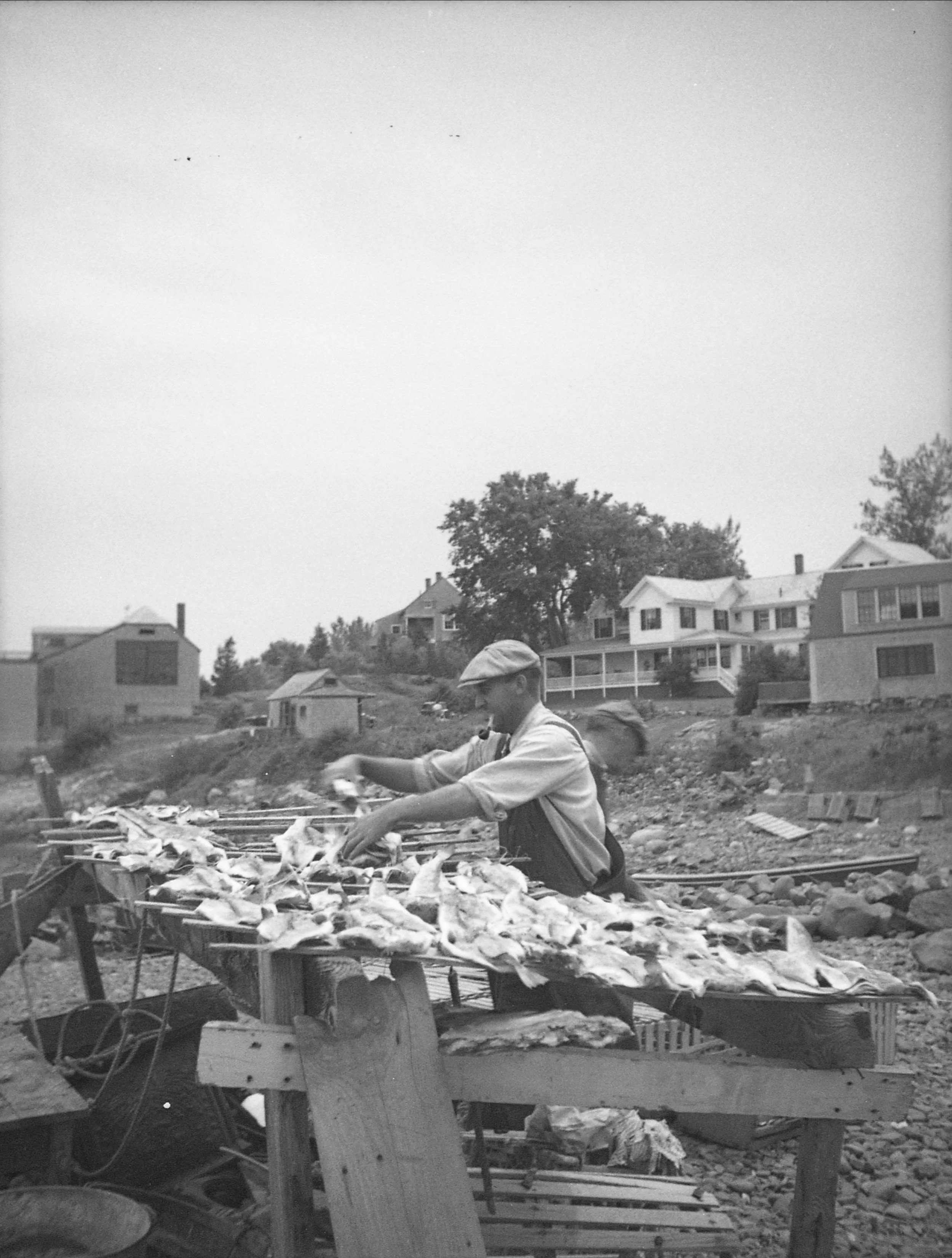
Fishermen in East Gloucester, MA c. 1942-1944. Photos courtesy of the Barnett Newman Foundation.
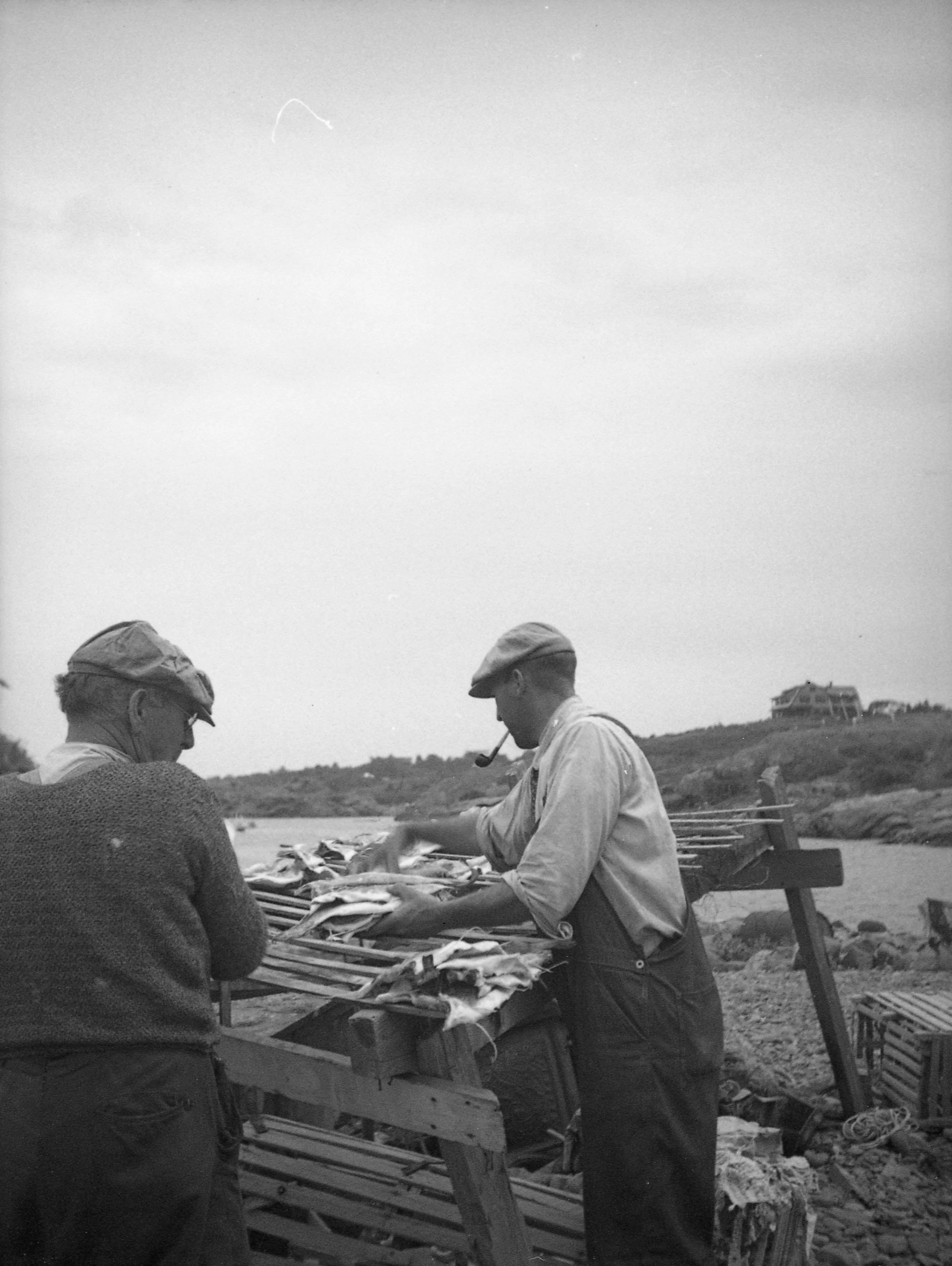
Fishermen in East Gloucester, MA c. 1942-1944. Photos courtesy of the Barnett Newman Foundation.
"Gloucester is quite different these days. Far from being a decaying fishing town, it is sort of thriving. The fishermen are almost all unionized. The activity is entirely due to the new freezing process which enables the middle west, in fact the whole country, to get fresh fish. We were watching the procedure at the new community fish pier and freezing plant this morning. Everything possible is done by machines and on conveyor belts; for example, a special machine for scaling the fish. Also, red fish which formerly were thrown away are now caught in huge quantities and used for fillets. They are very popular out west."
–Adolph Gottlieb in a letter to Paul Bodin, July 1941
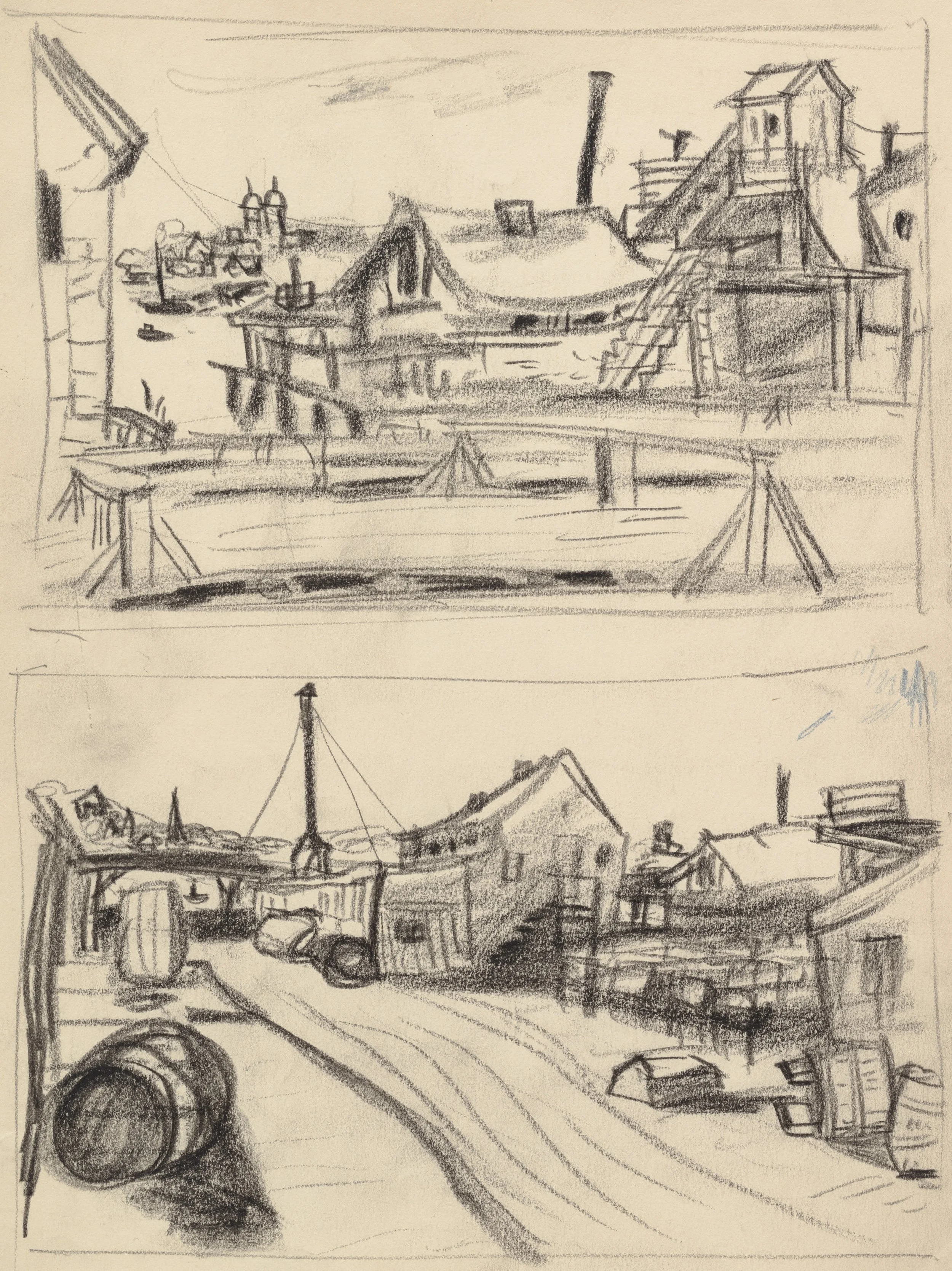
Adolph Gottlieb, Untitled (Gloucester Studies), c. 1934, crayon on paper, 11 3/4 x 8 7/8"
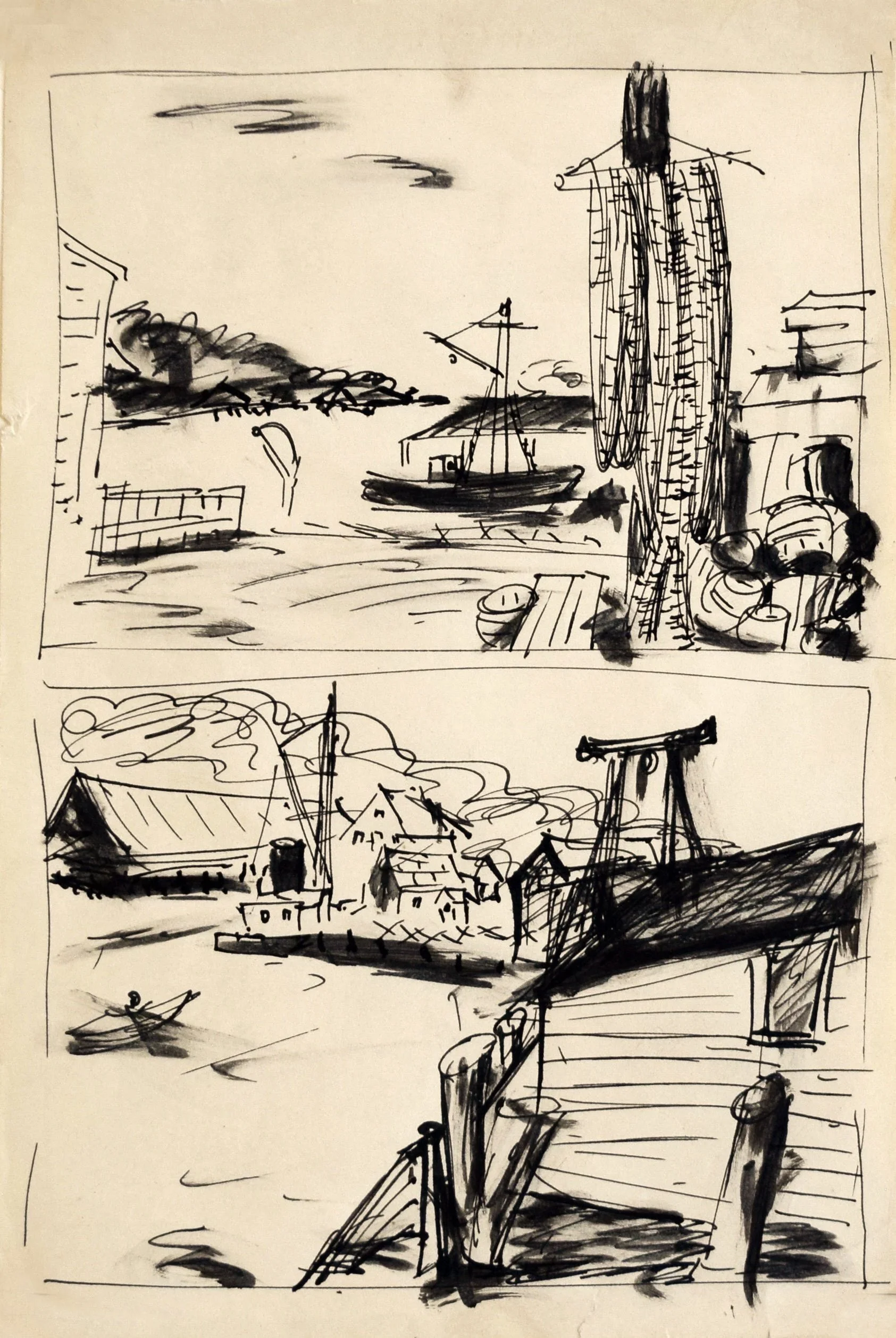
Adolph Gottlieb, Untitled (Two Gloucester Sketches), c. 1935, ink on paper, 8 1/2 x 5 1/2"
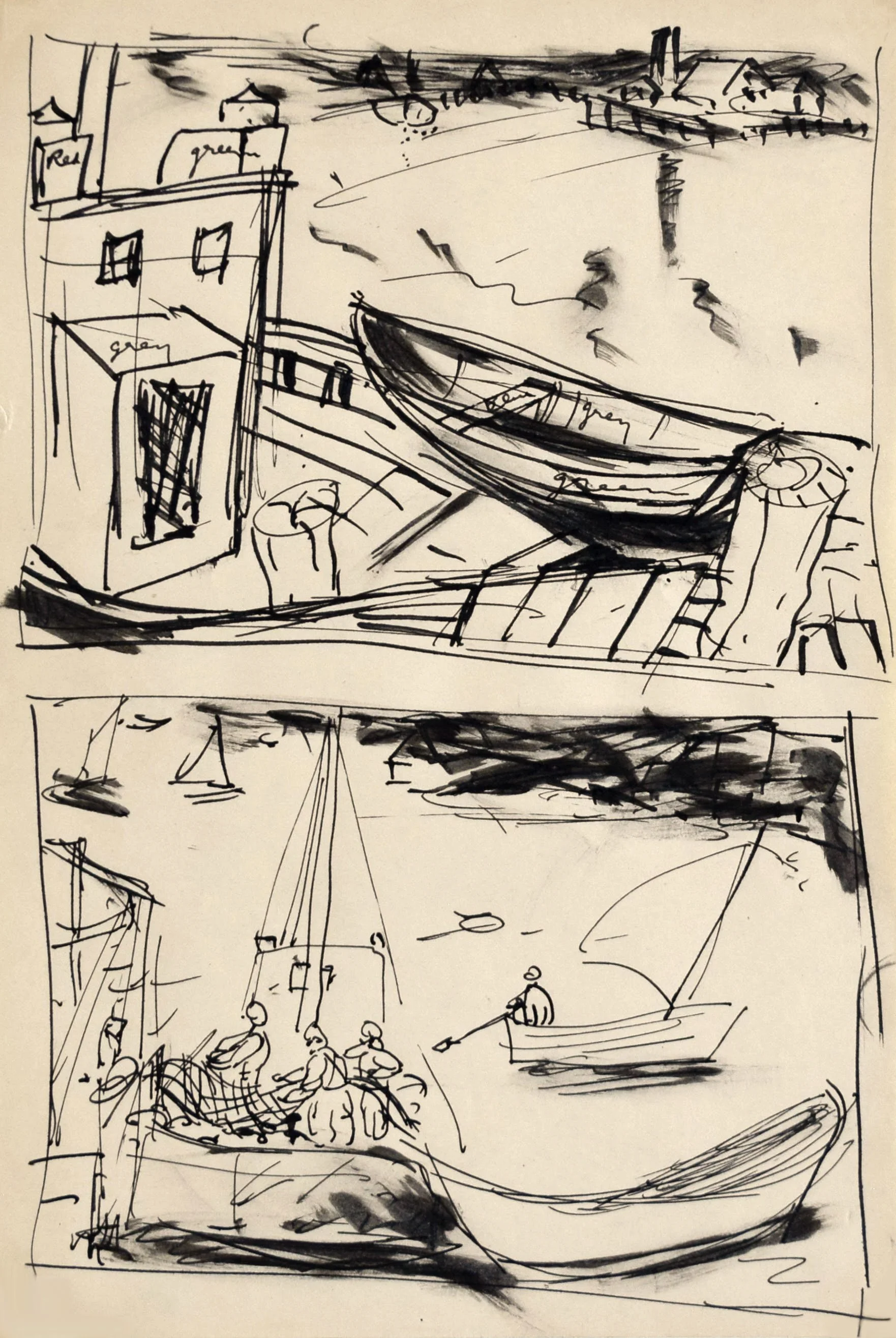
Adolph Gottlieb, Untitled (Two Gloucester Sketches), c. 1935, ink on paper, 8 1/2 x 5 1/2"
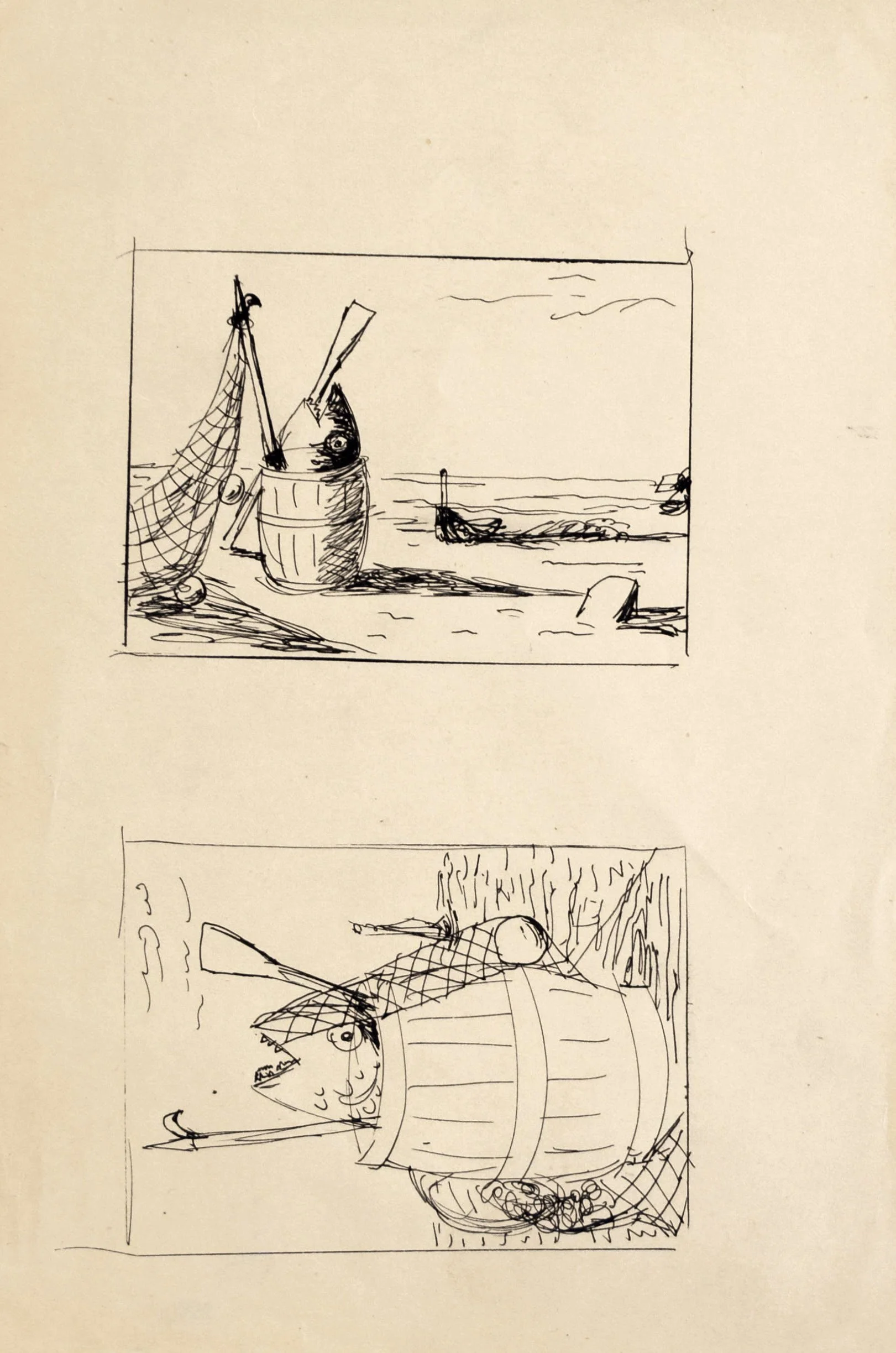
Adolph Gottlieb, Untitled (Two Gloucester Sketches), c. 1935, ink on paper, 8 1/2 x 5 1/2"
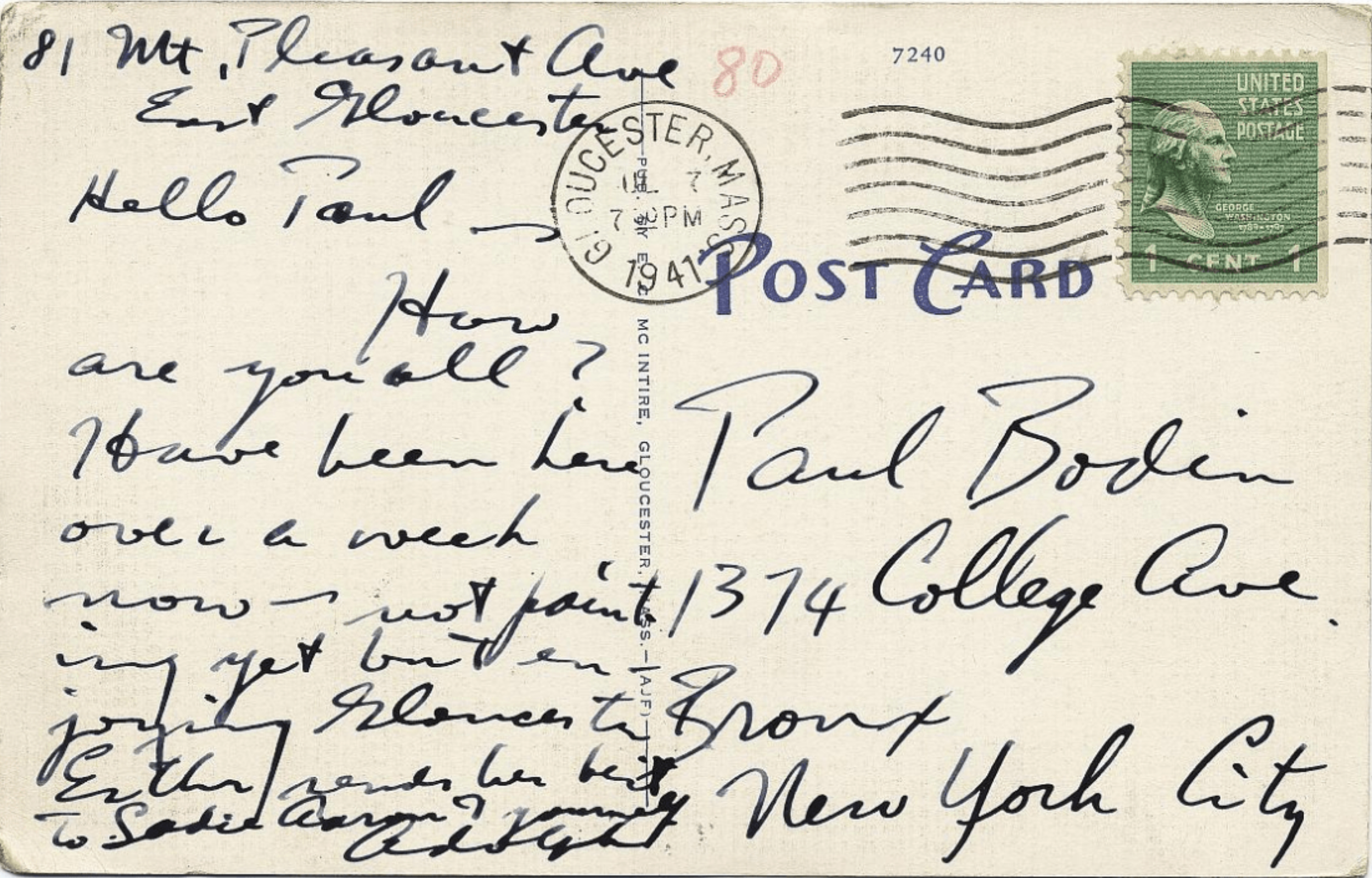
"We have been too busy patching up the old boat to paint, but ready to start now. Lots of activity here this summer, seeing the Averys among others from N.Y. Wish you could get up for a while anyway."
–Adolph Gottlieb in a postcard to Paul Bodin, July 1941
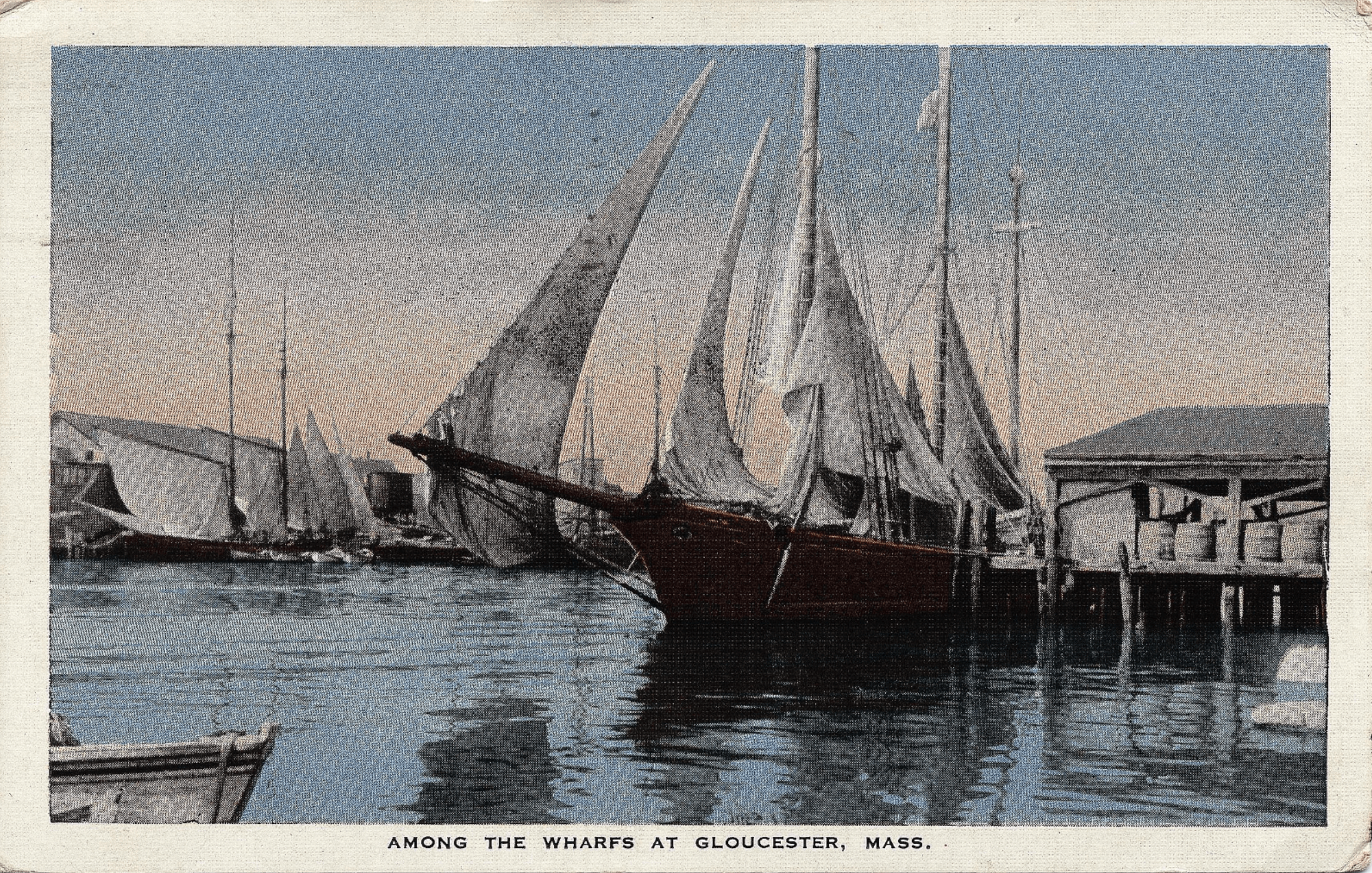
A postcard sent to Paul Bodin from Gloucester, MA, July 7, 1941.
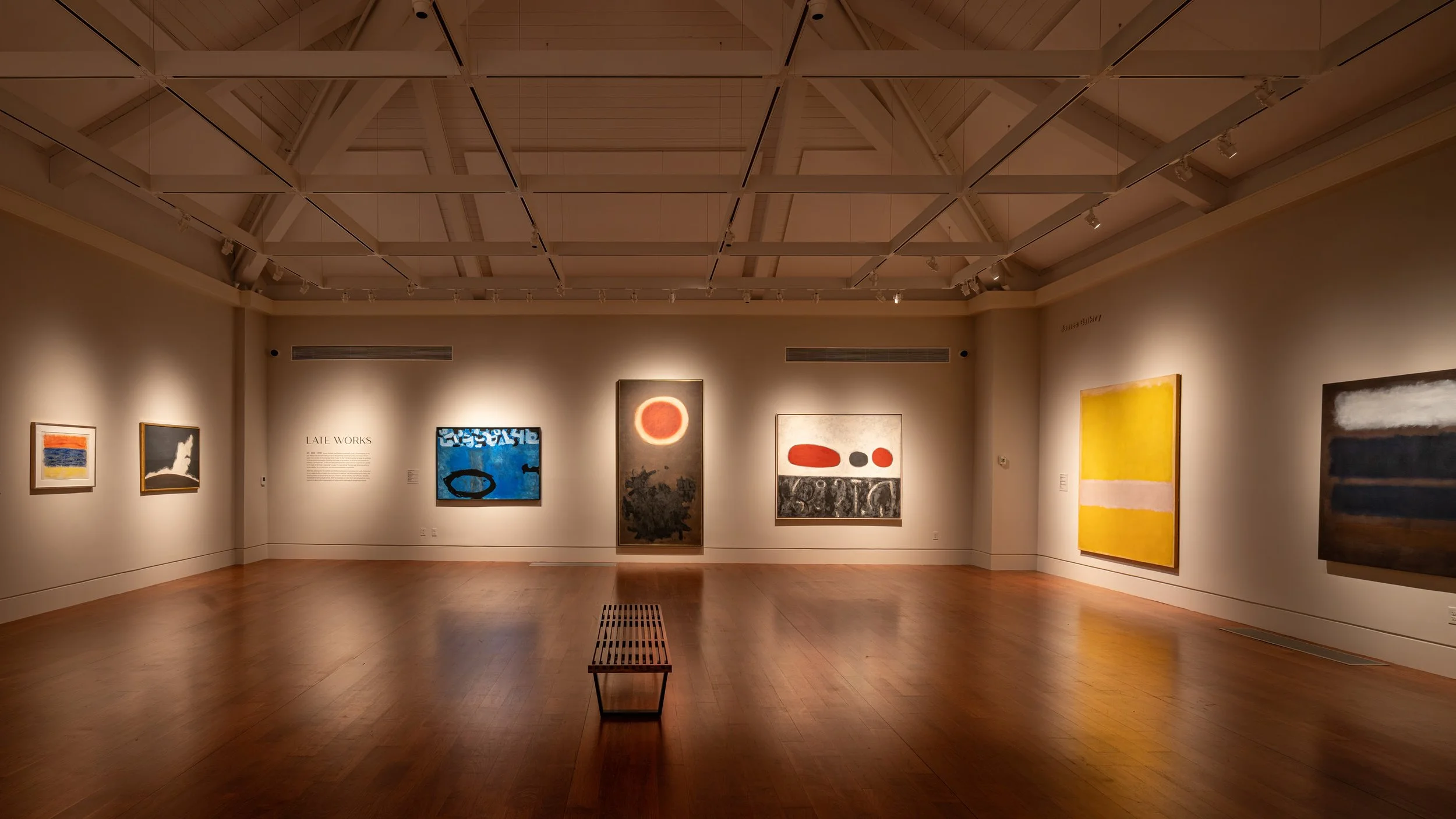
Installation view of “Avery, Gottlieb & Rothko: By the Sea” at the Cape Ann Museum, Gloucester, MA, 6/30/2026 – 9/27/2026, Photograph: Steve Rosenthal. Gottlieb works (from left to right): Blue at Night (1957), Under and Over (1959), Sea and Tide (1952), along with late paintings by Mark Rothko and Milton Avery.
Avery, Gottlieb & Rothko: By the Sea will be on view at the Cape Ann Museum through September 27th and will then travel to The Phillips Collection in Washington, D.C., opening October 24, 2026.
2026 Individual Support Grant Recipients Announced
For Immediate Release
The Adolph and Esther Gottlieb Foundation
Individual Support Grant Recipients, Spring 2026
The Adolph and Esther Gottlieb Foundation in New York City announces the selection of twenty artists to receive its 49th annual Individual Support Grants. A panel of four independent jurors reviewed applications submitted to the Foundation by 850 artists from 45 countries. Each of the following visual artists was chosen to receive an award of $25,000:
Agathe DeBailliencourt
Berlin, Germany
Deborah Druick
Bronx, NY
Ben Durham
Richmond, VA
Anindita Dutta
New Haven, CT
Peter Gallo
Hyde Park, VT
Lanie Gannon
Nashville, TN
Nereida García Ferraz
Miami, FL
Chuck Holtzman
Boston, MA
Ivelisse Jiménez
San Juan, Puerto Rico
Howard Johnson
Hudson, MA
Holly Lane
Merced, CA
Charles Matson Lume
St. Paul, MN
Edouard Prulhière
Malakoff, France
Blake Rayne
Brooklyn, NY
Matheus Rocha Pitta
Berlin, Germany
Scott Short
Plain City, OH
Ken’ichiro Taniguchi
Berlin, Germany
Travis Townsend
Lexington, KY
Johnathan VanDyke
Brooklyn, NY
Josephine Wood
London, United Kingdom
The Adolph and Esther Gottlieb Individual Support program was established in 1976 to encourage and recognize mature painters, sculptors, and printmakers who have dedicated their lives to developing their art regardless of their level of commercial success.
The Foundation also administers the Adolph and Esther Gottlieb Emergency Grant program, which offers assistance to mature visual artists who have suffered a current or recent catastrophic event. More information about the Foundation and its programs can be found here. Links to an application form for each program may likewise be found on the website.
For additional information, contact Petra Pankow, Grants Manager, at (212) 226-0581 or ppankow@gottliebfoundation.org.
Sanford Hirsch to Step Down as Executive Director of Adolph and Esther Gottlieb Foundation
NEW YORK, NY (April 16, 2026)— The Adolph and Esther Gottlieb Foundation announced today that Sanford Hirsch is stepping down from his position as Executive Director at the end of this year, the culmination of his venerable career founding and leading the organization for a half century. The Gottlieb Foundation stewards the work and legacy of American Abstract Expressionist painter Adolph Gottlieb (1903– 1974) and offers financial support to living artists through its grant programs. Hirsch was hired by Esther Gottlieb (1907– 1988) in 1976 to assist in the transition of her late husband’s estate into a not-for-profit foundation following a stipulation in Adolph’s will to support “mature, creative painters and sculptors.” Hirsch will return to his own studio to resume full-time the artmaking he practiced when he first met the Gottliebs. A search committee has been formed by the Foundation’s Board of Directors for a new Executive Director.
“Over his fifty-year career with the Gottlieb Foundation, Sandy Hirsch has exemplified the impact and integrity that heads of artist-endowed foundations work to achieve,” said Charlotta Kotik, President, Board of Directors. "Sandy has been an innovator in this field, securing the significance of Adolph Gottlieb’s painting and establishing a grant program where the Gottliebs bequest continues to support and sustain artists.”
“It has been an honor and a rare gift to be able to serve as Executive Director of the Gottlieb Foundation,” said Hirsch. “I am proud of what we have accomplished, both in the Foundation’s programs and in the model we established for artists to extend their legacies to the next generation. I am inspired by the incredible breadth of the art that I am privileged to view each year from all who apply to the Foundation’s grant programs. Their work is proof of Adolph and Esther’s vision in providing help to this important community in moments of need.”
During his tenure with the Gottlieb Foundation, Hirsch initiated twenty-one Gottlieb solo museum exhibitions that were installed at seventy-two museums in the United States, Europe, and Asia including the Los Angeles County Museum of Art, The Phillips Collection, Washington, DC, and the Peggy Guggenheim Collection, Venice, Italy. He collaborated with curators and scholars to include Gottlieb’s art in major thematic exhibitions in museums and galleries, such as the Whitney Museum of American Art and Zentrum Paul Klee, Bern, Switzerland. Hirsch has written extensively and lectured on Gottlieb’s work and American art of the twentieth century. Recently, Hirsch authored a major illustrated chronology on Gottlieb’s life and oversaw the publication of Adolph Gottlieb: A Powerful Will to Art (Gregory N. Miller & Co., 2025).
Hirsch sits on the Board of the Nancy Graves Foundation and the Hedda Sterne Foundation. He is a past Vice President of National Artists Equity and a former member of the Board of Artists Legacy Foundation.
About Adolph and Esther Gottlieb
Adolph Gottlieb was one of the small group of artists -- including Willem de Kooning, Lee Krasner, Joan Mitchell, Isamu Noguchi, Jackson Pollock, Mark Rothko, Hedda Sterne, David Smith, and others -- who developed the movement known as Abstract Expressionism.
Gottlieb was the recipient of numerous honors, prizes, and awards. He was the first American to win the Grand Prize at the São Paulo Biennial (1963). The Museum of Modern Art (MoMA), New York, acquired one work (1946) and The Solomon R. Guggenheim Museum purchased eleven of his works (1948). He was elected to the American Academy of Arts and Letters (1972). He was the subject of fifty-six solo exhibitions in his lifetime, including a simultaneous retrospective held at the Guggenheim and the Whitney Museum of American Art (1968). Other sites for monographic exhibitions include The Jewish Museum, New York (1957, 2001); Institute of Contemporary Arts, London (1959); Walker Art Center, Minneapolis (1963); MoMA (1974); Corcoran Gallery of Art, Washington, D.C. (1981); Los Angeles County Museum of Art (1981); Tel Aviv Museum (1981); Museum of Fine Arts Houston, Texas (1993), Phillips Collection, Washington, D.C. (1994); Brooklyn Museum of Art, New York (1994); IVAM Centre Julio Gonzalez, Valencia, Spain (2001); Fundació Pilar I Joan Miró A Mallorca, Palma de Mallorca, Spain (2006), Musée d’Art Moderne et d’Art Contemporain, Nice, France (2008) and Peggy Guggenheim Collection, Venice, Italy (2010–11).
Gottlieb achieved artistic and financial success far beyond his early expectations. Over the course of his life, Gottlieb had several friends and colleagues who, despite their artistic achievements, could not support themselves either through the sale of their art or through teaching or related work. The Foundation was founded in the spirit of support from artist to artist.
Esther Dick Gottlieb (1907– 1988) was a teacher who, during the Great Depression of the 1930s when the couple first married, worked at a vocational school in New York. She instructed needlework and design classes. Through her practice of sharing cash from her teaching salary with those artists in need in their community – including Mark Rothko and David Smith – she established a model for artist support, a precedent for the Foundation.
About the Adolph and Esther Gottlieb Foundation
The Adolph and Esther Gottlieb Foundation in New York has been operating since 1976. The Foundation, with offices in what was Adolph Gottlieb’s studio, offers grants to individual visual artists through two programs: an annual Individual Support Grant and a separate program to assist visual artists in cases of catastrophic events through Emergency Grants. The Foundation also maintains an archive on the art and life of Adolph Gottlieb and organizes exhibitions of his art in solo and group exhibitions. The program awarded its first grants in 1977 and now annually awards twenty grants of $25,000 each to artists nationally and internationally. In 1985, the Foundation initiated a second grant program, unique in grant-giving artist-endowed organizations, to provide assistance to mature artists with financial need to recover from a catastrophic emergency. In the last year, 107 emergency grants were awarded for a total of $500,000. Since 1976, the Foundation has distributed $18,000,000 to date in unrestricted grants.
From the Archives: The Millburn Ark Curtain
In 1950, Percival Goodman, architect of the newly constructed synagogue of the Congregation B'nai Israel in Millburn, NJ, commissioned three artists to create artwork for the building. Adolph Gottlieb, Robert Motherwell, and Herbert Ferber, all represented by the Samuel Kootz Gallery, created a torah ark curtain, a lobby mural, and an exterior sculpture, respectively.
Below, we have gathered photographs, documents, and ephemera from the Foundation's archives outlining the creation of the Millburn Torah Ark Curtain. This was one of four significant architectural collaborations in Gottlieb's career.
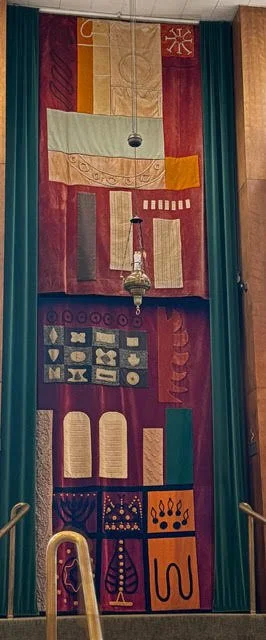
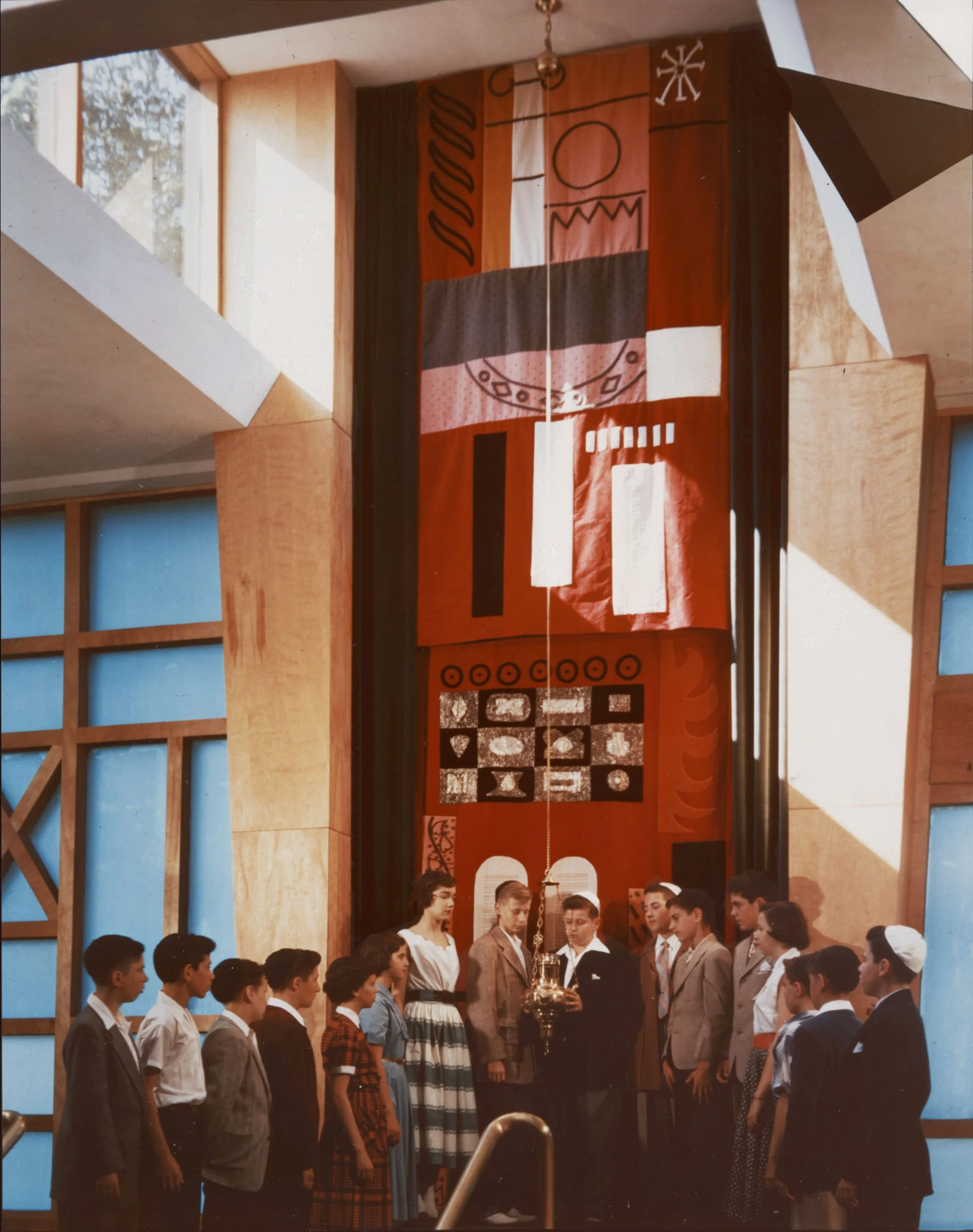
Shown: (left) A replica of the ark curtain currently in use at the Congregation B'nai Israel in Millburn, NJ. (right) The original ark curtain at Congregation B'nai Israel in Millburn, NJ, approx. mid-1950s.
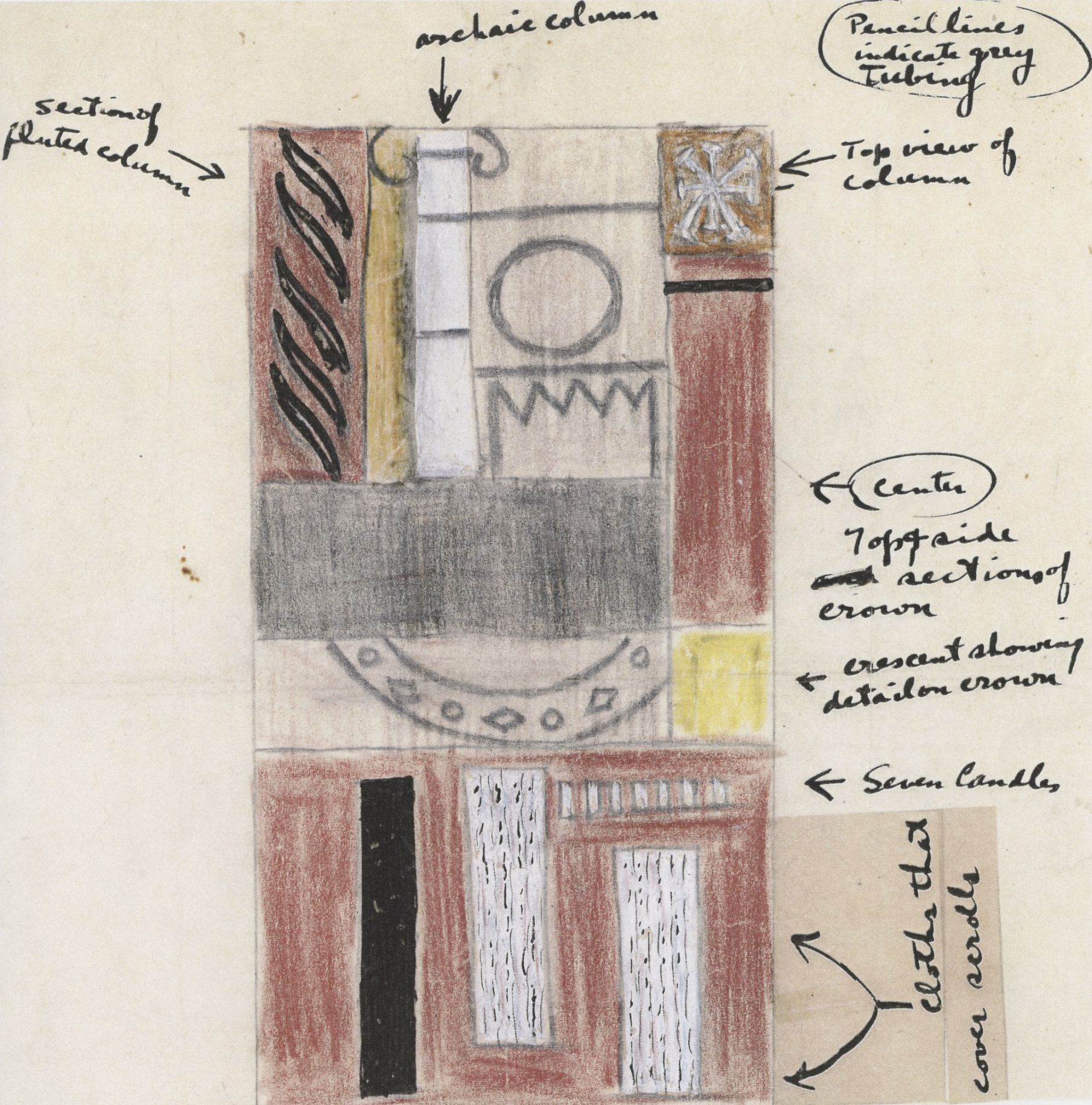
Gottlieb designed and selected the color and fabrics for the Ark Curtain. His design featured symbols from the Torah and the Jewish faith, including the Tree of Life, the Twelve Tribes, and a menorah. The compartmentalized symbols align with the style of Gottlieb's Pictographs, which he began in 1941 and continued to develop at the time of this commission.
The finished Ark Curtain measured 19 ft tall and 8 ft wide. The top half of the curtain was stationary while the bottom half covered the ark where the Torah scrolls rest.
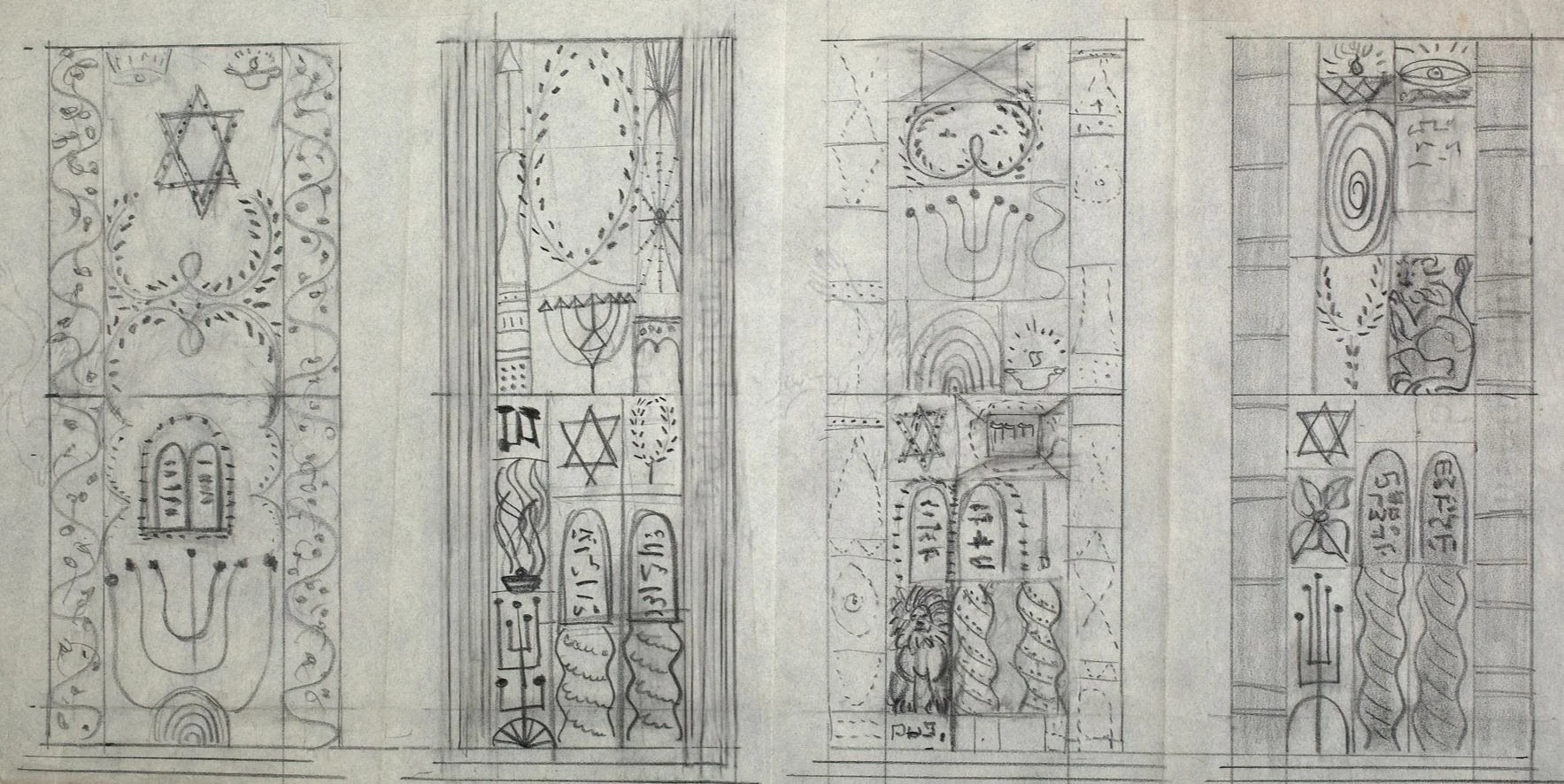
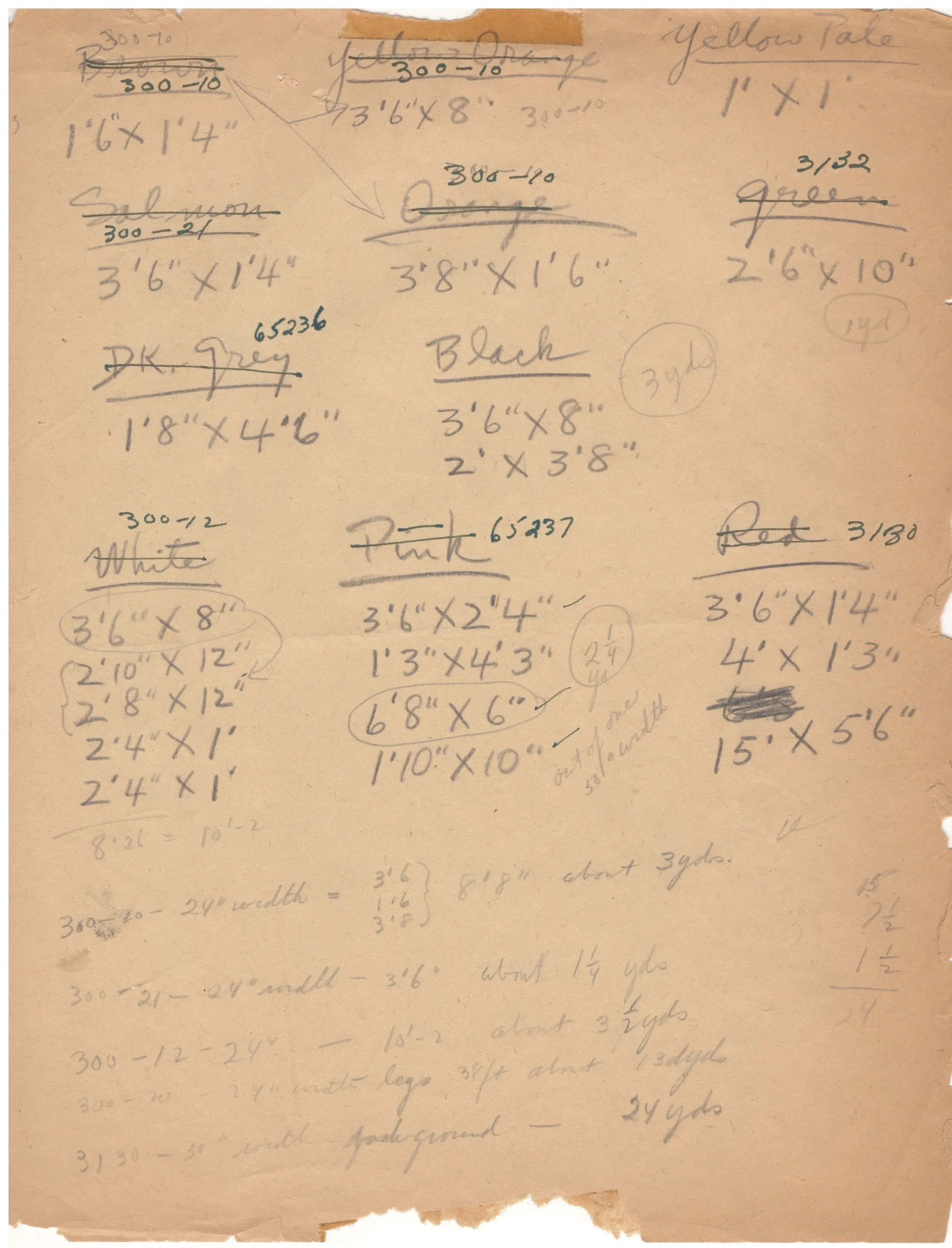
Shown: (left) Adolph Gottlieb, 4 Studies for Ark Curtain, Millburn Synagogue, 1951, pencil on vellum, 9 7/8 x 20 1/8 in. (right) Gottlieb's notes on the fabric dimensions and colors for the Ark Curtain.
"In decorating a church or synagogue, it seems to me reasonable and even interesting to utilize some of the symbols that relate to religious customs and beliefs; the artist cannot brush aside the fact that to members of any faith, their symbols are a serious and important matter. If I did not feel that the symbols I used had validity, I would not have used them."
–Adolph Gottlieb in a talk on Art and Architecture, April 18, 1957
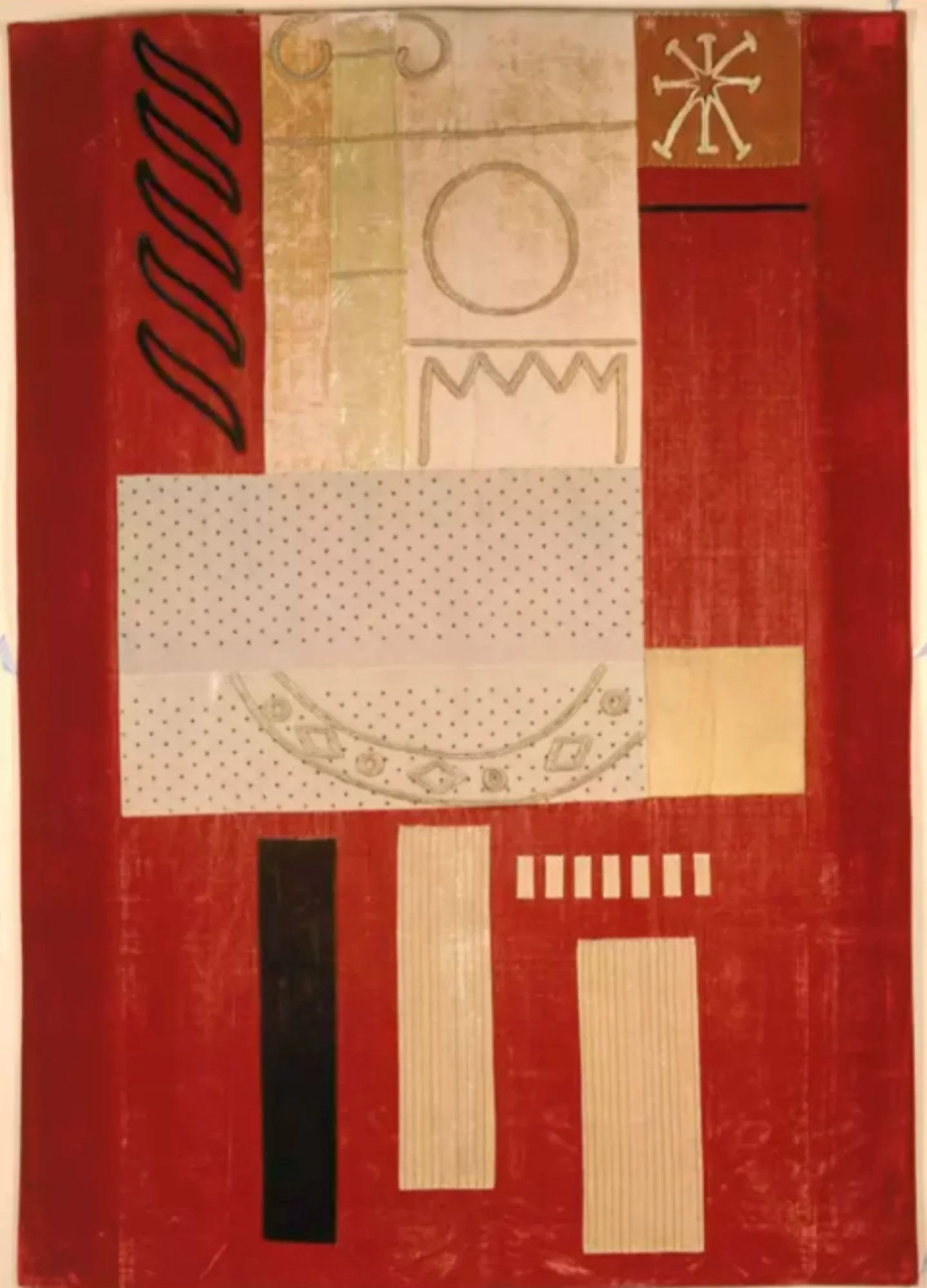
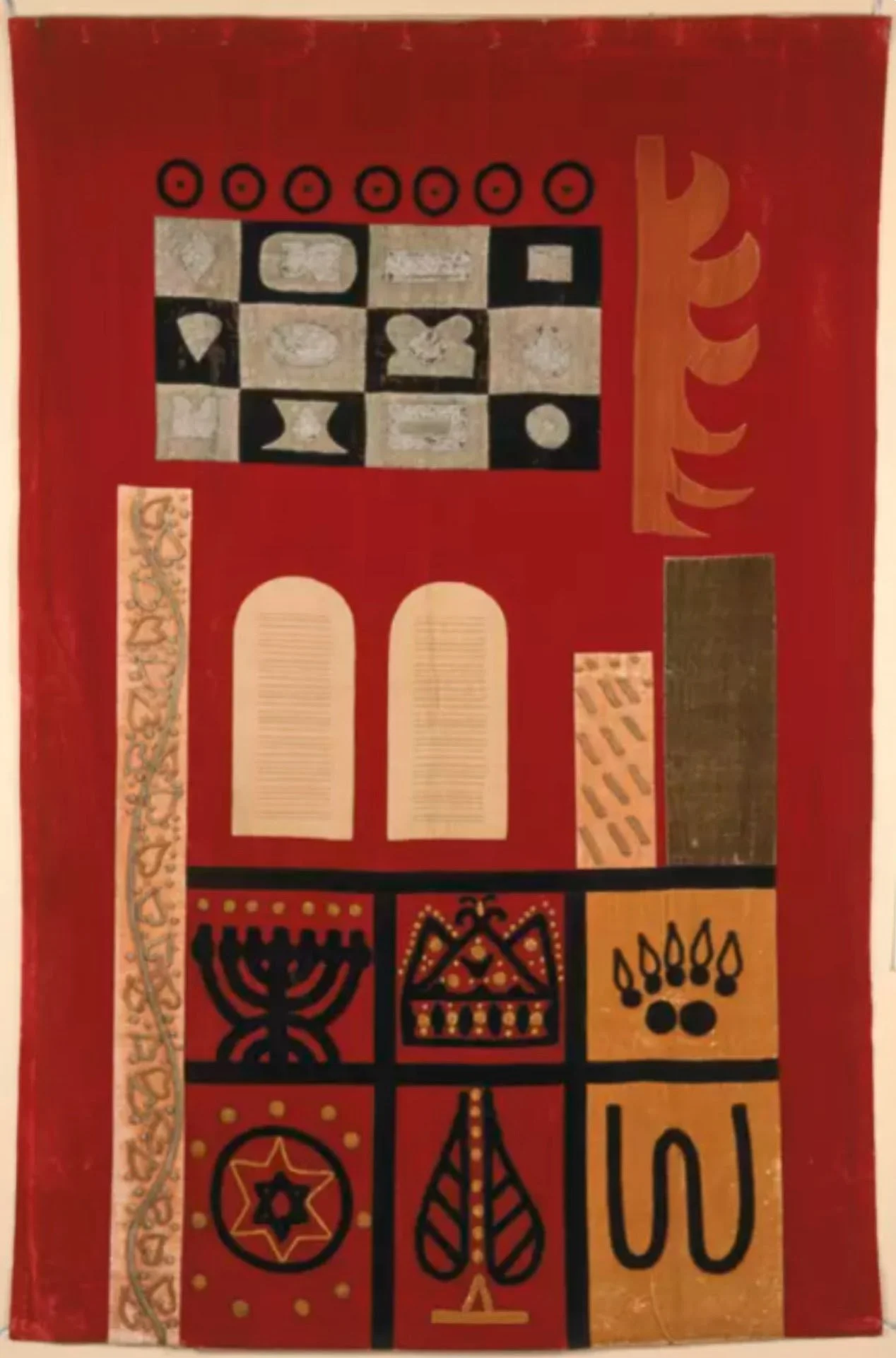
Shown: Adolph Gottlieb, Millburn Ark Curtain, c. 1951, silk and velvet, Upper section (left): 112 3/4 × 80 1/2 in. Lower section (right): 121 3/4 × 81 1/2 in. Collection of The Jewish Museum, New York, NY
While Gottlieb designed and planned the curtain, the work itself was made by a group of women from the Congregation B'nai Israel. They met at the home of Mary Bamdas, who led the group and carried out the artist's instructions. The skilled sewing and needlepoint group included Florence Cohen, Elle Feld, Rose Fish, Florence Flink, Hedwig Gruenewald, Bertha Jaffe, Ceil Pollack, Zelda Schofel, and Ida Wische. They were guided by Esther Gottlieb, the artist’s wife and a teacher of tailoring and needlecraft. The women embroidered and appliqued small sections of the curtain, and the pieces were finally assembled by a firm specializing in theatrical curtains.
"I think the important difference between painting and the kind of decorations I have mentioned lies precisely in the word design. A painter does not design paintings, but anyone working in the media of stained glass or fabrics, or any material structurally integrated with a building, is first and last a designer."
–Adolph Gottlieb in a talk on Art and Architecture, April 18, 1957
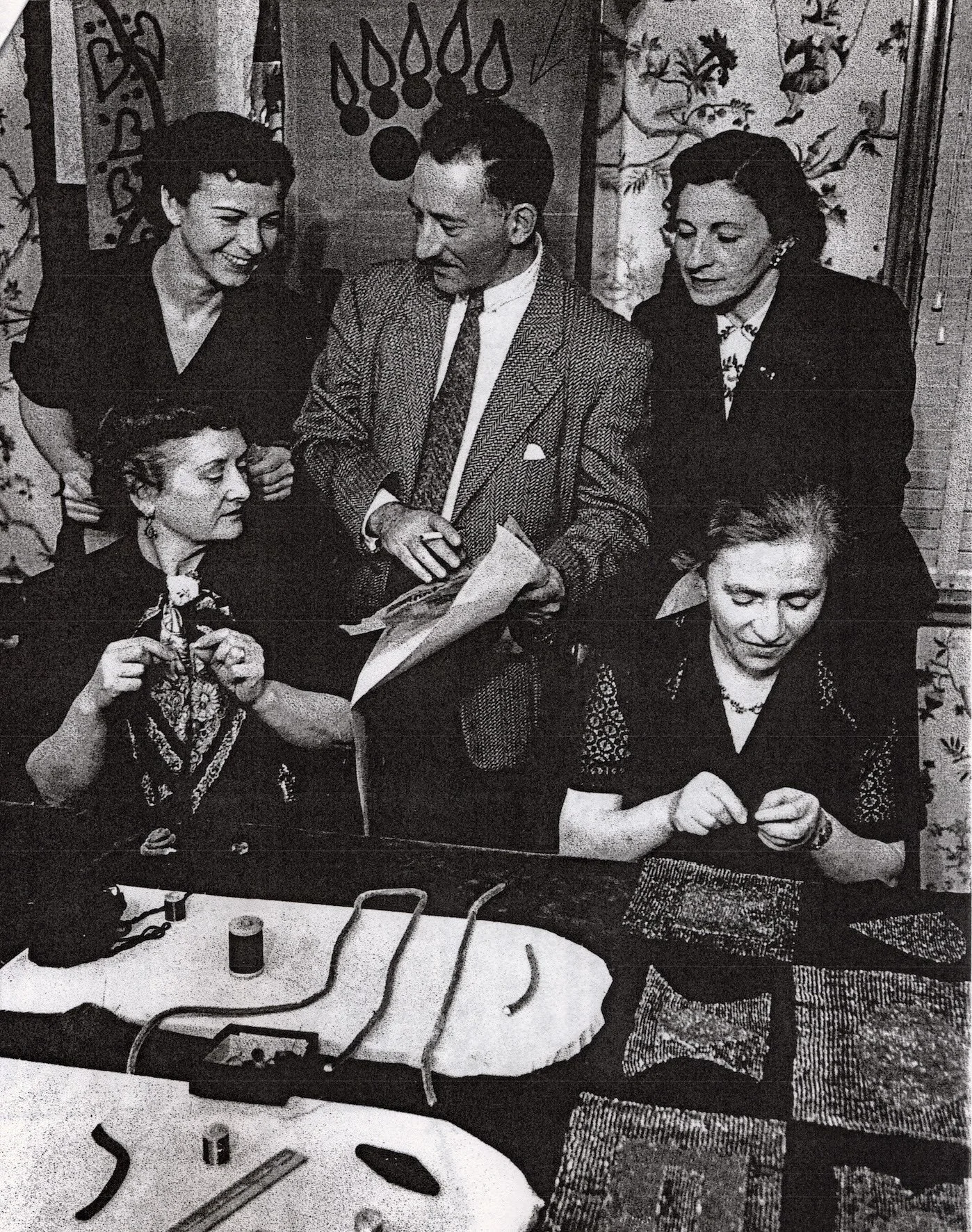
Shown: (left) Women from the Congregation B'nai Israel who constructed the Millburn Ark Curtain. Mary Bamdas is seen standing at the far left; Adolph Gottlieb is in the center, Rose Fish (standing at right), Mrs. Max Grünewald (Rabbi Grünewald's wife, sitting at left), Rose Israelow (sitting at right), c. 1950. (right) Drawings and notes by Adolph Gottlieb to the women of the congregation who assembled the curtain, Photos courtesy Mr. Michael Bamdas.
The Torah Ark Curtain was formally presented to the Congregation B'nai Israel along with two other commissions in dedication exercises on June 15, 1952. René d'Harnoncourt, Director of the Museum of Modern Art, spoke at the ceremony.
"What I learned from this experience [the Millburn commission] was the knowledge that communal efforts to make art could be very gratifying to the community."
–Adolph Gottlieb in a talk on Art and Architecture, April 18, 1957
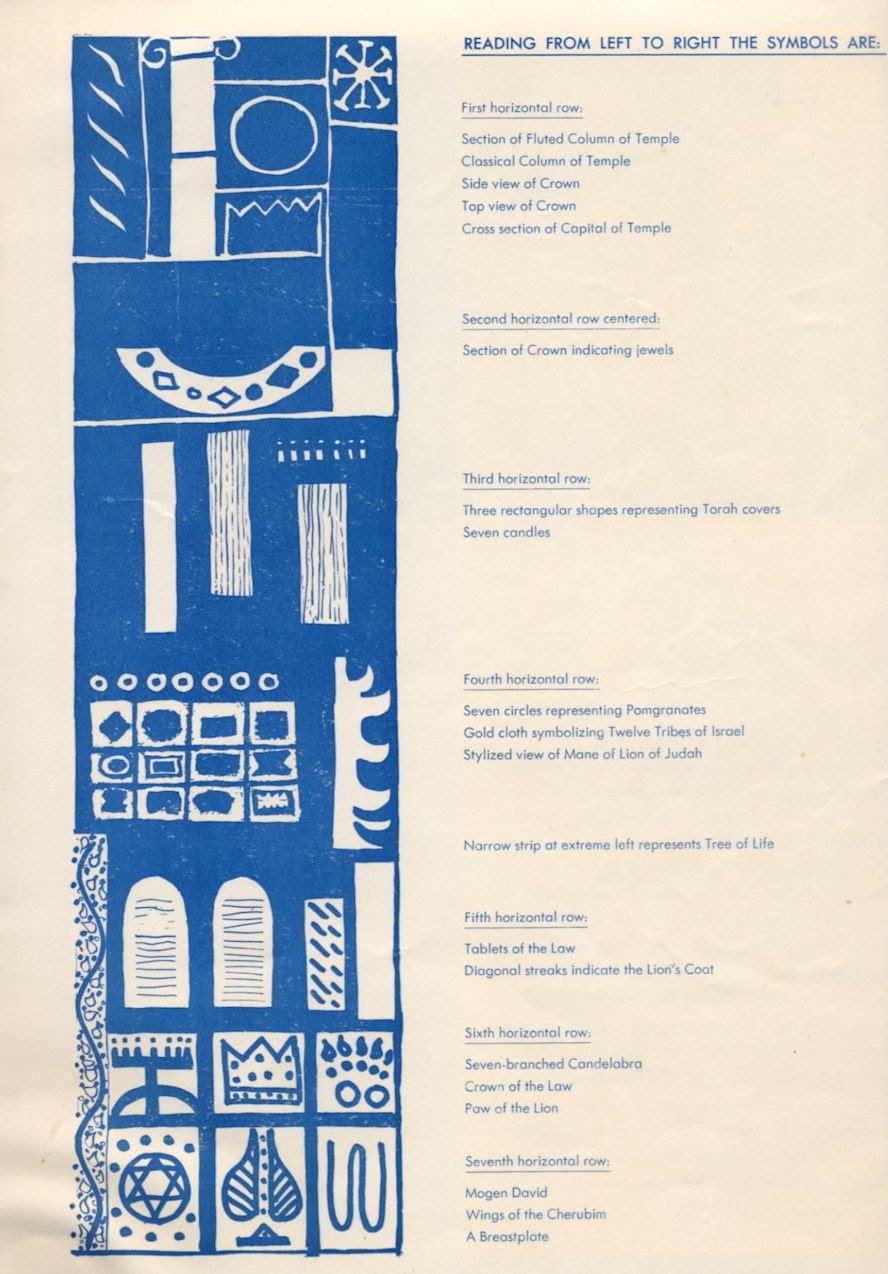
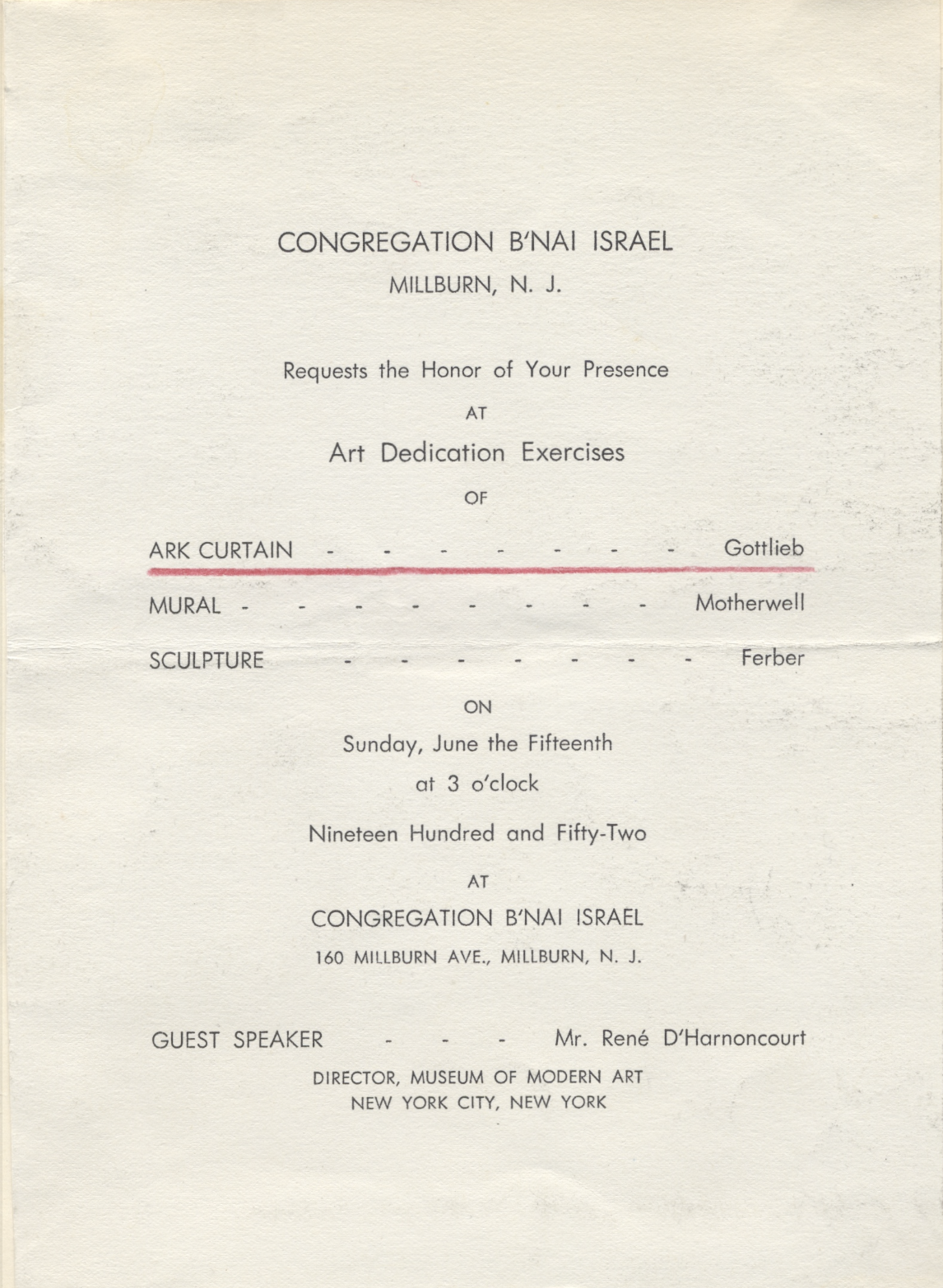
Shown: (left) A pamphlet from the Congregation B'nai Israel identifying the symbols used in Gottlieb's Ark Curtain. (right) An invitation to the dedication exercises of the three commissioned artworks, 1952.
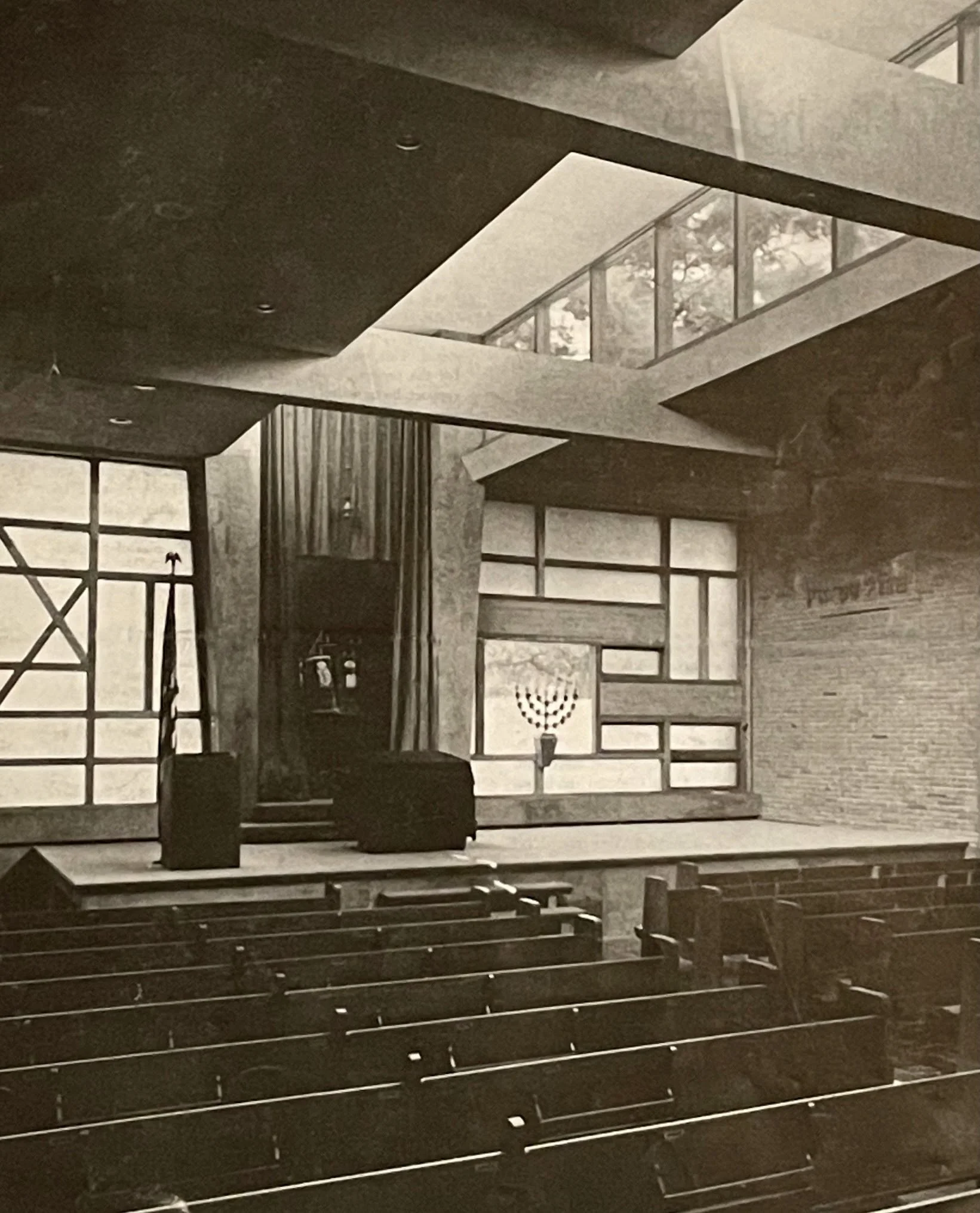
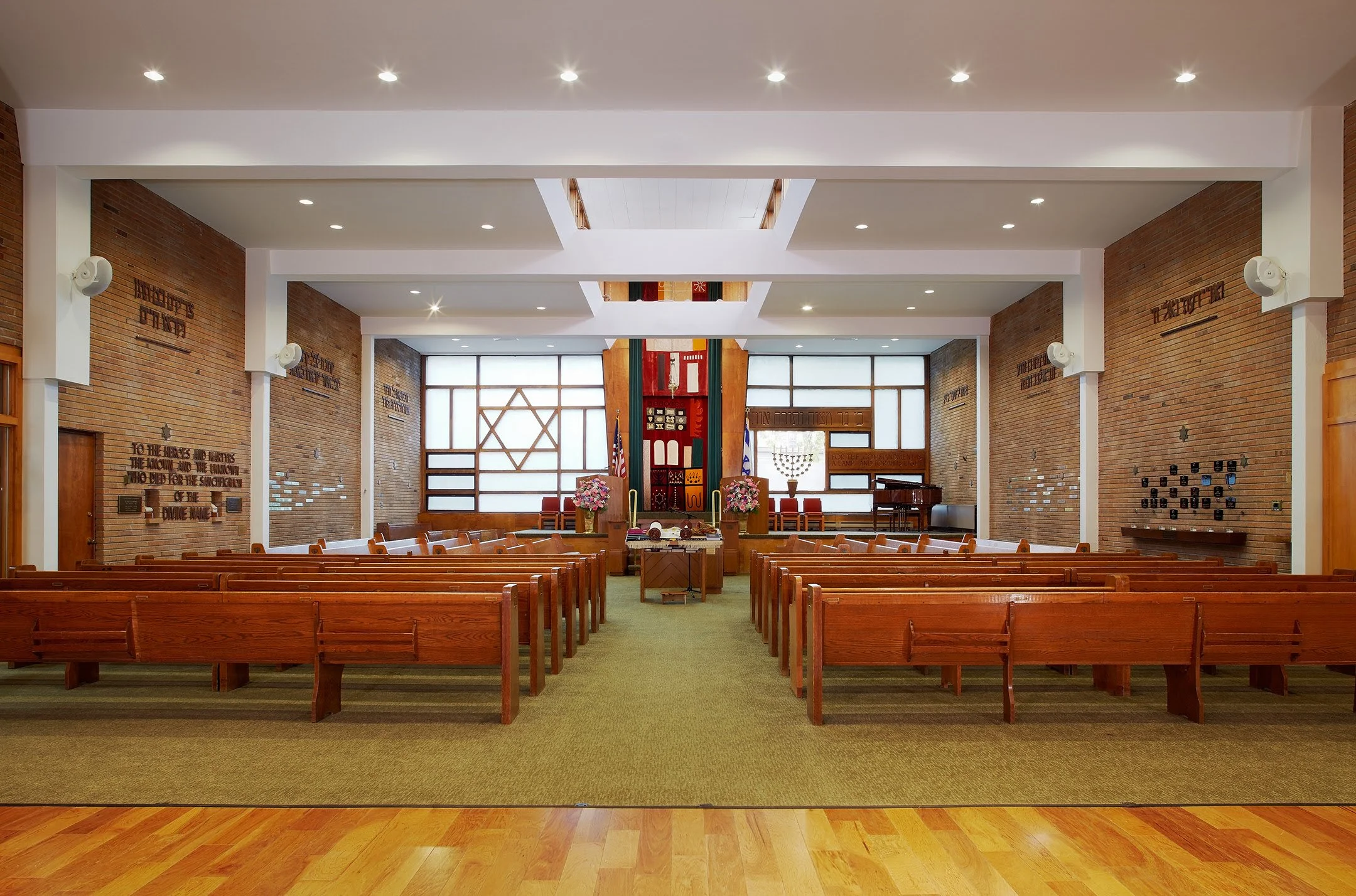
Shown: (left) Congregation B'nai Israel in Millburn, NJ, before the Ark Curtain. (right) The replica of Gottlieb's Ark Curtain at Congregation B'nai Israel in Millburn, NJ, present day. Photo courtesy Congregation B'nai Israel in Millburn, NJ.
In 1985, the Congregation B'nai Israel donated the original Ark Curtain to The Jewish Museum in New York to preserve the curtain's longevity. A replica was made for the synagogue that is still in use today.
The three commissioned works for the Congregation B'nai Israel were the subject of the 2010 exhibition Modern Art, Sacred Space: Motherwell, Ferber, and Gottlieb at the Jewish Museum. Conservation work was carried out on the Ark Curtain in preparation for the exhibition, as shown below.
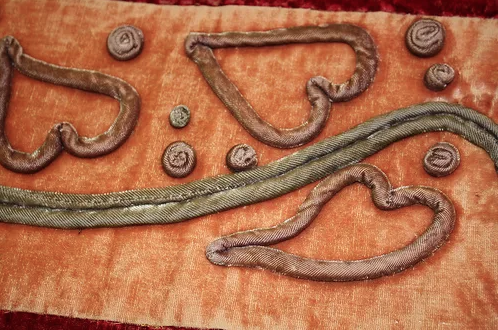
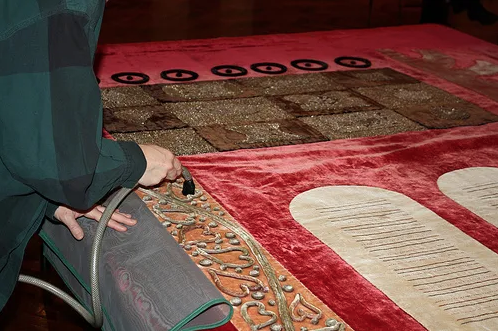
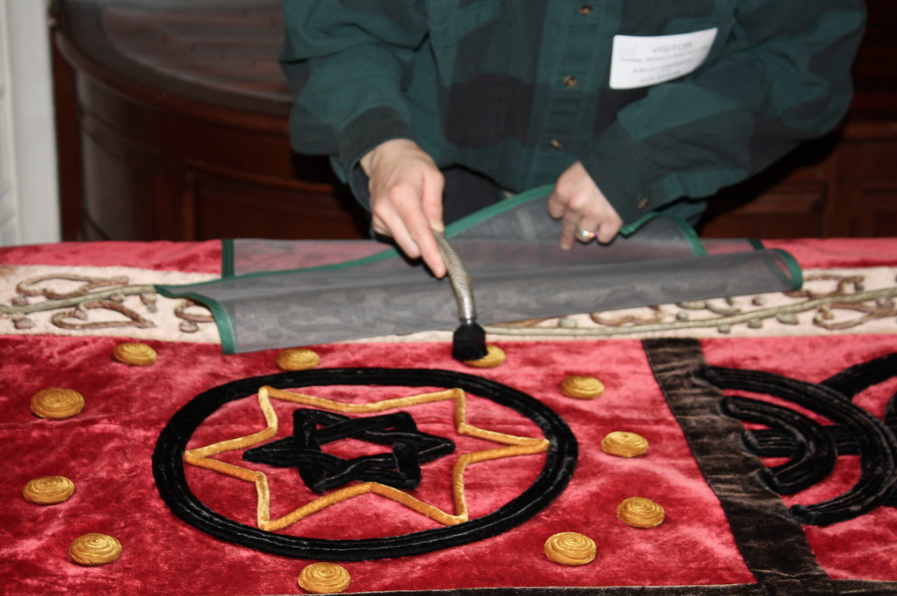
Shown: Detail images of the conservation of the Ark Curtain at The Jewish Museum, Photos courtesy The Jewish Museum, 2010.
Robert Motherwell's mural and Herbert Ferber's exterior sculpture of the Burning Bush are still on view today at the Congregation B'nai Israel in Millburn, N.J. Gottlieb's Ark Curtain is currently on view at The Jewish Museum in New York, NY in the exhibition Identity, Culture, and Community: Stories from the Collection of the Jewish Museum and Pruzan Family Center for Learning.
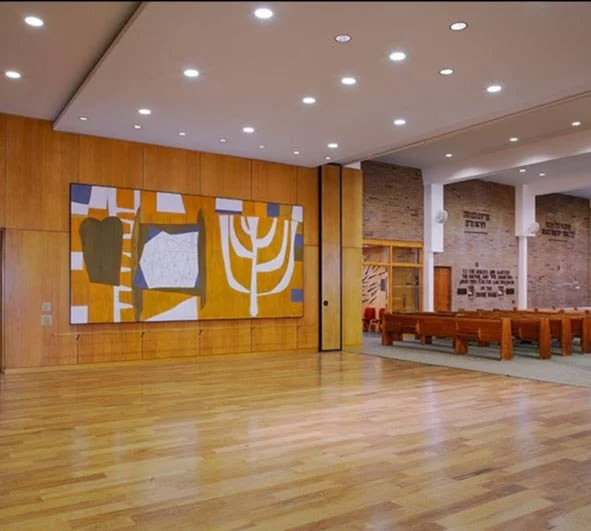
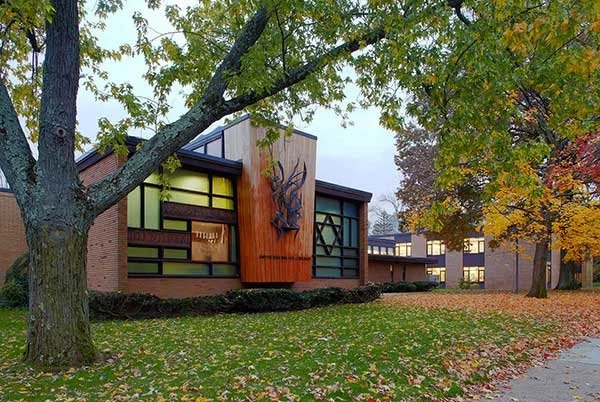
Shown: (left) Robert Motherwell's mural at Congregation B'nai Israel in Millburn, NJ, present day, Robert Motherwell, Wall of the Temple, 1951, oil on masonite, 96 x 192 in. © Dedalus Foundation, Inc. (right) Exterior of Congregation B'nai Israel in Millburn, NJ, showing Herbert Ferber's sculpture Burning Bush, present day, Artwork © The Estate of Herbert Ferber, New York. Photos courtesy Congregation B'nai Israel in Millburn, NJ.
Individual Support Grant Recipient Forum: Artist Residencies
Individual Support Grant Recipient Forum: Artist Residencies
This meeting was recorded on Tuesday, September 9, 2025
Artist residencies can be vital creative catalysts and excellent opportunities for professional development, networking, and deepening artistic practice. This session brings together five Individual Support Grant recipients to discuss residency programs in the US and internationally with the goal of providing an informal overview of their respective locations, areas of focus, duration, funding, and other helpful information. The conversation will be moderated by Mary-Kim Arnold, Chief of Staff at the Alliance of Artists Communities, an international association of artists’ communities and residencies supporting artists in the development of new work.
This event is part of a series of programs designed to nurture conversation and exchange among Gottlieb Foundation grant recipients.
Panelists:
Morgan O’Hara Venice, Italy (2011 Individual Support Grant Recipient)
Lorna Ritz Amherst, MA (2018 Individual Support Grant Recipient)
Leslie Roberts Brooklyn, NY (2024 Individual Support Grant Recipient)
Judith Simonian New York, NY (2000 and 2006 Individual Support Grant Recipient)
Hadi Tabatabai San Francisco, CA (2025 Individual Support Grant Recipient)
A Companion Guide to "Gottlieb/Rothko: The Realist Years" at 125 Newbury


Left: Mark Rothko, Self Portrait, 1936 © 1998 Kate Rothko Prizel & Christopher Rothko / Artists Rights Society (ARS), New York.
Right: Adolph Gottlieb, Untitled (Self Portrait), 1928, oil on canvas, 33 3/4 x 21 13/16" © 2025 Adolph and Esther Gottlieb Foundation / Licensed by VAGA at Artists Rights Society (ARS), NY
Gottlieb/Rothko: The Realist Years is currently on view through July 25 at 125 Newbury. The exhibition features 15 paintings and 6 works on paper by Adolph Gottlieb, along with 13 paintings and 11 works on paper by Mark Rothko from the 1920s and 1930s.
From the 125 Newbury Press Release:
"The exhibition offers an intimate look at the artists’ friendship, mutual influences, and their parallel development during the 1920s and the 1930s. Their friendship began long before their pioneering roles in Abstract Expressionism, when both artists explored figuration in strikingly parallel trajectories, strongly influenced by the achievements of the School of Paris, German expressionism, and most of all their mentorship by Milton Avery. Gottlieb/Rothko: The Realist Years provides a fresh perspective on the artists’ transition from figuration to abstraction, and is particularly relevant at a moment when most contemporary artists seem to be anchored to figuration. The Realist Years, which could have defined careers in themselves, was a period through which these two artists matriculated in their evolution to becoming key figures of post-war American painting, renowned for their emotional use of color."
Below, we have gathered photographs and documents from our archives to provide a detailed look into Gottlieb's early years working as an artist. All artwork reproduced below is currently on view in Gottlieb/Rothko: The Realist Years.

Mark Rothko, Entrance to Subway {Subway Station/ Subway Scene}, 1938 © 1998 Kate Rothko Prizel & Christopher Rothko / Artists Rights Society (ARS), New York.
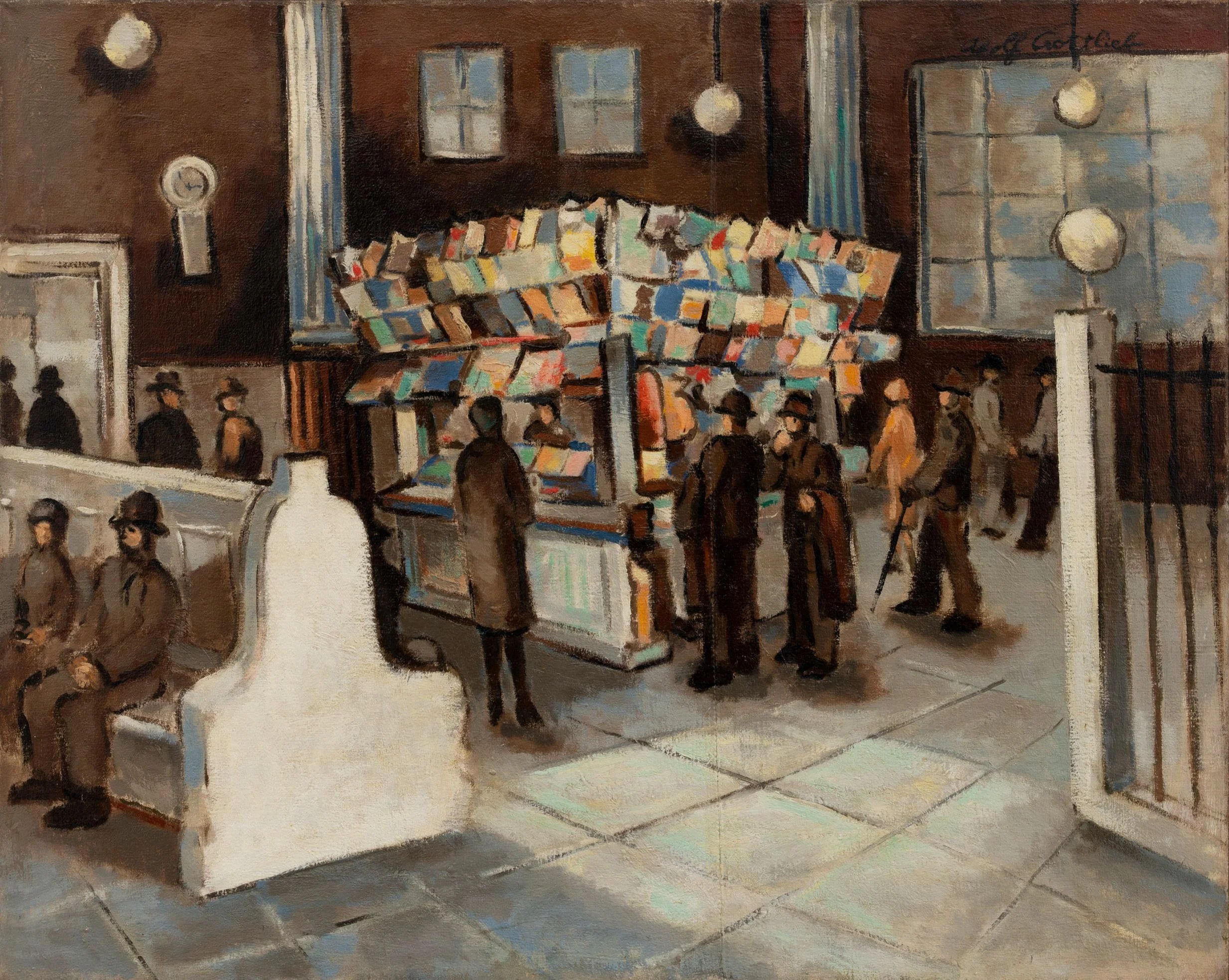
Adolph Gottlieb, South Ferry Waiting Room, c. 1929, oil on cotton, 36 x 45" © 2025 Adolph and Esther Gottlieb Foundation / Licensed by VAGA at Artists Rights Society (ARS), NY
A Timeline of Gottlieb's Early Life:
1903:
Adolf Gottlieb is born in New York City on March 14, 1903. His parents are Emil Gottlieb (1873 – 1947) and Elsie Berger Gottlieb (1881 – 1958). His given name is Adolf, possibly after his maternal grandfather. The family lives at 295 East 10th Street in Manhattan at the time of his birth. Adolph is the oldest of three children and the only male child.

Adolph Gottlieb (seated at left) with Emil, Rhoda, Elsie, and Edna Gottlieb in their New York apartment. October 1930.

An advertisement for a short story anthology featuring a quote from Adolph Gottlieb as a high school student, c. 1918.
1920:
Gottlieb leaves high school and begins to work in his father’s wholesale stationery business, Gottlieb & Sons, at 264 East 2nd Street in Manhattan. He enrolls in the Art Students’ League, where he takes evening classes under John Sloan and attends lectures by Robert Henri. He shares a studio on East Broadway with Chaim Gross, Louis Schanker, and Moses and Isaac Soyer.

Adolph Gottlieb, Untitled (Portrait of Emil), c. 1934, oil on canvas, 33 7/8 x 26". Emil Gottlieb was Adolph Gottlieb's father.
1921:
At the age of 18, Gottlieb and a friend work their passage to Europe on the Steamer Zeeland. He lives at 269 Rue Saint Jacques in Paris for 3–6 months. He attends sketch classes at the Académie de la Grande Chaumière and visits the Musée du Louvre daily.
1922:
Gottlieb travels in central Europe, visiting art galleries and museums in Berlin, Munich, Dresden, Vienna, and Prague. Elsie Gottlieb travels to Europe to reunite with family. Gottlieb meets his mother in Berlin, and they return to New York together, departing from Hamburg on August 18.

Adolph Gottlieb and his mother, Elsie, returning to New York, 1922.
1923 – 1924:
Back in New York, encouraged by his family, Gottlieb attends high school classes in the evenings while working at his father’s business. He re-enrolls in the Art Students’ League; takes classes with John Sloan and Henry Schnackenberg. Gottlieb meets fellow students Barnett Newman and John Graham, who become lifelong friends.

Barnett Newman, Adolph Gottlieb, Alex Borodulin, Otto Soglow, and unidentified friend in Central Park, c. 1925.

John Sloan class photo, 1924. Adolph Gottlieb is pictured in the rear, standing above the crowd.
1928 –1929:
Gottlieb begins showing his paintings at the Opportunity Gallery on West 56th Street in New York. He meets and begins lasting friendships with Milton Avery and Mark Rothko, who also exhibit at the gallery. Gottlieb enters and is awarded first prize, along with the artist Konrad Cramer, in the Dudensing National Competition. His prize is a solo exhibition at the prestigious Dudensing Gallery on East 57th Street in Manhattan. Adolph Gottlieb meets Esther Dick at a party in Greenwich Village.

Adolph Gottlieb at 27 years of age in his family's New York apartment, October 1930. Visible on wall: Adolph Gottlieb, Portrait, c. 1923, oil on canvas, 23 1/16 x 17 1/8"

A review of Gottlieb's first solo exhibition at Dudensing Gallery by Alexander Borodulin, May 25, 1930. Borodulin can be seen in the above photograph and in the painting Untitled (Alex with Mandolin), c. 1930.
1930:
Gottlieb rents a studio, which is occasionally shared with Barnett Newman, on East Broadway in Manhattan. His first solo exhibition opens at the Dudensing Gallery in New York on May 1. Gottlieb exhibits 18 paintings.

Adolph Gottlieb, Untitled (Alex with Mandolin), c. 1930, oil on linen, 19 7/8 x 16"

Adolph Gottlieb, Aaron Siskind, c. 1927, oil on canvas, 27 1/16 x 19 13/16"
1931 – 1932:
Gottlieb’s paintings are included in two exhibitions at the Opportunity Gallery (May and June). Adolph Gottlieb and Esther Dick are married in New York City on June 12, 1932. They spend their summer in Rockport, Massachusetts, along with Milton and Sally Avery. Adolph and Esther Gottlieb move to 14 Christopher Street in Manhattan.

Newly married Adolph and Esther Gottlieb on the roof of Adolph Gottlieb's parents' apartment building at 845 West End Ave., September 1932.

Adolph Gottlieb, Esther, 1931, oil on canvas, 19 x 24"
1933:
Gottlieb permanently changes the spelling of his first name from Adolf to Adolph in reaction to the appointment of Adolf Hitler as Chancellor of Germany. The Gottliebs summer in East Gloucester, Massachusetts, along with the Averys. They will vacation around Gloucester for three consecutive summers. The Gottliebs move to 155 State Street in Brooklyn in November. Gottlieb becomes close friends with the artist David Smith, who lives at 124 State Street. Gottlieb purchases a second-hand etching press and begins making prints in his home, a practice he will continue through 1947.

Adolph Gottlieb on the beach in Cape Ann, 1934.

Adolph and Esther Gottlieb sailing off Cape Ann, c. 1934.
1935:
Gottlieb is included in the inaugural group exhibition of Gallery Secession, New York. He is a founding member of The Ten, a group of artists dedicated to expressionist and abstract painting. The Gottliebs travel to Europe, visiting Amsterdam, Brussels, Tervuren, and Paris. In addition to museums and contemporary galleries, the Gottliebs visit galleries that display African art, some of which were recommended by John Graham. The Gottliebs spend the money they had saved for a last special meal in Paris to purchase five African sculptures they are offered. They return to New York on September 3.

Adolph Gottlieb, Seated Nude, 1934, oil on canvas, 39 9/16 x 35 1/2"

Adolph Gottlieb, Untitled (Portrait-Leopard Coat), 1934, oil on canvas, 33 5/8 x 25 9/16"
1936:
Gottlieb joins the Artists’ Union as well as the Easel Division of the WPA. He also joins the American Artists’ Congress against War and Fascism. The Gottliebs spend the summer in Three Bridges, New Jersey, and are visited by Milton and Sally Avery.

Adolph Gottlieb (left) and Milton Avery (right) in Three Bridges, NJ, Summer 1936.
1937:
Gottlieb spends part of the summer in Fire Island, New York, then visits the Averys in Bondeville, Vermont. Gottlieb resigns from the WPA in October. To improve Esther Gottlieb’s health, the Gottliebs leave New York City on October 27 and drive to Tucson, Arizona, where they live and work for the next eight months.
To continue reading Gottlieb’s chronology, click here!
2025 Individual Support Grant Recipients Announced
May 16, 2025
For Immediate Release
The Adolph and Esther Gottlieb Foundation
Individual Support Grant Recipients, Spring 2025
The Adolph and Esther Gottlieb Foundation in New York City announces the selection of twenty artists to receive its 48th annual Individual Support Grants. A panel of five independent jurors reviewed applications submitted to the Foundation by 865 artists from 58 countries. Each of the following visual artists was chosen to receive an award of $25,000:
Elise Adibi
Pittsburgh, PA
J Stoner Blackwell
Bennington, VT
Buddy Bunting
Seattle, WA
Edgar Cano
Natchitoches, LA
Michelle Charles
London, United Kingdom
Lynn Fulton
Southwell, United Kingdom
Carrie Gundersdorf
Brooklyn, NY
Sharon Hall
London, United Kingdom
Annie Hayes
Delhi, NY
Frederick Hayes
Brooklyn, NY
Kaoru Hirano
Hiroshima, Japan
Bryan Ida
Los Angeles, CA
Jason Karolak
Brooklyn, NY
Lauris Mīlbrets
Riga, Latvia
Johannes Rave
Stuttgart, Germany
Jayanta Roy
Kolkata, India
Sanjay Singh
Bangalore, India
Hadi Tabatabai
San Francisco, CA
Michelle Weinberg
New York, NY
Uroš Weinberger
Ljubljana, Slovenia
The Adolph and Esther Gottlieb Individual Support program was established in 1976 to encourage and recognize mature painters, sculptors, and printmakers who have dedicated their lives to developing their art regardless of their level of commercial success.
The Foundation also administers the Adolph and Esther Gottlieb Emergency Grant program, which offers assistance to mature visual artists who have suffered a current or recent catastrophic event. More information about the Foundation and its programs can be found here. Links to an application form for each program may likewise be found on the website.
For additional information, contact Petra Pankow, Grants Manager, at (212) 226-0581 or ppankow@gottliebfoundation.org.
"Adolph Gottlieb: A Powerful Will to Art"

Printing the monograph at Trifolio, Verona, Italy, September 2024, Photo by Anna Tonolli.
The first monograph on Adolph Gottlieb was released on December 17, 2024. Adolph Gottlieb: A Powerful Will to Art is published by Gregory R. Miller & Co. in collaboration with the Adolph and Esther Gottlieb Foundation. Please enjoy this behind-the-scenes look at the production of the monograph and join us on December 12th for a book launch and conversation with Harry Cooper and James Lawrence hosted by Pace Live.
Adolph Gottlieb: A Powerful Will to Art is available for purchase at Pace Gallery.
For additional information on the monograph visit Gregory R. Miller & Co.

Front cover of the publication Adolph Gottlieb: A Powerful Will to Art.

Back cover of the publication Adolph Gottlieb: A Powerful Will to Art
Pace Live will present a celebratory book launch of Adolph Gottlieb: A Powerful Will to Art
Featuring a conversation between
Harry Cooper, Bunny Mellon Curator of Modern Art at the National Gallery of Art
James Lawrence, Critic and Historian of Modern and Contemporary Art
Thursday, December 12
6:30 – 8:00 PM
Doors Open at 6:00 PM
Pace Gallery
540 W 25th St,
7th Floor
New York, NY 10001

Color proofing plates in the monograph with Sanford Hirsch and Julia Ma of Miko McGinty Design at Trifolio, Verona, Italy, September 2024, Photo by Anna Tonolli.

Color proofing plates in the monograph with Sanford Hirsch and Julia Ma of Miko McGinty Design at Trifolio, Verona, Italy, September 2024, Photo by Anna Tonolli.
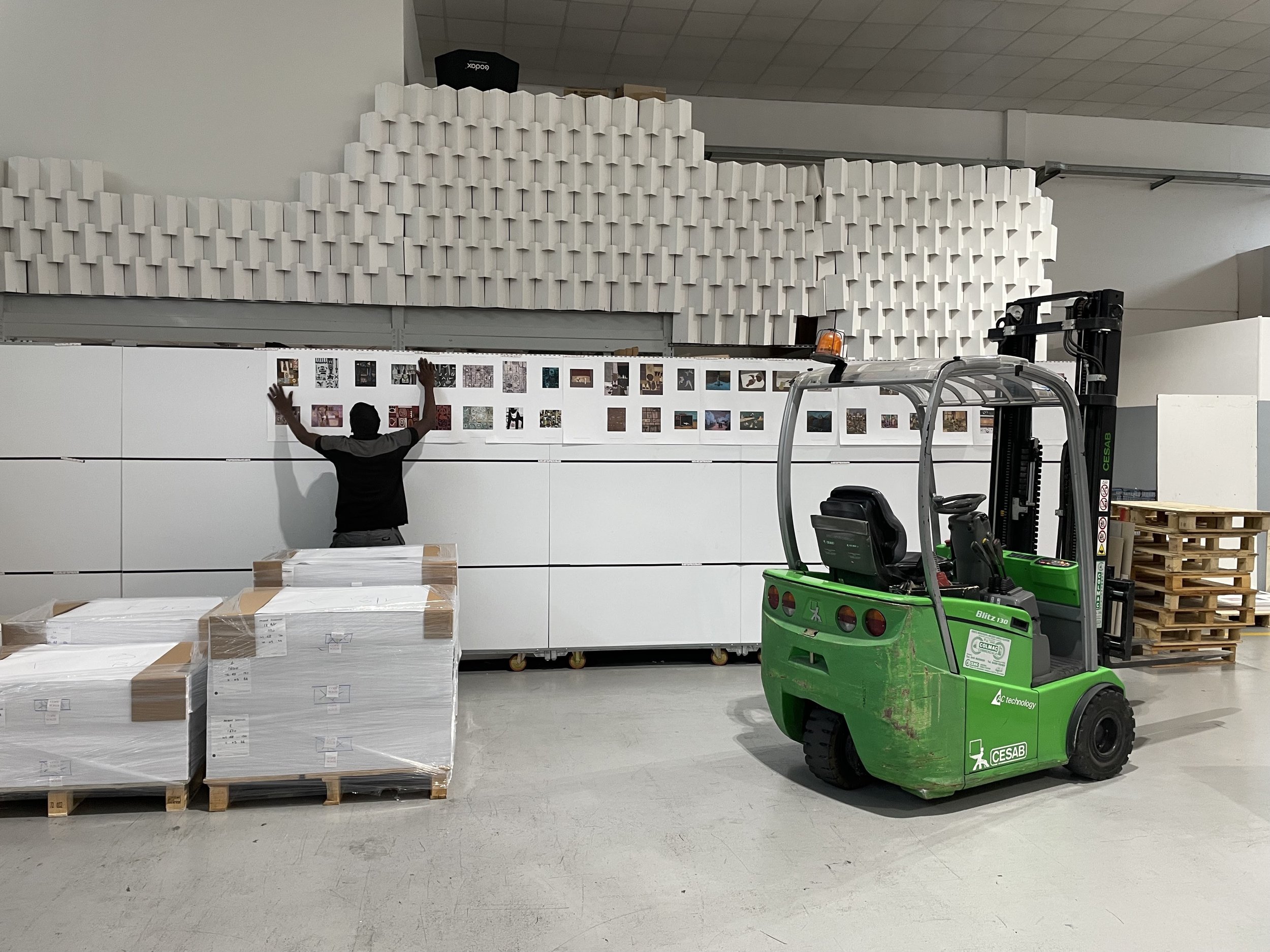
Pages of the monograph seen at Trifolio on the first day of printing, September 2024.

Pages of the monograph seen at Trifolio on the final day of printing, September 2024.

Printing pages of the monograph at Trifolio, September 2024.

The monograph cover printed at Trifolio, September 2024.
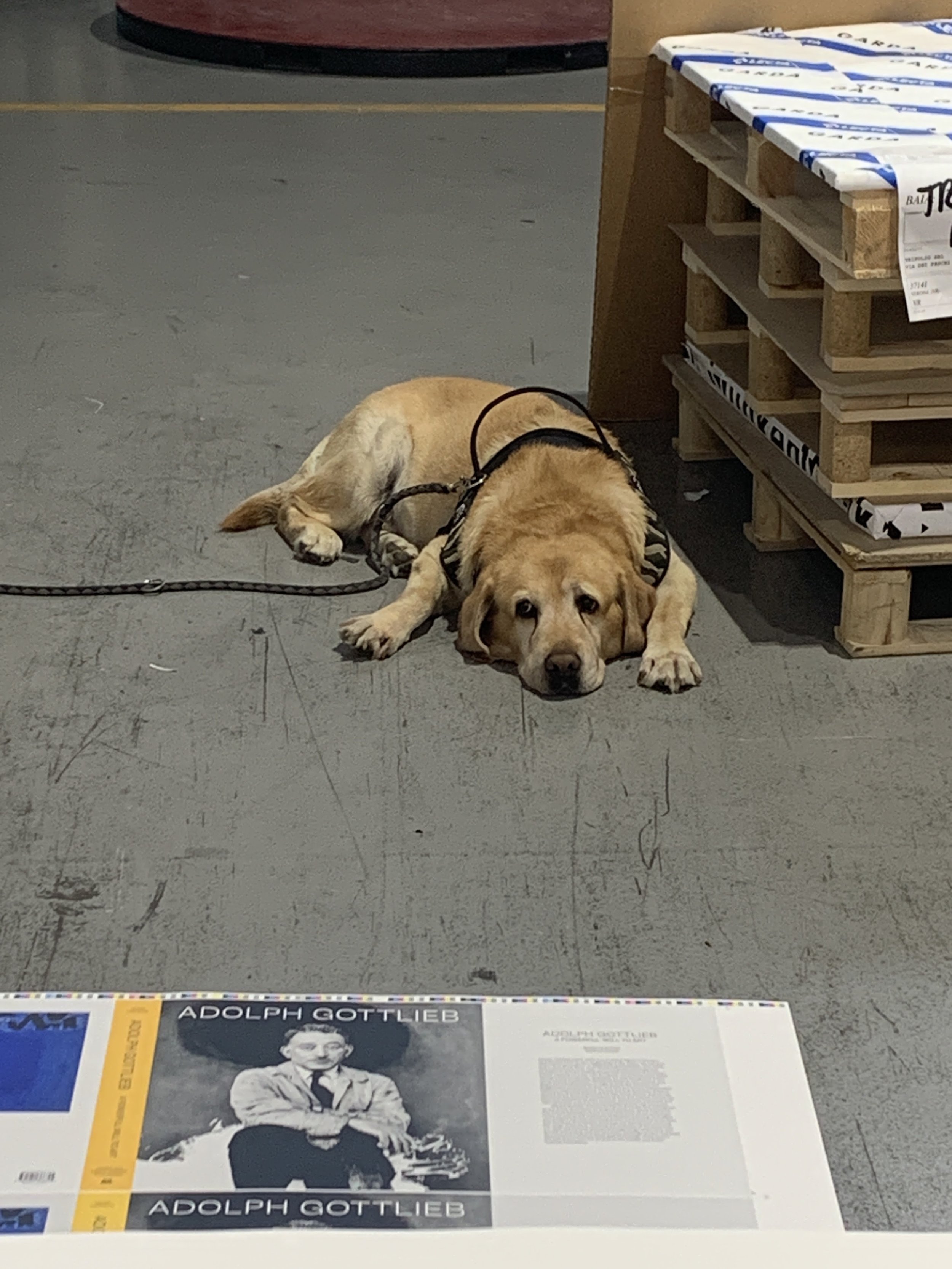
The monograph cover printed at Trifolio with Ciaky the dog, September 2024.

Team members from Trifolio Press, Miko McGinty Design, and the Adolph and Esther Gottlieb Foundation on the final day of printing at Trifolio, Verona, Italy, September 2024.
Front row (left to right): Massimo Tonolli, Claudio Lovato, Anna Tonolli
Back row (left to right): Damiano Manara, Nicola Oliboni, Oumar Dia, Federico Cristanelli, Sanford Hirsch, Silvia Zanetti, Julia Ma, Michela Zanetti, Alessandro Tosi, Luca Velsanti
In Memory of Nancy Litwin
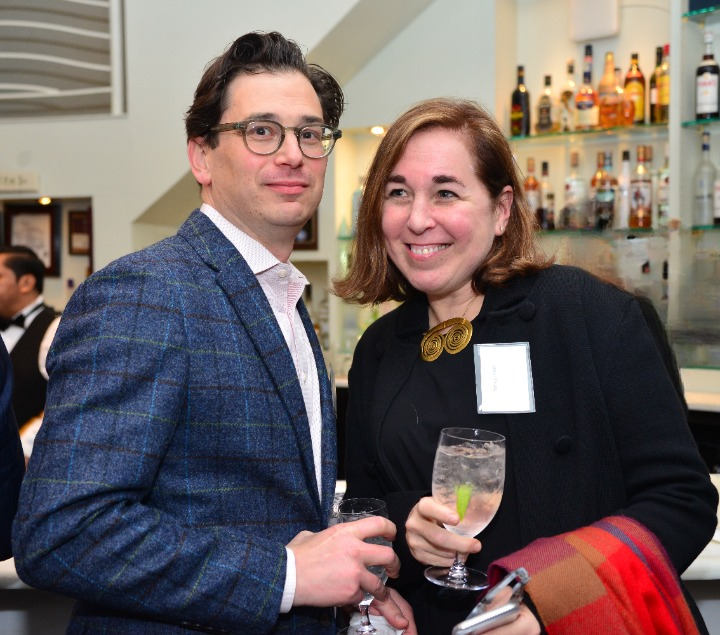
Doug Flamm and Nancy Litwin, October 2019.
On December 1, we lost our friend and colleague Nancy Litwin. Our sincere condolences go out to her husband, Doug Flamm, and their children, Abbey and Charlie Flamm, as well as to her sisters and extended family and friends. Nancy was a significant and much-loved presence in the lives of all who knew and worked with her. She is missed and will be remembered fondly by us all.
Nancy joined the Gottlieb Foundation in 1998 as its Art Collections Manager. In that capacity, she reorganized the inventory system that was in place, and over the years, she managed the development of two subsequent digital databases to keep track of Adolph Gottlieb’s art. Nancy also advanced research into the artist’s career and was a crucial partner in organizing research leading toward a catalogue raisonné. She acted as registrar for the Foundation’s collection and communicated with art museums, galleries, auction houses, and individuals around the world. Her primary project was the reorganization, extension, and maintenance of the archives of the Gottlieb Foundation. Nancy made certain that each person with an interest in the artist had the most complete and accurate information. Her contributions to the Gottlieb Foundation and to Adolph Gottlieb’s legacy over the 25 years she was with us will be a fundamental resource for scholars and art historians for years to come.
Beyond her contributions to the Foundation, Nancy was a valued and cherished member of our small team. We are diminished by her absence and sad at her loss that came too suddenly and too soon. We wish her family and friends peace and comfort in accepting her passing, and we know that her warm and indomitable spirit will be what we recall and value most as we go on.
From the Archives: Five Questions with Adolph Gottlieb for the Christian Science Monitor, 1972
In 1972, to mark the opening of Abstract Painting in the 70s (April 14 – May 12, 1972) at the Museum of Fine Arts, Boston, Adolph Gottlieb was asked to respond to five questions by Susan Drysdale, writer for the Christian Science Monitor. His responses were published in an article in The Christian Science Monitor along with the responses of other artists included in the exhibition such as Richard Diebenkorn, Robert Motherwell, and Helen Frankenthaler. Four works by Gottlieb were included in the exhibition.
Gottlieb's responses are printed below in full and supplemented with material from the Foundation's archives.
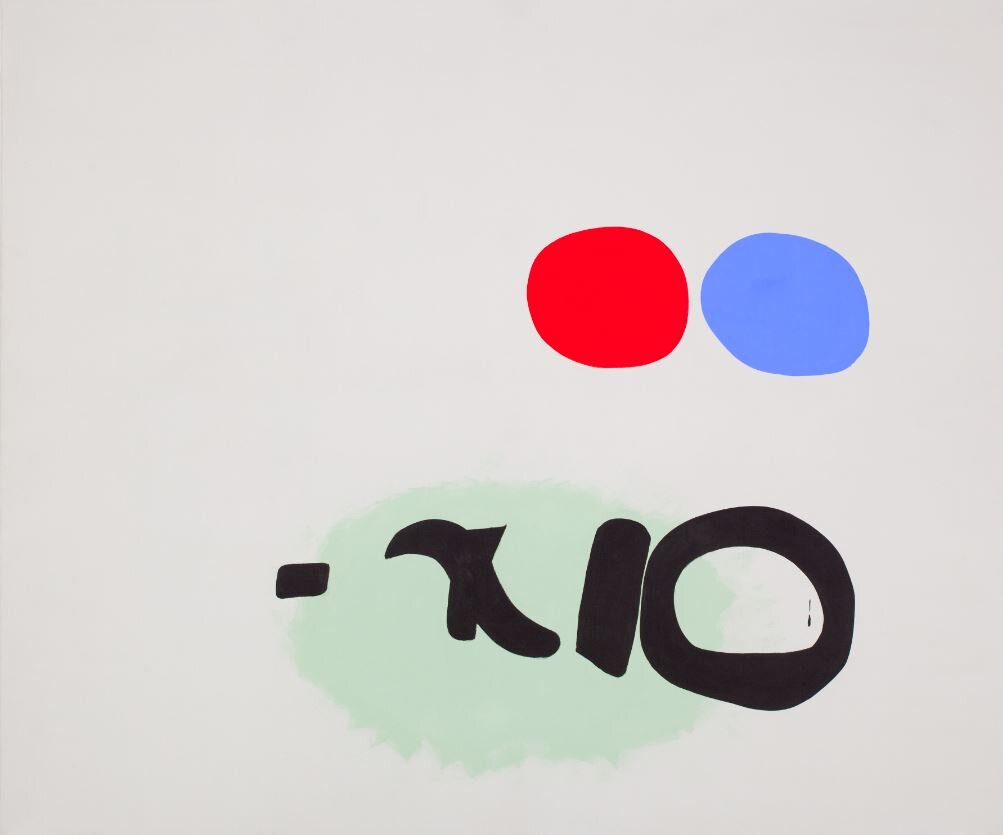
One of the four paintings exhibited in Abstract Painting in the 70s at the Museum of Fine Arts Boston, Adolph Gottlieb, Red vs. Blue, 1972, acrylic on canvas, 90 x 108"
Susan Drysdale: What have you found to be the greatest single problem facing you as an artist, and has this changed over the years?
Adolph Gottlieb: The greatest single problem I have facing me as an artist is the gap between the artist and the public, and I have found this has not changed through the years.
SD: Do you start with a preconceived idea of what you want to paint or what is your starting point?
AG: I generally have a clear idea of what I want to paint, otherwise I would be working in a state of confusion.

Adolph Gottlieb at 22nd Street studio, New York City, c. 1965. Photographer: Robert Estrin
SD: May I have some idea of your working methods – such as – if your work does not develop as you expect do you start again or work with it until something emerges, perhaps in a totally different form; do you paint directly onto the canvas, or sketch it out first or make preliminary drawings or what? Do you generally lay on the paint – with a brush, sponge, spray gun, etc; do you find it difficult to decide when a painting is finished, and when it is do you wish it out of sight, or are you reluctant to part with it?
AG: When I start working the painting must be good immediately, otherwise I discard the canvas and start another one. I have often worked over the same painting for long periods, but I am always seeking the “alla prima” that spontaneous effect that looks as if I get what I sought immediately. I detest paintings, that look labored and I do not want to burden the spectator with my struggle.

One of the four paintings exhibited in Abstract Painting in the 70s at the Museum of Fine Arts Boston, Adolph Gottlieb, Lake, 1971, acrylic on canvas, 90 x 108"
SD: If you were to name any three or four painters or people both contemporary and earlier whom you know to have had an effect on your work and viewpoint who would you pick?
AG: Concerning my influences: of early painters, Cimabue has had the greatest effect on me. Of contemporary painters, I cannot be so specific because if I see anything at all useful around me, I see no reason not to take it. I do not like to be tagged as being influenced by Mr. “X” or Mr. “Y” whom I consider my peers. I think I like doing best what I feel is uniquely my own. I shall say that in my early days, the painter whom I admired the most and who, in certain respects, influenced me was Cézanne. I have been influenced also by James Joyce, Dostoyevsky, and Sigmund Freud, as well as Hemingway and Faulkner. This may seem far-fetched, but it merely indicates that almost everything in our environment influences us, even phenomena such as the Grand Canyon.

Cimabue, The Virgin and Child in Majesty Surrounded by Six Angels, c. 1275, Collection of Musée du Louvre © 1997 RMN-Grand Palais (Musée du Louvre) / Hervé Lewandowski

Adolph Gottlieb, Pictograph, 1942, oil on canvas, 48 x 36“

Paul Cézanne, Madame Cézanne (Hortense Fiquet), 1891. Oil on canvas; 36 ¼ x 28 ¾”, The Metropolitan Museum of Art, Bequest of Stephen C. Clark, 1960 (61.101.2)

Adolph Gottlieb, Esther, 1931, oil on canvas, 19 x 24"
SD: Many people, even today, find it hard to understand that thought and emotion can be expressed in the abstract. Would you be kind enough to give me the titles of say three or four paintings in collections and in the Boston show that demonstrate their use as a vehicle for a particular emotion, and what in your opinion is the feeling that comes over strongest – tragic, joyful, contemplative, etc.?
AG: It is difficult for me to pinpoint the specific emotions I try to convey in my paintings. The closest I can come is to say the paintings deal with disparate images, and I am involved with tension which is set up in such polarities so that my work can be involved with both love and hate at the same time. Admittedly, this creates difficulties for people who must see things as either black or white. I do not think it is my responsibility to define the range in between, for this is a complex problem involving subtleties of feelings.

Adolph Gottlieb in his 23rd Street Studio, 1960. Photographer: Guy Weill.
From the Library of Adolph Gottlieb:
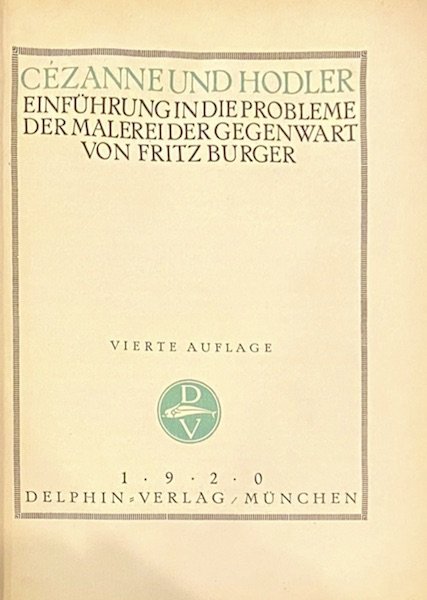
Title page of a book from Adolph Gottlieb's personal library: Burger, Fritz. Cezanne und Hodler: Eifuehrung in Die Probleme Der Malerei Gegenwart, Munich: Delphia Verlag, 1920.

A sketch made by the artist on the inside cover, c. 1922.

Title page of a book from Adolph Gottlieb's personal library. Joyce, James. A Portrait of the Artist as a Young Man, New York: B. W. Huebsch, 1917.

Title page of a book from Adolph Gottlieb's personal library. Freud, Sigmund. A General Introduction to Psychoanalysis, Garden City: Garden City Publishing Company, Inc., 1943.
Archival Material:

Letter from Susan Drysdale to Adolph Gottlieb including questions for the artist to answer for an article in The Christian Science Monitor, March 31, 1972.


Gottlieb's responses to Drysdale's questions, April 10, 1972.

Drysdale, Susan. "Abstract ‘Artmaking’ in the ‘70s", Christian Science Monitor, April 24, 1972
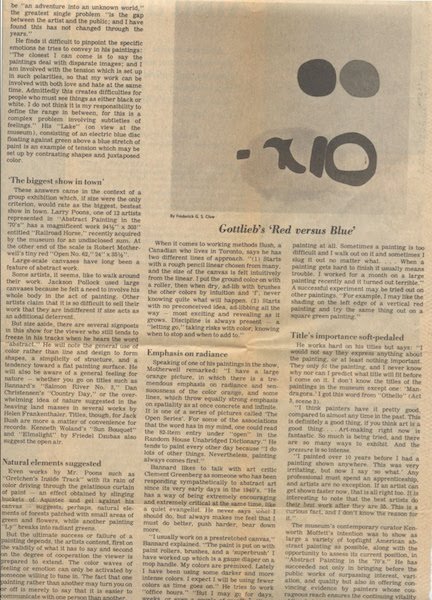

Installation image of Abstract Painting in the 70s (April 14 – May 12, 1972) at the Museum of Fine Arts, Boston. Adolph Gottlieb's Curtain (1971) is pictured to the right of the door frame.
A Photo Essay: Adolph Gottlieb Portraits by Aaron Siskind

Adolph Gottlieb, Aaron Siskind, c. 1927, oil on canvas, 27 1/16 x 19 13/16"
In 1942, Adolph Gottlieb was photographed at his home in Brooklyn by his friend and photographer Aaron Siskind. In the 1920s, after Gottlieb returned to New York from his time in Europe, the two first met as members of a literary society. Siskind was then a student at City College studying social science and his friendship with Gottlieb fueled his interest in contemporary art.
Below, we have collected the 1942 photographs of Gottlieb by Aaron Siskind and other supplementary material from our archive.

Adolph Gottlieb in his home/studio in Brooklyn with pieces from his African art collection, 1942, © Aaron Siskind Foundation.
"It was in the early ‘20s. And Aaron, together with a group of my friends, were all going to City College at the time. Most of them belonged to a literary society at City College called Clyonia. All of them had literary interests. I had some literary interests, but only as a side issue because I already considered myself at that time a painter. Well, I didn’t go to City College. I had, at that point, come back from a year and a half, a year where I had been studying painting. So that was these literary men, so-called, I guess. I was the one who knew about painting—I more or less introduced them to Contemporary Painting. A number of us used to go quite regularly to the museums and the galleries. We used to haunt them, the museums."
–Adolph Gottlieb in a March 1971 interview with Carl Chiarenza
"I had spent a year in Arizona, in ’37. When I came back I recall that Aaron made some photographs of me. And then I made a deal with him that he would photograph all my new paintings and I would give him a painting, which we did."
–Adolph Gottlieb in a March 1971 interview with Carl Chiarenza
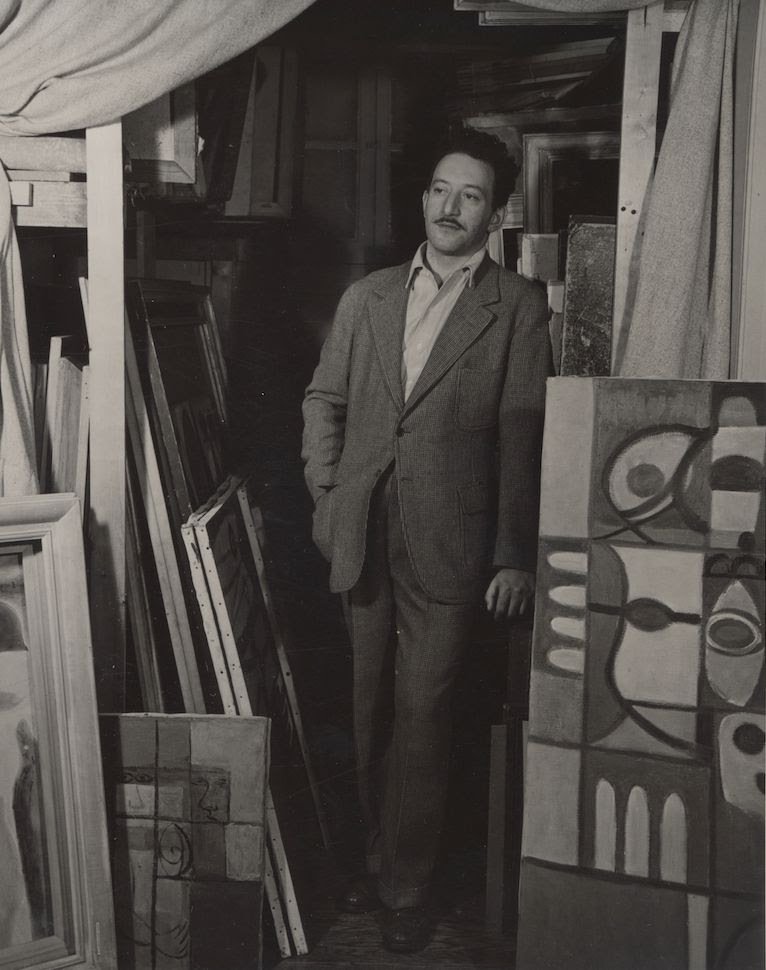
Adolph Gottlieb in his home/studio in Brooklyn with paintings including Reflection (1941) and Pictograph (1942), 1942, © Aaron Siskind Foundation.

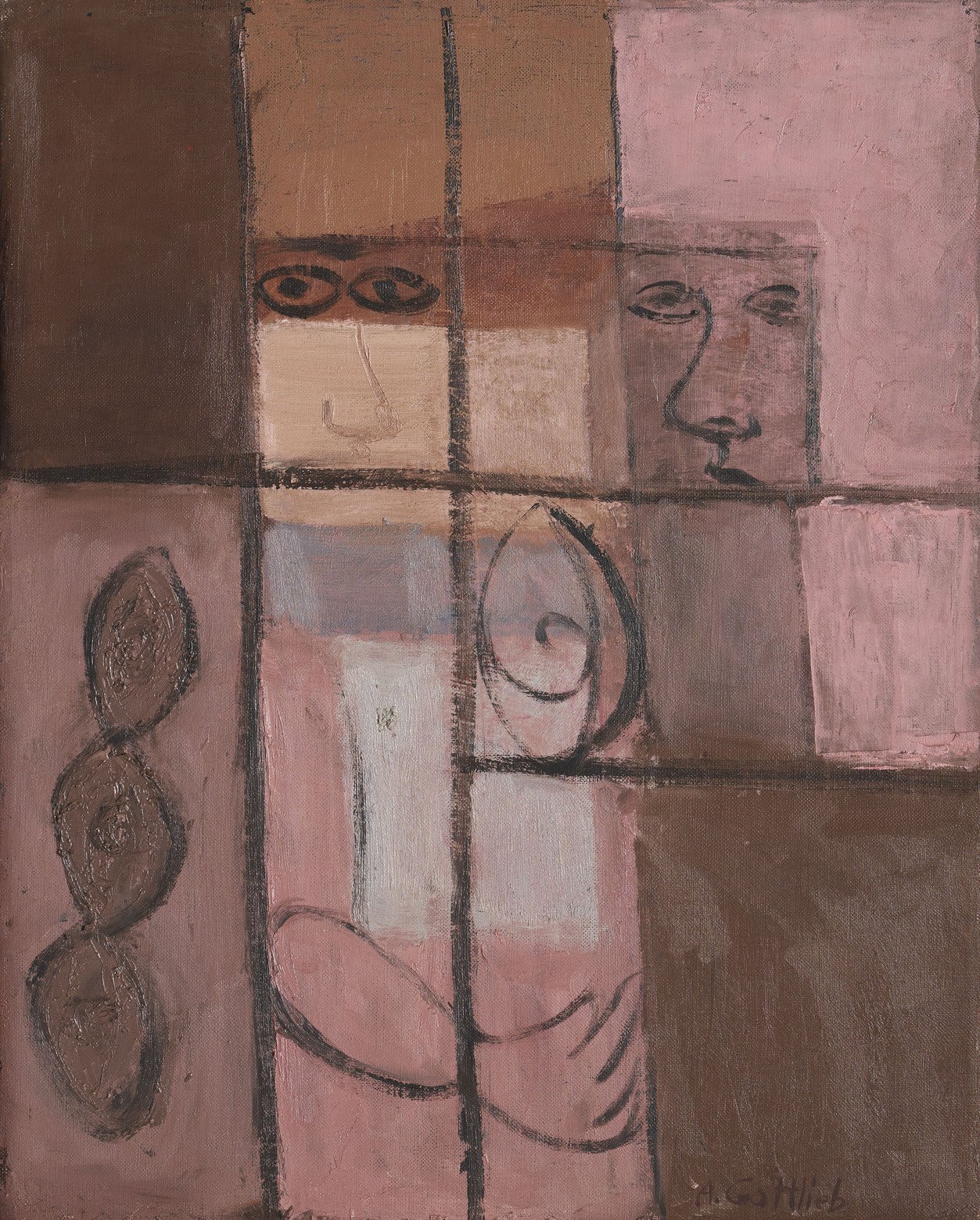
Adolph Gottlieb, Reflection, 1941, oil on linen, 20 x 16 1/16"

Adolph Gottlieb, Pictograph, 1942, oil on canvas, 48 x 36"
"I was rather surprised when I discovered that Aaron was very seriously taking photographs. And the first ones I recall seeing were in the early ‘40s up in Gloucester when he was taking photographs of a wooden fence, and showing the cracks, minute detail. They looked very much like Abstract Expressionist paintings. It struck me. They had this painterly character."
–Adolph Gottlieb in a March 1971 interview with Carl Chiarenza

Adolph Gottlieb in his home/studio in Brooklyn in front of Pictograph - Symbol (1942), 1942, © Aaron Siskind Foundation

Adolph Gottlieb, Pictograph - Symbol, 1942, oil on canvas, 54 x 40", Collection of the Art Institute of Chicago.
Siskind frequently visited Gottlieb during his many summers spent in Gloucester, Massachusettes and they remained close friends until Siskind moved to Chicago in 1951.
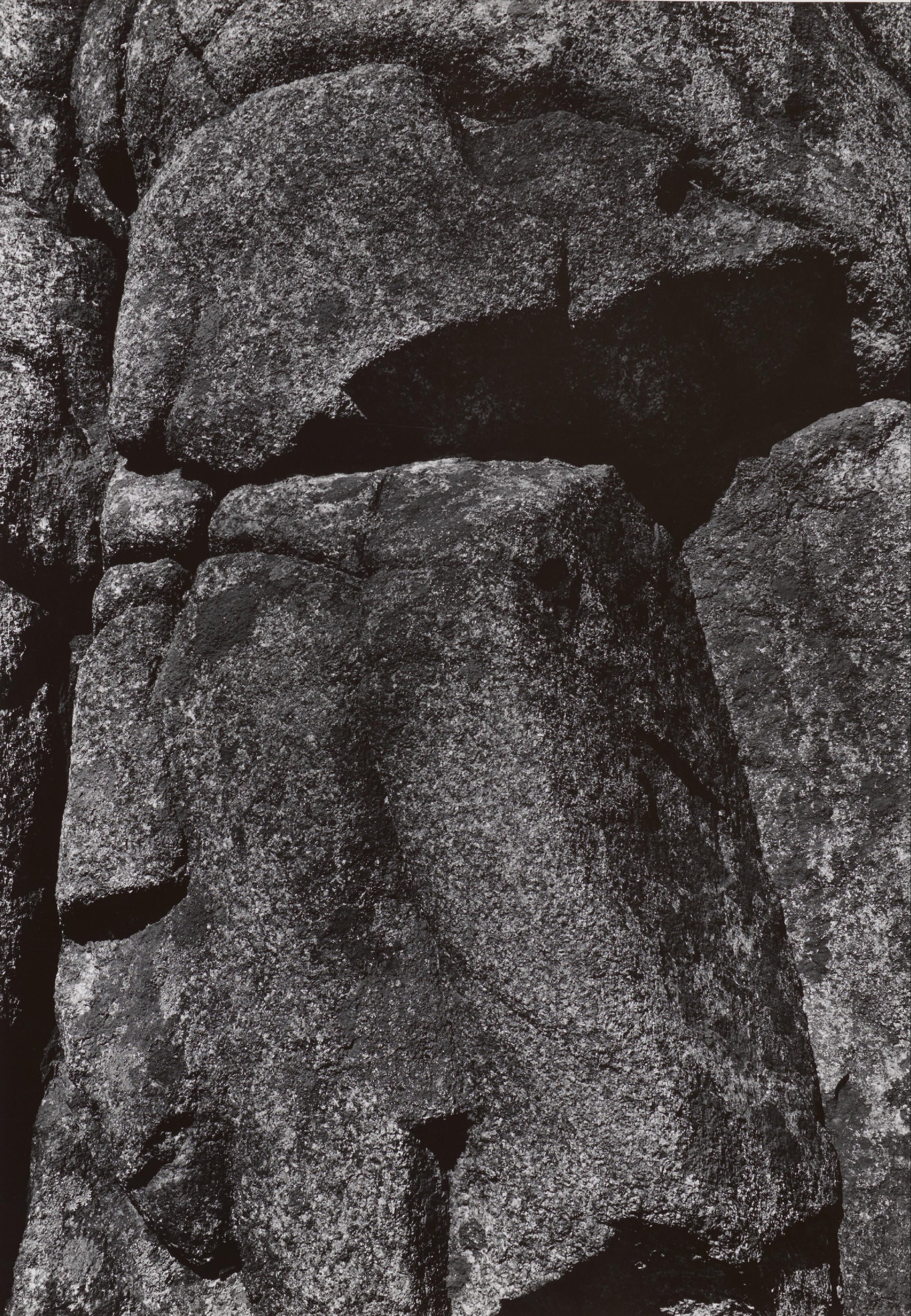
Aaron Siskind, Gloucester Rocks 3, 1944, Gelatin silver print, © Aaron Siskind Foundation, Philadelphia Museum of Art.
From the Archive: Adolph Gottlieb and Milton Avery
"Avery's last works were as fresh as though he were a young painter and of course, they also had the authority of an old master. Avery is one of the few great painters of our time."
–Adolph Gottlieb
"At first Adolph painted moody landscapes; then he went on to bolder, simpler statements, his color becoming clearer and more melodious... for me, this has been exciting to watch."
–Milton Avery
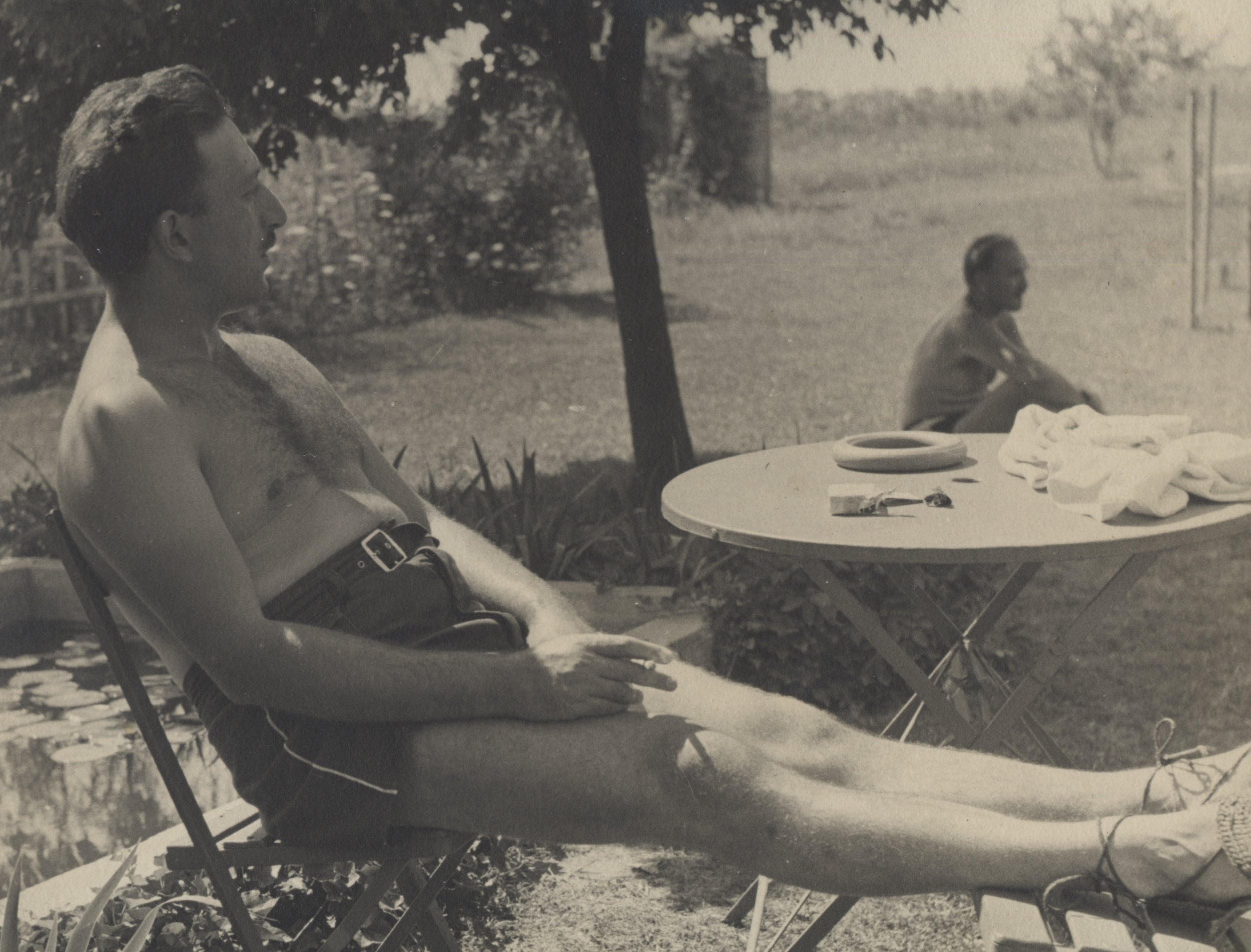
Shown: Adolph Gottlieb (left) and Milton Avery (right) in Three Bridges, NJ, Summer 1936.
Adolph Gottlieb first met Milton Avery (1885–1965) in 1929 while showing at Opportunity Gallery on 56th Street in New York City, and the two became close and supportive friends. During the 1930s Adolph Gottlieb and Mark Rothko would frequent Milton and Sally Avery's Upper West Side studio. They would also spend occasional summers together in Three Bridges, NJ, Gloucester, MA, and southern Vermont. As Gottlieb stated, "...in the early '30s, I began to be influenced by Milton Avery. In 1932 I got married and we went up to Rockport for the summer. The Averys were there and we used to see an awful lot of them. He was a good 10 years older than I and at that point, the difference meant quite a bit...while he was painting a lot of portraits of his wife, I painted my wife. We'd paint scenes of Gloucester Harbor. I got into the habit of working the way he did but that was sort of natural for me because I had always worked from sketches. We'd go out and make sketches of Gloucester Harbor or people on the beach up in Gloucester and then go home and paint them."
Gottlieb and Avery's life-long friendship and mutual support for each other's work are documented below through interviews, correspondence, and artwork.
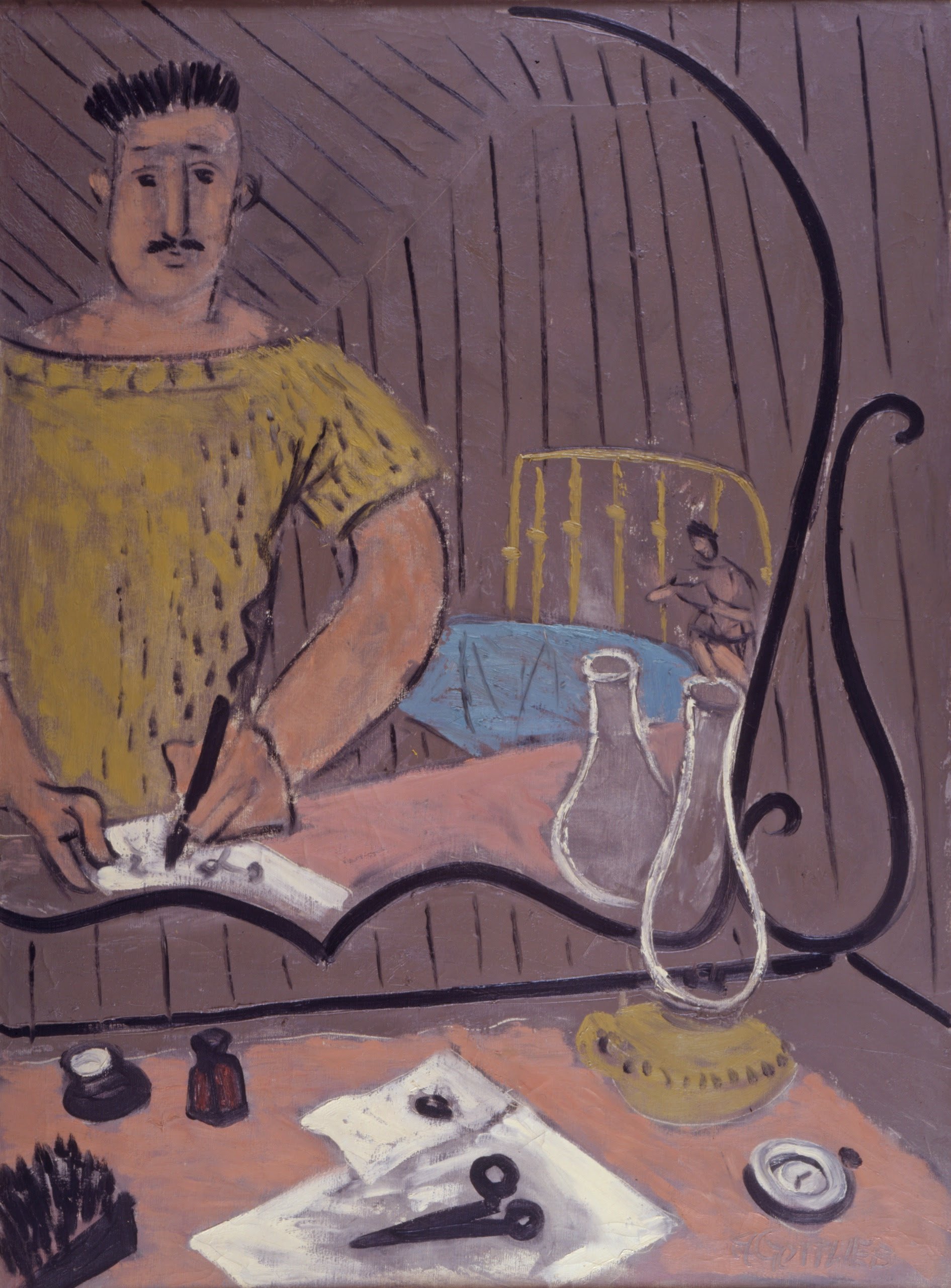
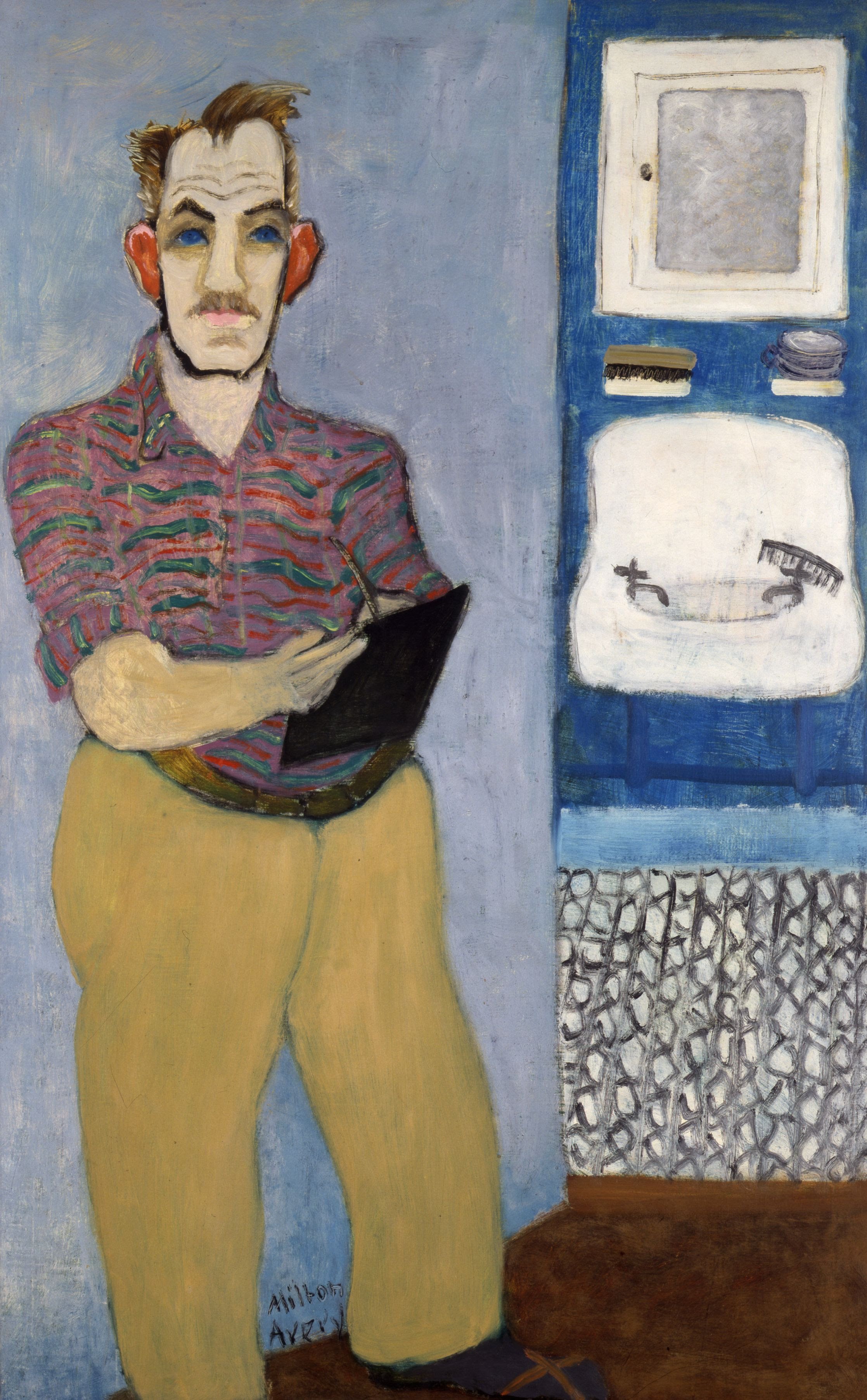
Shown: (left) Adolph Gottlieb, Untitled (Self Portrait in Mirror), c. 1938, oil on canvas, 39 7/8 x 29 5/8" (right) Milton Avery, Self Portrait, 1941, oil on canvas, 54 x 34", Neuberger Museum of Art, Purchase College, State University of New York, Milton Avery Trust.
“I have always thought he [Avery] was a great artist. When Social Realism and the American Scene were considered the important thing, he took an aesthetic stand opposed to regional subject matter. I shared his point of view; and since he was ten years my senior and an artist I respected, his attitude helped reinforce me in my chosen direction. I always regarded him as a brilliant colorist and draftsman, a solitary figure working against the stream.”
– Adolph Gottlieb quoted in The New York Post after Avery's death by Charlotte Willard, ''In the Art Galleries'', January 10, 1965
CORRESPONDENCE
Both Gottlieb and Avery celebrated each other's successes throughout their careers. Below you will find select correspondence and statements from both artists concerning several important life events. Their friendship lasted until Avery's death in 1965.

Shown: A letter from Milton Avery to Gottlieb in 1962 after Gottlieb suffered a heart attack, December 1962.

A letter from Milton Avery to Director Martin Friedman about Gottlieb's exhibition at The Walker Art Center, January 28, 1963.

A letter from Milton and Sally Avery to Adolph and Esther Gottlieb congratulating them on Gottlieb's exhibition at The Walker Art Center, May 24, 1963.

A letter from Adolph Gottlieb to Adelyn Breeskin of the Baltimore Museum of Art including a statement on Avery's work to include in a publication, September 25, 1959

Adolph Gottlieb's statement on Avery sent to Jack Fader of Gallery Reese Palley to include in the forward for the catalogue for their Milton Avery retrospective, May 29, 1968.
ARTISTIC INFLUENCE
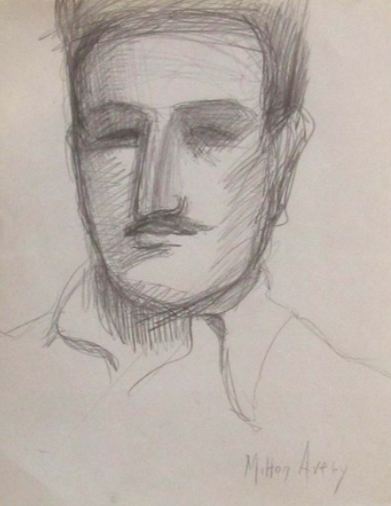
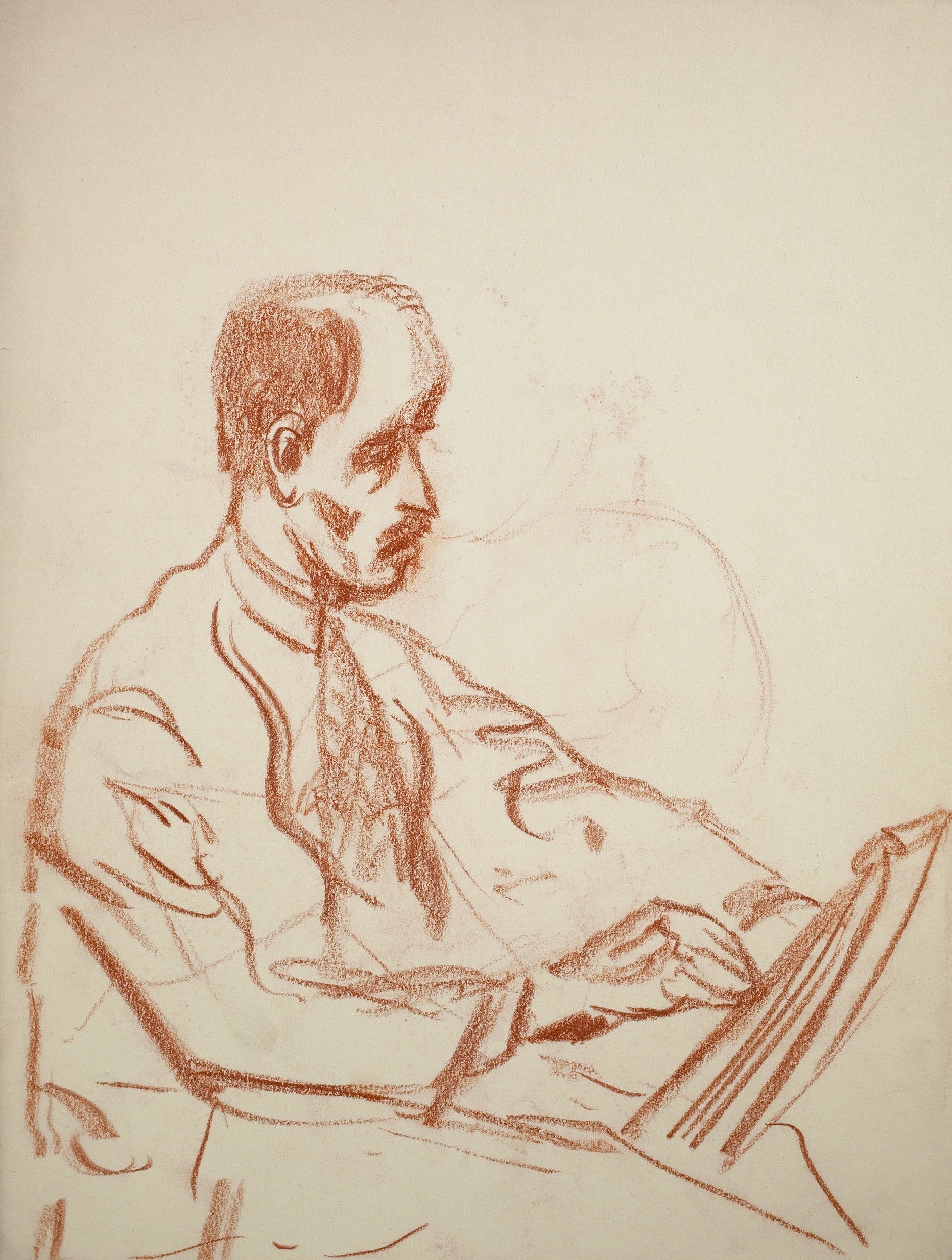
Shown: (left) Milton Avery, Portrait of Adolph Gottlieb, pencil on paper, 11 x 18 1/2", Milton Avery Trust. (right) Adolph Gottlieb, Untitled (Sketch of Milton Avery), c. 1932, conte crayon on paper, 11 3/4 x 9"
"They [Adolph Gottlieb and Mark Rothko] were about ten years younger than Milton, but they all respected him a great deal and they used to hang around, as we'd say. You know, in the City, Rothko lived across the street from us and he'd be at our house almost every night. And Gottlieb would come in very often. And, you know, they'd bring their girlfriends and finally, they'd bring their wives when they had them and it was like a close-knit family. We were very close. And they used to bring their friends to show them what Milton was doing.
And I know how Baumbach says he remembers when Adolph Gottlieb took him up to show him Milton's work. And David Smith was in that group. It was nice and we were always together a lot. We were always having a lot of parties together and things like that."
–Sally Avery in an interview with Dorothy Seckler, November 3, 1967
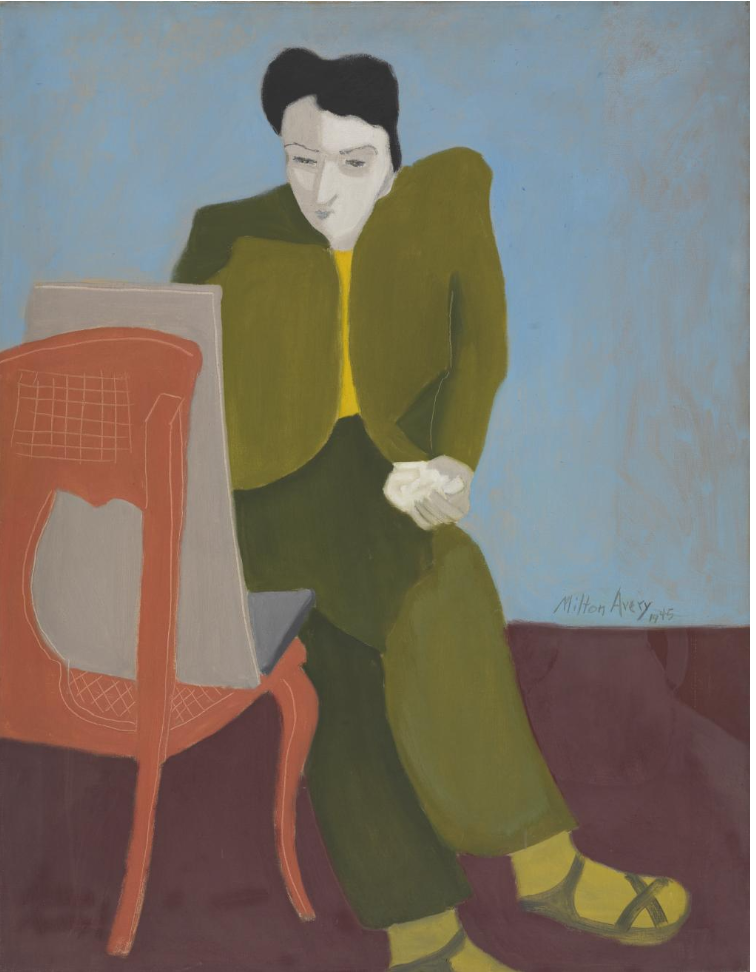
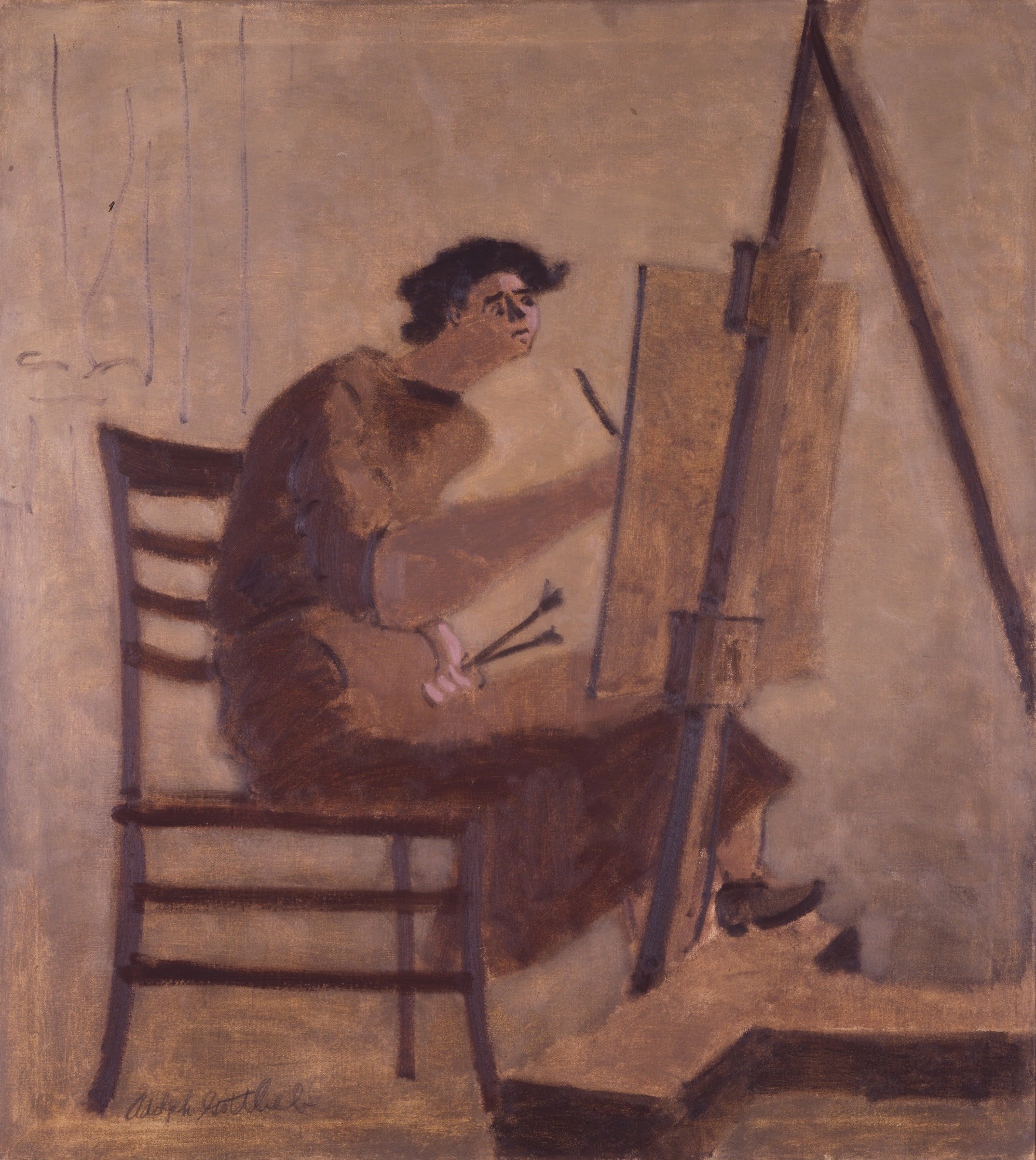
Shown: (left) Milton Avery, Studious Sketcher, 1944-45, oil on canvas, 36 x 28", Cleveland Museum of Art, Milton Avery Trust. (right) Adolph Gottlieb, Untitled (Esther at Easel), c. 1937, oil on canvas, 40 x 36 1/8"
"Then we all went to Gloucester, I remember and everybody would work during the daytime and the evenings would be spent looking over the work people had done that day. They were all very anxious to see what Milton had done. Because Milton would do three or four watercolors a day and you know, with three or four watercolors every day you get a lot of ideas. But it was nice. And we'd play beach tennis and it was really, considering that - you know, we never drank, no one ever had a beer because we were very poor and at night time we'd sit around and have tea and crackers and just discuss painting. It was a really sort of dedicated time."
–Sally Avery in an interview with Dorothy Seckler, November 3, 1967
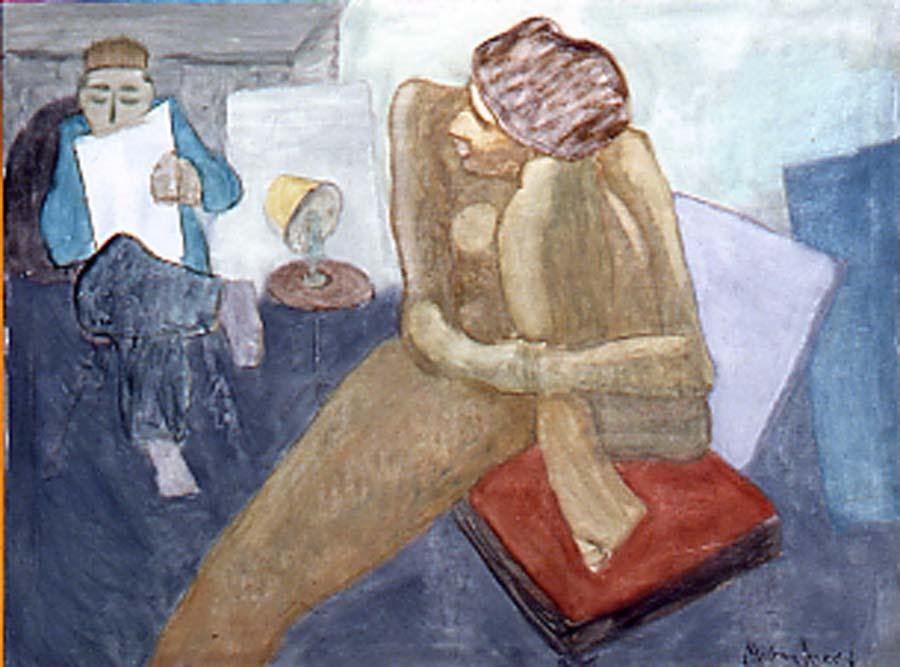
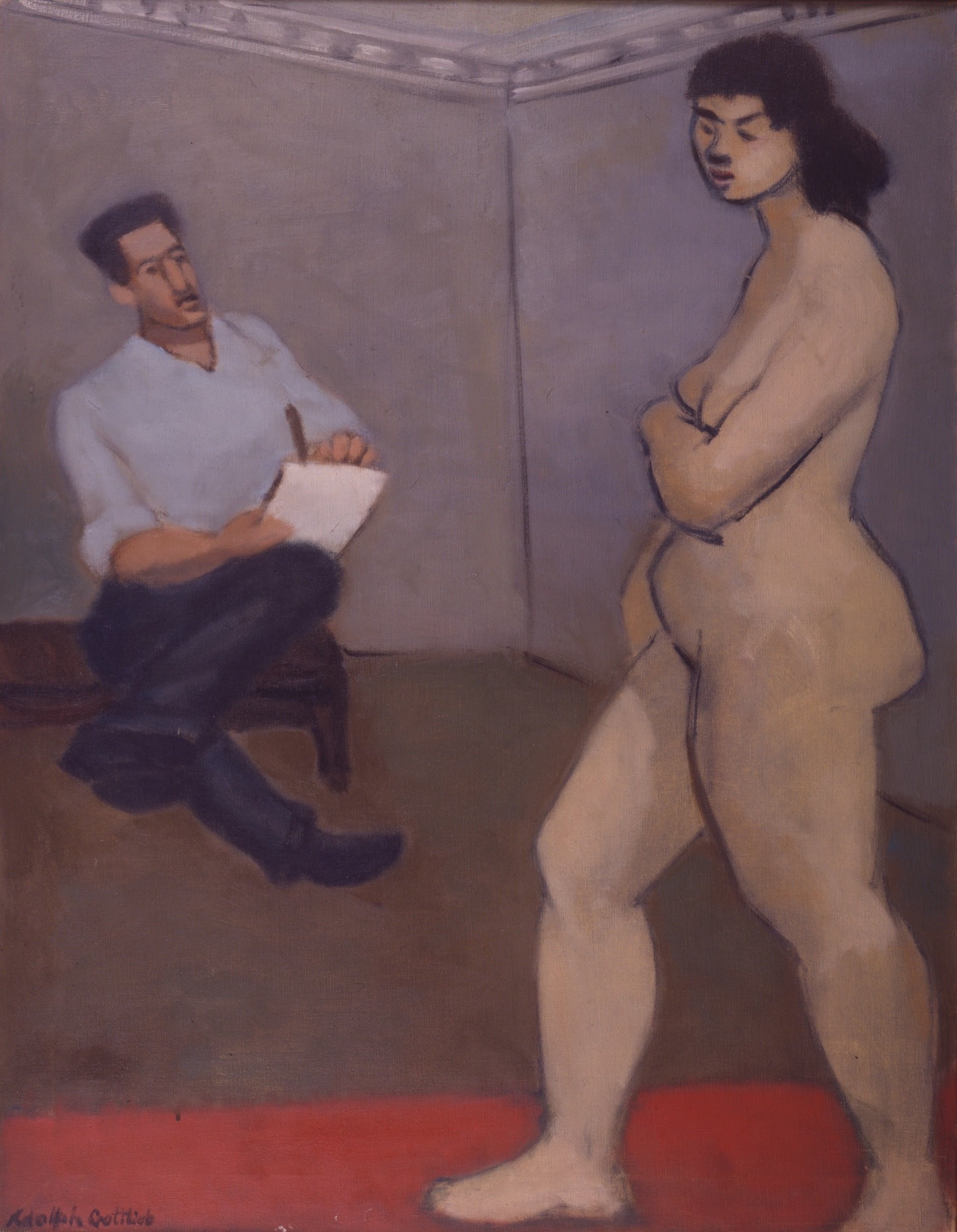
Shown: (left) Milton Avery, Artist and Model, c. 1939, oil on canvas, 38 x 50", Addison Gallery of American Art, Phillips Academy, Milton Avery Trust. (right) Adolph Gottlieb, Untitled (Artist and Model), 1934, oil on canvas, 31 3/4 x 24 7/8"
After returning from Arizona in 1939, “Gottlieb resumed his life in New York, but things had changed. He was no longer Avery’s young admirer, but an artist with ideas of his own. Although Avery disapproved, he continued to be interested in Surrealism - especially the art of Dali…he knew that Verist Surrealism contradicted the painterly tradition Avery stood for and to which he belonged, but he understood that to oppose Avery was the only way to find himself."
– Mary Davis MacNaughton in "Adolph Gottlieb: His Life and Art", 1981
"I have changed my mind about an idea of Milton's -- as he says, "don't try to paint a masterpiece." It seems to me now that that is the very thing to do -- try to make a masterpiece -- it probably won't be one anyway. Of course, from his point of view, Milton's right, there are many pictures that would be pretty good if they were not belabored and worked to death in trying for perfection. But right now I am sick of all the pretty good pictures and want a picture that is either damn good or no good."
– Adolph Gottlieb (in Tuscon, Arizona) in a letter to Harold Baumbach, January 18, 1938
"But then when we went to Arizona, I think Adolph had an opportunity to not be so much involved with Milton and Milton’s point of view. Not that Milton spoke very much but I mean just the aura of being with him and he was working so quickly... then from there, having drifted away from Avery, and Mark [Rothko] had also drifted away from the influence of Avery, I think they were also influenced by the fact that as a reaction to American scene painting, they were searching for some new subject matter."
– Esther Gottlieb in an interview with Phyllis Tuchman, 1981
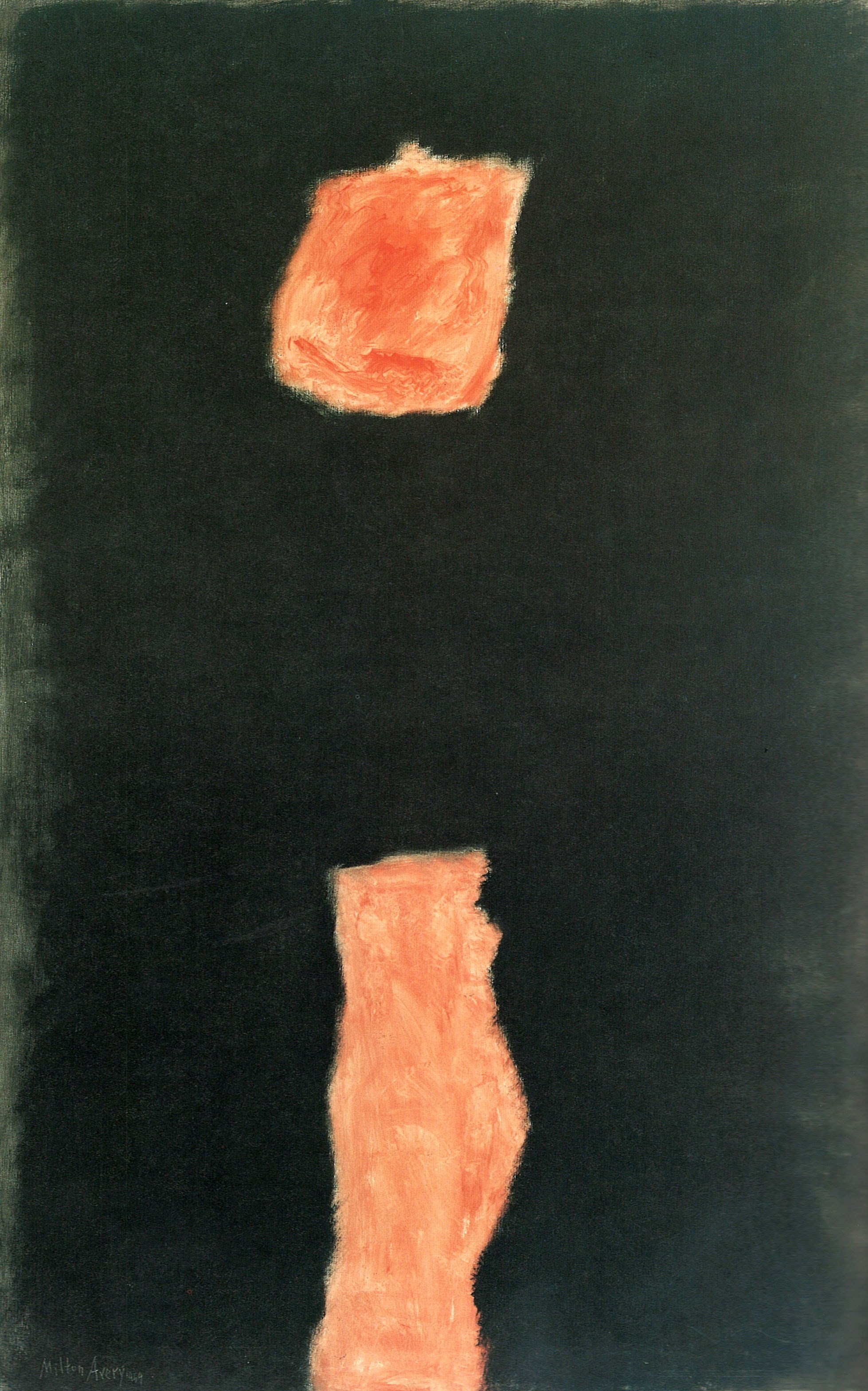
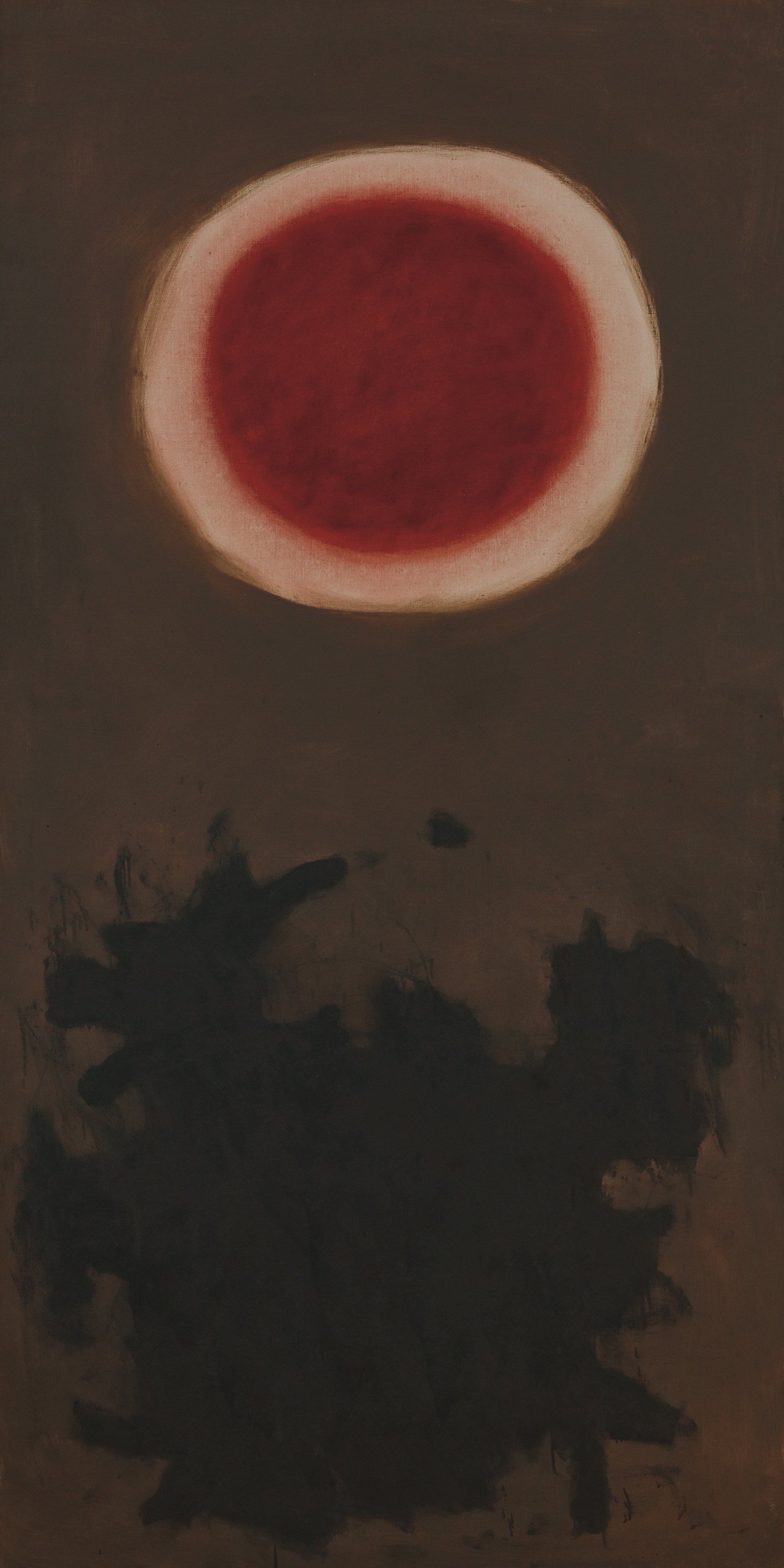
Shown: (left) Milton Avery, Black Night, 1959, oil on canvas, 52 x 34", Milton Avery Trust. (right) Adolph Gottlieb, Under and Over, 1959, oil on canvas, 96 x 48"
"Though we do not see the Gottliebs as frequently now, we still maintain a warm relationship and deep friendship."
– Milton Avery in a letter to Martin Friedman, January 1963.
"My feeling is that Avery is sort of the American Matisse. He has a terrific flair for that sort of color."
– Adolph Gottlieb in an interview with Martin Friedman, August 1962

Milton Avery, Tangerine Moon and Wine Dark Sea, 1959, oil on canvas, 60 x 72", Milton Avery Trust.

Shown: Adolph Gottlieb, Hot Horizon, 1956, oil on canvas, 50 x 72", Yale University Art Gallery.
A Closer Look: Adolph Gottlieb's Stained Glass Façade of the Milton Steinberg House

Detailed photograph of the interior of the Rabbi's office, c. 1954.
In 1953, Adolph Gottlieb was commissioned by the architectural firm of Kelly and Gruzen to design the stained-glass exterior of the Milton Steinberg House which served as a community center and offices for the Park Avenue Synagogue. The final free-standing façade consisted of 91 stained-glass panels covering an area of over 1300 square feet. This glass "wall" spanned five stories making it the largest single work by an Abstract Expressionist artist. Gottlieb spent the better part of two years planning and carefully overseeing the production of his designs.
From the Foundation's archives, we have gathered photographs, works on paper, interviews, and ephemera from the creation of the Milton Steinberg House stained-glass. This was one of four significant architectural collaborations in Gottlieb's career.

Adolph Gottlieb, Proposal for Steinberg House, c. 1953, gouache and pencil on presentation board, image size = 39 1/2 x 26"
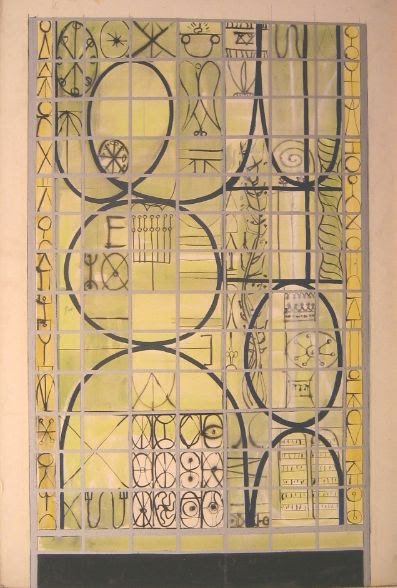
Adolph Gottlieb, Proposal For Steinberg House, c. 1953, ink, pencil, gouache, and metallic paint on presentation board, image size = 36 1/2 x 21 3/4, board size= 36 1/2 x 28”

Adolph Gottlieb, Untitled (Proposal for the Steinberg House Windows), c. 1953, gouache and ink on illustration board, 29 7/8 x 20"

Adolph Gottlieb, Untitled (Study for Steinberg House Windows), c.1953, ink, pencil, and gouache on presentation board, image size = 11 3/16 x 28”
Gottlieb made numerous proposals and studies for the windows on paper and in stained glass. Working closely with stained-glass makers Heinigke and Smith to manufacture these designs, the "finest imported and domestic antique glass" was used in the final window panels.

Adolph Gottlieb in his studio with drawings for the Steinberg House façade, c.1953-1954

Adolph Gottlieb in his Provincetown studio with studies for the Milton Steinberg House, Summer 1953. Photographer: Maurice Berezov.

Adolph Gottlieb in his Provincetown studio with studies for the Milton Steinberg House, Summer 1953. Photographer: Maurice Berezov.
"As a painter, I am fascinated by the luminous brilliance of stained glass. Working with glass is entirely different than paint because with every change in the intensity of light the color and the character of the glass changes. Not only is it different on a gray day than on a bright sunny day, but when there are clouds in the sky as the clouds move the glass is continually changing as one stands watching. So one is not dealing with color which is fixed and precise as in paint, but with colored light that is constantly changing and has its own moods."
–Adolph Gottlieb in a Q & A on the Steinberg House, 1954

Adolph Gottlieb, Untitled (Study for Steinberg House Windows), c. 1953, ink, crayon, gouache, and pencil on paper, 5 1/2 x 17”

Adolph Gottlieb, Untitled (Study for Steinberg House Windows), c. 1953, pencil, ink, and watercolor on paper, 5 1/2 x 17"

Adolph Gottlieb, Untitled (Study for Steinberg House Windows), c. 1953, pencil, ink, and watercolor on paper, 5 1/2 x 17”
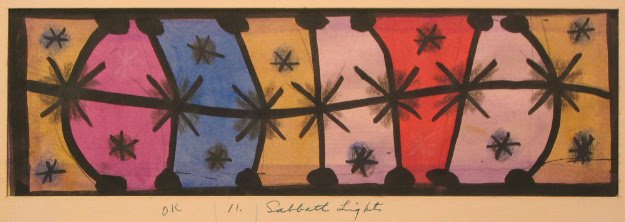
Adolph Gottlieb, Untitled (Study for Steinberg House Windows), c. 1953, pencil, ink, and watercolor on paper, 5 1/2 x 17”

Adolph Gottlieb and Otto Heinigke from Heinigke & Smith looking over templates for Steinberg House façade windows, c. 1953.

Adolph Gottlieb at Heinigke & Smith looking over templates for Steinberg House façade windows, c. 1953.

Adolph Gottlieb in the studio at Heinigke & Smith inspecting stained glass for Steinberg House façade, c. 1953-1954.

Adolph Gottlieb in the studio at Heinigke & Smith with stained glass artisans working on Steinberg House façade. Photo taken for Life Magazine, c. 1953-1954.
The Milton Steinberg House was unveiled on September 19, 1954, after two years of collaborative efforts between the building's architects, Heinigke and Smith, and Adolph Gottlieb.
"Working with architects has added enormously to my education. On each job so far I have been required to work at very short notice in an entirely unfamiliar material. I am now at the point where I feel that I can handle any material, at least with competence, I have learned that it is possible to get craftsmen to execute my designs with exactitude, providing I supervise them closely enough; and now realize that architects will go along with any design that handles specific problems intelligently and on a rational basis."
–Adolph Gottlieb in a Q & A on the Steinberg House, 1954

Program for Milton Steinberg House Dedication, September 19, 1954.

Adolph Gottlieb's notes preparing for a Q & A talk on the Steinberg House façade, 1954.

Adolph Gottlieb's notes preparing for a Q & A talk on the Steinberg House façade, 1954.
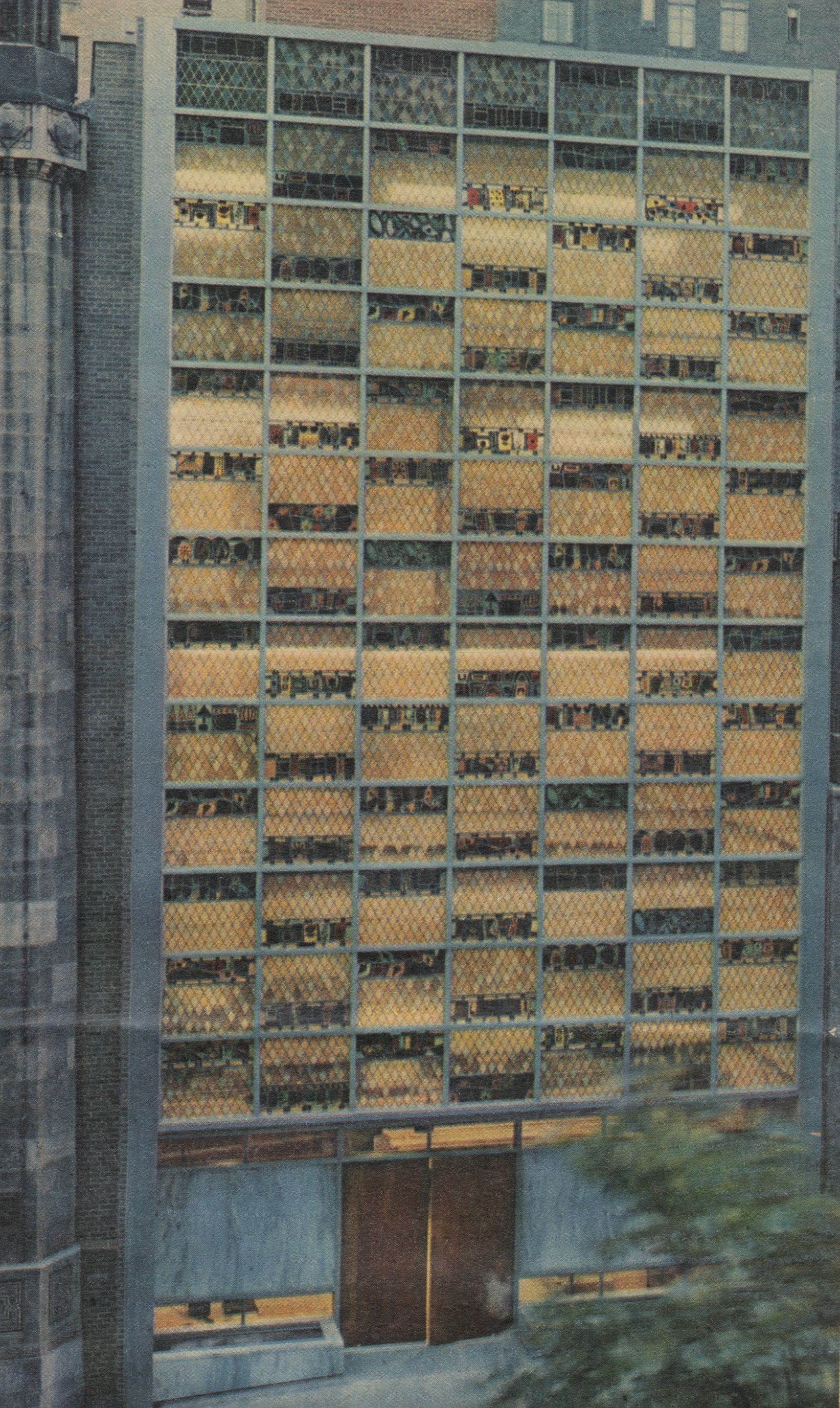
Photographs of the completed Milton Steinberg House façade, c. 1954.

The finished façade consisted of 91 individual panels installed in a repeat pattern that Gottlieb carefully devised. Unfortunately, this unique structure was dismantled in 1980. However, individual panels of the glass still exist and some are in use as clear-story windows in the current building adjacent to the Park Avenue Synagogue at 87th Street and Madison Avenue.
A Closer Look: Adolph Gottlieb's Partisan Review Cover
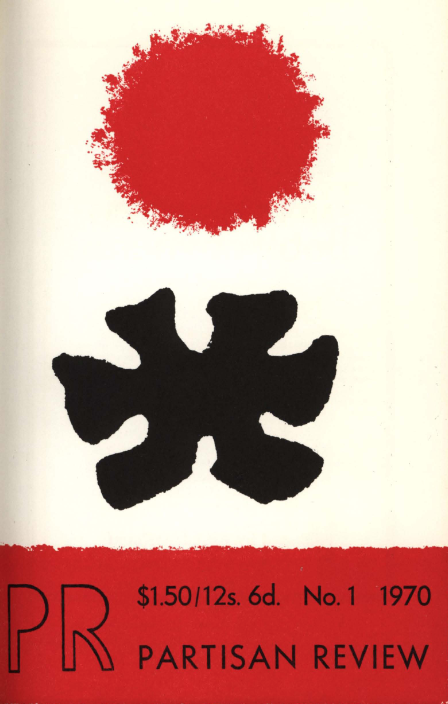
Shown: (left) The final Partisan Review cover published in 1970, Volume 37, Number 1.
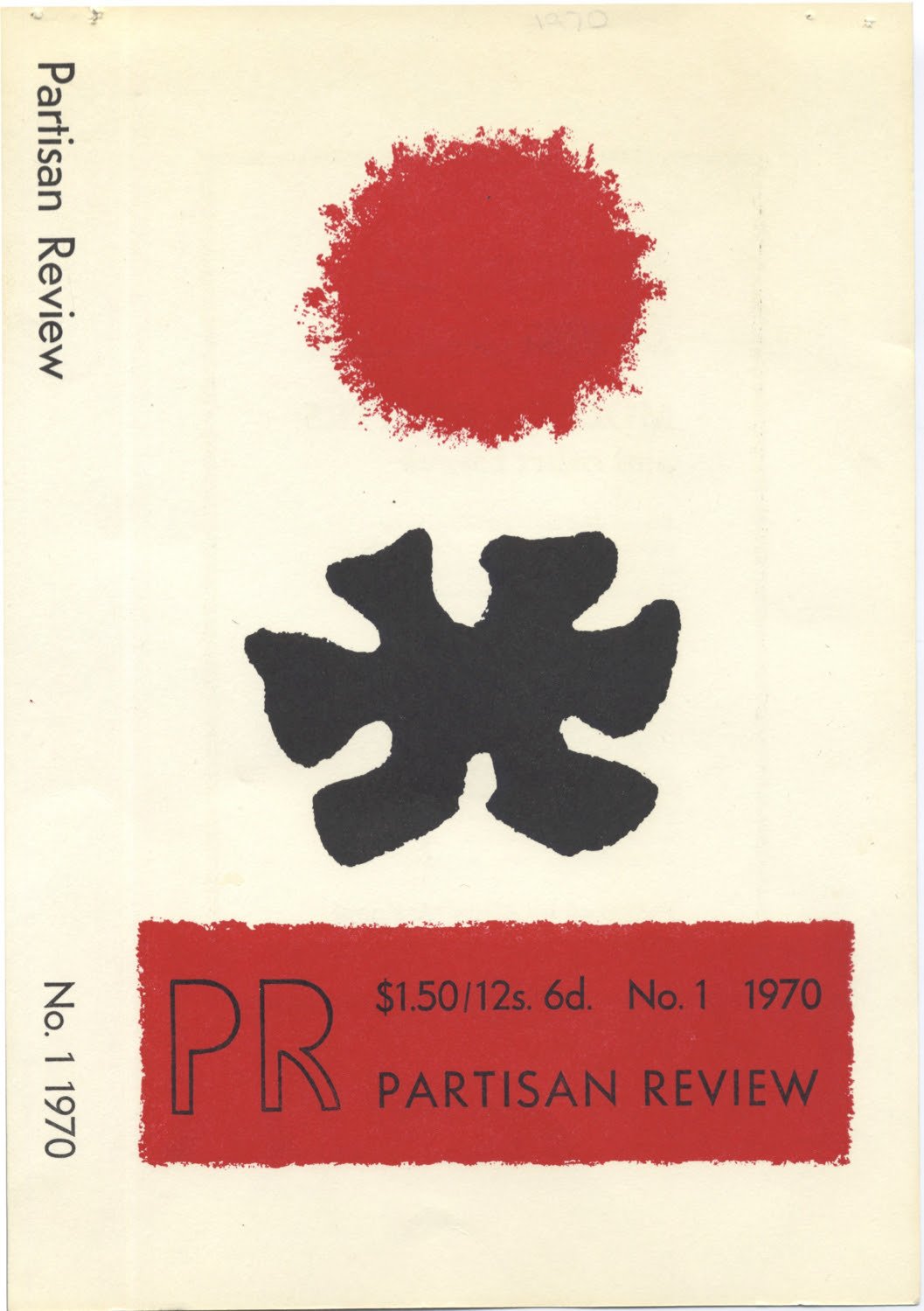
(right) An uncropped printer’s proof of the cover and spine.
Adolph Gottlieb was a lifelong advocate for artists' involvement in contemporary culture and reader of Partisan Review. In 1969, after his joint solo exhibition at the Solomon R. Guggenheim and the Whitney museums, Gottlieb was asked to design the cover of a 1970 issue of Partisan Review. Founded in 1934, Partisan Review was one of the most significant cultural literary journals in the United States. The Review's editors William Phillips, Philip Rahv, and Edith Kurzweil provided a vital space for the publication of creative essays, commentary, book reviews, and book excerpts.
In its sixty-nine-year history, the journal published the work of such luminaries as James Baldwin, Samuel Beckett, Allen Ginsberg, Franz Kafka, Doris Lessing, George Orwell, and Susan Sontag.

Adolph Gottlieb, Untitled (Study for Partisan Review Cover), 1969, gouache on paper, 7 15/16 x 5 3/8 inches.
The journal also referenced and reviewed Adolph Gottlieb's artwork, including Clement Greenberg's 1955 article titled "American-Type" Painting. Greenberg was a major contributor to the publication having contributed over 30 articles to the Review from 1939 to 1981.
"Over the years, in a characteristically sober way, Gottlieb has made himself one of the surest craftsmen in contemporary painting: one who can, for instance, place a flat and irregular silhouette, that most difficult of all shapes to adjust in isolation to the rectangle, with a force and rightness no other living painter seems capable of."
–Clement Greenberg, an excerpt from"American-Type" Painting in Partisan Review, 1955, Vol. 22, No. 2

Adolph Gottlieb, Untitled (Study for Partisan Review Cover), 1969, gouache and acrylic on paper, mounted on canvasboard, 7 15/16 x 5 3/8 inches.
While designing the 1970 cover, Gottlieb made 3 studies on paper before finalizing the cover design featuring an irregular red disc above an asterisk. It is interesting to note that Gottlieb painted some of these studies on the pages of previous issues of Partisan Review as a shortcut to visualizing the correct scale. Hence, the text is visible under the paint in some of the studies creating a collage effect.

Adolph Gottlieb, Untitled (Study for Partisan Review Cover), 1969, gouache on paper, 9 x 6 inches.
You can read and view all the issues of the journal online, including the issue with the Gottlieb cover: 1970 Vol. 37 No.1.

Installation photos of “Adolph Gottlieb: Small Images Spanning Four Decades 1938–1973” at Manny Silverman Gallery, April 1995. Three untitled studies for the cover of Partisan Review (all 1969).